


















Lesson 7 of 49 · Stress and Strain
Normal Stress: Tension and Compression
Learn to calculate normal stress in bars and posts with σ = P/A, size a rod for an allowable stress, and understand why the average stress is only valid away from the ends.
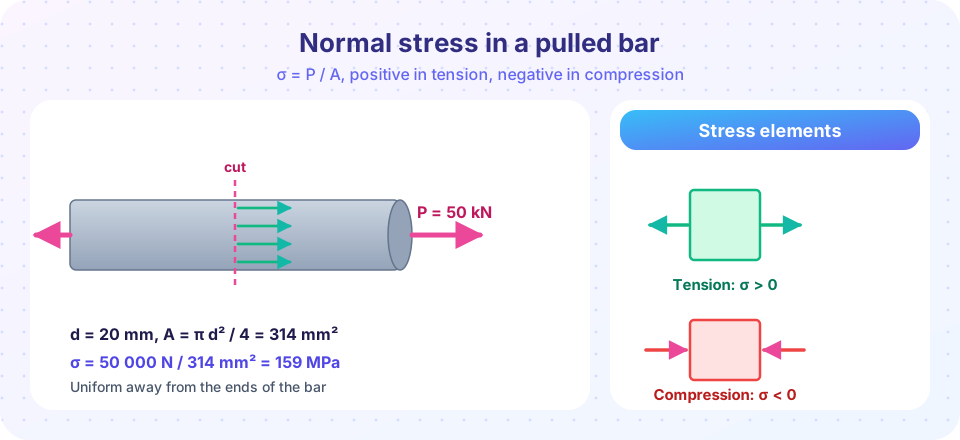
Normal stress is the first formula of strength of materials, and it is also the one you will use most. If a force P passes through the centroid of a straight bar's cross-section and acts along its axis, every part of that section carries about the same stress:
σ = P / A
This lesson explains where that formula holds, how to use it to check or size members, and where it needs help.
What you will learn
- The definition of normal stress and the sign convention.
- How to compute stress for round, square and hollow sections.
- How to size a member for an allowable stress.
- Where the "uniform stress" assumption fails.
Key terms
Cross-section area A: the area of the cut face, perpendicular to the load.
Allowable stress σ_allow: the stress a design permits, equal to the failure stress divided by the factor of safety.
Centroidal load: a load whose line of action passes through the centroid of the section.
Average stress: force divided by area, which equals the true stress only if the stress is uniform.
Definition and sign
Cut the bar with a plane perpendicular to its axis. The internal axial force N (from the method of sections) is spread over the area A. The average normal stress is σ = N / A. We call it tensile (positive) when N pulls and compressive (negative) when N pushes. Units: N/mm² = MPa.
Why the stress is uniform (when it is)
If the bar is straight, the material is homogeneous, and the load acts through the centroid, every fibre stretches by the same amount between two sections. Equal strain with the same material gives equal stress. If the load is off-centre, one side is pulled harder and the stress is not uniform; that adds a bending effect covered in chapter 6.
Close to the point where the load enters, the stress pattern is complicated: a bolt pushing on a plate crowds stress under itself. Saint-Venant's principle says the formula becomes accurate at a distance of about one bar width from the ends.
Example 1: check a round bar
A 20 mm diameter round bar carries 50 kN in tension.
A = π d² / 4 = π × 20² / 4 = 314.2 mm²
σ = 50 000 / 314.2 = 159.2 MPa
If the steel yields at 250 MPa, the factor of safety against yield is 250 / 159.2 = 1.57.
Example 2: size a tension rod
A rod must carry 30 kN with an allowable stress of 120 MPa. The required area is
A = P / σ_allow = 30 000 / 120 = 250 mm²
so the diameter is d = √(4A / π) = √(4 × 250 / π) = 17.84 mm. You round up to a standard size such as 18 mm (254 mm², stress 118 MPa) or 20 mm.
Example 3: compare sections
The same 50 kN acts on three sections. Round 20 mm: A = 314.2 mm², σ = 159 MPa. Square 20 mm: A = 400 mm², σ = 125 MPa. Hollow round tube (outer 30 mm, inner 26 mm): A = π/4 (30² − 26²) = 175.9 mm², σ = 284 MPa. The tube is lighter but more highly stressed. Only the area matters for axial stress, not the shape.
Press Run (or Ctrl + Enter) to see the result here.
Program input · what you'd type while the program runs
Type the answers before you press Run, one per line. Each time the program reads a line (with input()), it gets the next line from this box.
Compression and slender members
In compression the same formula σ = P / A holds for a short, stocky member such as a concrete block, a short post or a bolt under a nut. For a long, slender member, a small sideways deflection grows under the load and the member buckles before the material is crushed. The formula still gives the average stress, but it does not predict failure; chapter 7 handles that.
Common misconceptions
"The stress is the same everywhere in the bar." Only on sections away from the ends and from holes, notches and shape changes. At a hole, the stress can be about three times the average.
"A tube is weaker than a rod because it has a hole." For axial load, only the area matters. A tube with the same area carries the same load at the same stress, and for bending and twisting hollow sections are often better.
"σ = P / A uses the original area." For the engineering stress used in design, yes: the original, undeformed area. The true stress uses the current area and matters near fracture, a subject of the next lessons.
Check your understanding
Quick check · 5 questions
of 5 answered You scored / 5 · perfect!
-
1. A 20 mm diameter bar carries 50 kN. Which stress is closest?
A = π × 20² / 4 = 314.2 mm², σ = 50 000 / 314.2 = 159 MPa. -
2. A rod must carry 30 kN with σ_allow = 120 MPa. What minimum area is required?
A = P / σ_allow = 30 000 / 120 = 250 mm². -
3. The load on a bar is applied off-centre. What is true?
An off-centre axial load also produces a moment, so one side of the section is stressed more than the other. -
4. According to Saint-Venant's principle, σ = P / A becomes accurate…
Local stress patterns die away at a distance comparable to the section width. -
5. Which of these gives the lowest axial stress for P = 50 kN?
The square has the largest area (400 mm²), so σ = 125 MPa, the lowest of the three.
Summary
- Average normal stress is
σ = P / A(N/mm² = MPa); tension is positive. - It is uniform for straight bars with centroidal loads, at least one width from the ends.
- Size a member by
A = P / σ_allow, rounding up to a standard section. - For compression of slender members, buckling (chapter 7) comes first.
Next: Shear and Bearing Stress
Track your progress
Create a free account to tick off lessons and pick up where you left off on any device.
of Strength of Materials lessons completed