


















Lesson 26 of 49 · Bending of Beams
Second moment of area and the parallel-axis theorem
Compute centroids and second moments of area for rectangles, circles and built-up T- and I-sections using the parallel-axis theorem, step by step.
In the last lesson I appeared as a number we looked up for a rectangle. Now we open the box. The second moment of area (also called the area moment of inertia) measures how far a shape's area is spread from an axis, and it controls both bending stress and bending stiffness. Real beams are rarely simple rectangles: they are T-shapes, I-shapes, channels and boxes, so you also need a way to build I for composite sections. That tool is the parallel-axis theorem.
What you will learn
- The definition
I = ∫ y² dAand why distance is squared. - Standard results for rectangles, circles and triangles.
- How to find the centroid of a composite section.
- How to use the parallel-axis theorem
I = I₀ + A·d².
Key terms
- Centroid: the geometric center of an area; the neutral axis passes through it.
- Second moment of area
I:∫ y² dAabout a given axis, in mm⁴ or m⁴. - Parallel-axis theorem: moves
Ifrom a part's own centroidal axis to another parallel axis. - Radius of gyration
k:k = √(I/A), used for columns in Chapter 7.
The definition
Slice the cross-section into thin horizontal strips. A strip of area dA at distance y from the axis contributes y²·dA. Add them all:
I = ∫ y² dA
The square has two consequences. Area far from the axis counts enormously: a strip 4 times farther away counts 16 times more. And the contribution is always positive, so I is always positive no matter which side of the axis the strip lies on.
For a rectangle of width b and height h, with the axis through its centroid, dA = b·dy and
I = ∫ from −h/2 to +h/2 of y² · b dy = b·h³ / 12
Always take the dimension perpendicular to the axis as the cubed one. For a rectangle bending about its horizontal centroidal axis that is the height.
Standard shapes (about the centroidal axis)
| Shape | I about the centroid |
Section modulus S |
|---|---|---|
Rectangle b × h (axis parallel to b) |
b·h³/12 |
b·h²/6 |
Solid circle, diameter d |
π·d⁴/64 |
π·d³/32 |
Hollow circle, D and d |
π(D⁴ − d⁴)/64 |
π(D⁴ − d⁴)/(32·D) |
Triangle, base b, height h |
b·h³/36 |
depends on the side |
The parallel-axis theorem
Most axes of interest do not pass through the centroid of each part. If you know I₀, the second moment of a part about its own centroidal axis, then about a parallel axis a distance d away:
I = I₀ + A·d²
The A·d² term is the area moved a distance d; it is exactly why a thin flange far from the axis contributes so much. The theorem only works when I₀ is about the part's own centroid; it can only increase I relative to that axis.
A composite section step by step
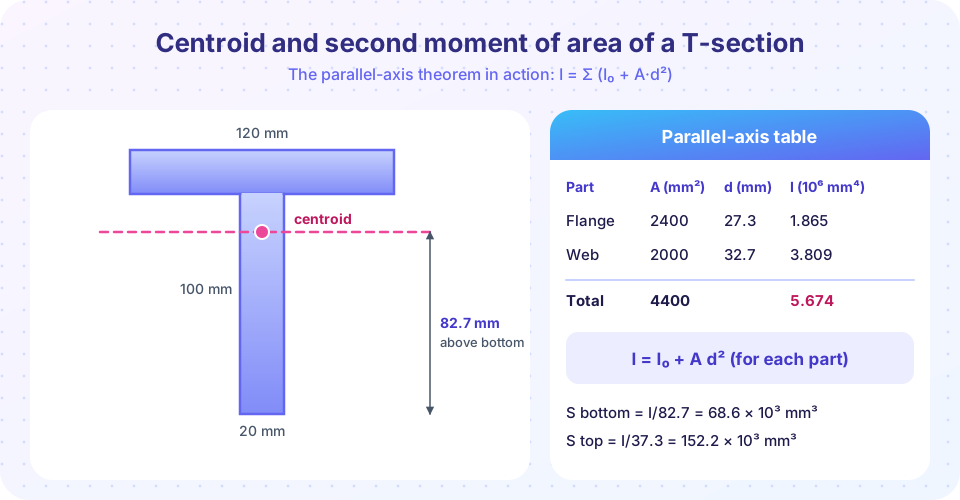
The T-section in the figure has a flange 120 mm wide and 20 mm thick on top of a web 20 mm wide and 100 mm tall (total height 120 mm). We need the strength about the horizontal centroidal axis.
Step 1, centroid. Measure heights from the bottom. The web has A = 20 × 100 = 2000 mm² with its centroid at y = 50 mm. The flange has A = 120 × 20 = 2400 mm² with its centroid at y = 110 mm.
ȳ = (2000·50 + 2400·110) / (2000 + 2400) = 364 000 / 4 400 = 82.7 mm
Step 2, each part. The web's centroid is 82.7 − 50 = 32.7 mm below the section centroid; the flange's is 110 − 82.7 = 27.3 mm above. Then:
Web:    I = 20·100³/12 + 2000·(32.7)² = 1.667×10⁶ + 2.142×10⁶ = 3.809×10⁶ mm⁴
Flange: I = 120·20³/12 + 2400·(27.3)² = 0.080×10⁶ + 1.785×10⁶ = 1.865×10⁶ mm⁴
Step 3, add. I = 3.809 + 1.865 = 5.674 × 10⁶ mm⁴.
Step 4, use it. The distance to the bottom is 82.7 mm and to the top 37.3 mm, so S_bottom = 5.674×10⁶/82.7 = 68.6×10³ mm³ and S_top = 152×10³ mm³. A section like this has two different section moduli, because the centroid is not in the middle. Under a sagging moment the bottom (the web tip) is in tension and has the higher stress.
Holes and cut-outs are handled by treating them as negative areas: subtract their A and their I (including the A·d² term) from the total.
Common misconceptions
- "I can add the I values of the parts directly." Only if each part's
Iis taken about the same axis. If the parts' own centroids differ from the section centroid, you must addA·d². - "The centroid of a T-section is at mid-height." It is pulled toward the heavier part; in our example it sits 82.7 mm above the bottom, not at 60 mm.
- "I is measured about any axis through the section."
Iis different for every axis. Bending about the horizontal axis uses the vertical dimensions, and vice versa.
Try it
First, a composite-section calculator for any stack of rectangles. It reproduces the T-section and can be edited to try an I-section.
Press Run (or Ctrl + Enter) to see the result here.
Program input · what you'd type while the program runs
Type the answers before you press Run, one per line. Each time the program reads a line (with input()), it gets the next line from this box.
Second, a numerical check of the definition: add up y² dA for thin strips and compare with the formula b·h³/12.
Press Run (or Ctrl + Enter) to see the result here.
Program input · what you'd type while the program runs
Type the answers before you press Run, one per line. Each time the program reads a line (with input()), it gets the next line from this box.
The shaded area under the curve is I. Most of it sits near the two outer edges, which is why I-beams work.
Check your understanding
Quick check · 4 questions
of 4 answered You scored / 4 · perfect!
-
1. What is I for a rectangle 60 mm wide and 120 mm tall about its horizontal centroidal axis?
I = b h³/12 = 60 × 120³ / 12 = 60 × 1 728 000 / 12 = 8.64 × 10⁶ mm⁴. -
2. The parallel-axis theorem says I = I₀ + A d². What is I₀?
I₀ must be taken about the part's own centroid; d is the distance to the new parallel axis. -
3. A 50 × 50 mm square is placed with its centroid 100 mm from an axis. What is I about that axis?
I₀ = 50⁴/12 = 0.52 × 10⁶ mm⁴ and A d² = 2500 × 100² = 25 × 10⁶ mm⁴, so I ≈ 25.5 × 10⁶ mm⁴. -
4. Why does a thin flange far from the neutral axis add so much to I?
The A d² term grows with the square of the distance.
Summary
I = ∫ y² dA; the square makes distant area count very heavily.- Rectangle:
b h³/12; circle:π d⁴/64; triangle:b h³/36(all about the centroid). - Find the centroid of a composite shape from
Σ A·y / Σ A. - Parallel-axis theorem:
I = I₀ + A d², withI₀about each part's own centroid. - A section that is not symmetric has two section moduli, one for each extreme fiber.
Next: Chapter 5 review
Track your progress
Create a free account to tick off lessons and pick up where you left off on any device.
of Strength of Materials lessons completed