


















Lesson 28 of 49 · Shear and Combined Loading
Chapter 6 overview: shear and combined loading
Preview transverse shear stress, combined axial, bending and torsion loads, and Mohr's circle, and see how they fit together in this chapter.
So far each load did its own job: bending gave normal stress, torsion gave shear stress, axial force gave uniform stress. Real parts feel several at once. A drive shaft is bent by its gears and twisted by the motor. A bridge pier is squeezed by the deck and bent by the wind. A cantilever sign post is bent, twisted and sheared at the same time. This chapter teaches you to find the stresses from each load, add them at the critical point, and then ask the question that matters: what is the worst stress this material element actually feels?
What you will learn
- Why a beam that bends also carries shear stress, and how large it is.
- How to superpose axial, bending, shear and torsional effects at a point.
- How to rotate a stress state and find the principal stresses.
- How Mohr's circle turns the algebra into a picture.
Why shear matters
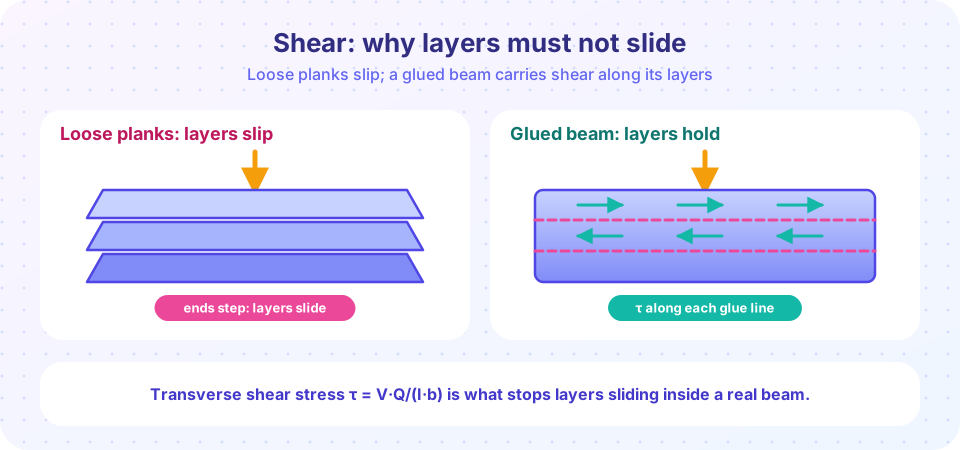
Take a stack of planks. If they are loose, each plank bends separately and the layers slide over each other at the ends. Glue them, and they must act together, so the glue has to resist sliding: the glue line carries a shear stress. In a solid beam there is no glue line, but the same horizontal shear stress exists on every imaginary layer. Because a stress on one plane always comes with an equal stress on the perpendicular plane, this horizontal shear is matched by a vertical shear stress τ on the cross-section.
For short, deep beams, for timber (weak along the grain), for thin webs and for glued or bolted built-up sections, this shear can govern the design.
Shear in beams
Combined loads
Superposition
Principal stresses
Try it
A solid beam made of n planks has a very different strength depending on whether they are glued. This console tool compares the second moment I and section modulus S for n loose planks against one glued beam of the same total height.
Press Run (or Ctrl + Enter) to see the console output here.
No output.
The ratios come from the cubes and squares in the formulas: depth enters I as h³, so stacking n layers multiplies it by n³, while the loose planks only add up to n times one plank.
What each lesson covers
| Lesson | Key question |
|---|---|
| Transverse shear stress in beams | How large is τ in a beam, and how far apart should nails be? |
| Combined axial, bending and torsion | How do I add up several loads at a critical point? |
| Stress transformation and Mohr's circle | What are the principal stresses and the maximum shear stress? |
| Chapter 6 review | Can I solve a full combined-loading problem? |
Check your understanding
Quick check · 3 questions
of 3 answered You scored / 3 · perfect!
-
1. Why do glued planks make a stiffer beam than loose planks?
Preventing slip makes the stack bend as one deep section, so I grows with the cube of the total depth. -
2. Three loose planks are glued into one beam. By what factor does I increase?
Loose I = 3 b t³/12. Glued I = b (3t)³/12 = 27 b t³/12, which is 9 times larger. -
3. Which stress combination can occur at one point of a loaded shaft?
A shaft carrying a transverse load and a torque has both, and they must be combined.
Summary
- Beams carry transverse shear stress as well as bending stress; it holds layers together.
- Real parts see combined loads; at a point, elastic stresses from each load simply add.
- Rotating the stress element gives principal stresses; Mohr's circle displays them all.
- The worst combination, not the largest single stress, decides whether a part is safe.
Track your progress
Create a free account to tick off lessons and pick up where you left off on any device.
of Strength of Materials lessons completed