


















Lesson 22 of 49 · Torsion
Chapter 4 Review: Torsion
Review torsion of circular shafts, angle of twist, power transmission, indeterminate shafts and thin-walled tubes with a summary sheet, a recap table and a ten-question quiz.
Chapter 4 showed that twisting follows the same logic as stretching, with new symbols: torque T, polar moment J, shear modulus G and angle of twist φ. You can now check the stress and twist of a shaft, size one for a motor, solve a shaft fixed at both ends, and judge when a thin-walled tube is a good torsion member.
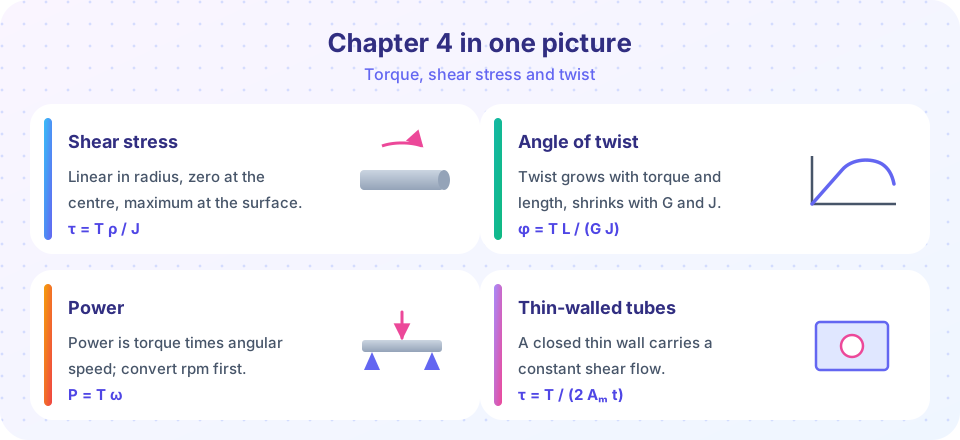
Recap table
| Lesson | Idea | Formula |
|---|---|---|
| Torsion formula | Linear shear stress | τ = T ρ / J, J = π d⁴ / 32 |
| Twist and power | Rotation of the ends | φ = T L / (G J), P = T ω |
| Indeterminate shafts | Equilibrium + compatibility | TA + TB = T₀, φ_AB + φ_BC = 0 |
| Thin-walled tubes | Constant shear flow | τ = T / (2 Aₘ t) |
The axial-torsion dictionary
| Axial | Torsion |
|---|---|
force P |
torque T |
stress σ = P / A |
τ = T ρ / J |
strain ε |
shear strain γ = ρ φ / L |
E, A |
G, J |
δ = P L / (A E) |
φ = T L / (G J) |
| bar between walls | shaft between walls |
Worked recap
A hollow steel shaft with D = 60 mm, d = 40 mm and L = 2 m transmits 45 kW at 300 rpm. G = 80 GPa.
- Torque:
ω = 2π × 300 / 60 = 31.42 rad/s;T = 45 000 / 31.42 = 1432 N·m. - Section:
J = π (60⁴ − 40⁴) / 32 = π (12 960 000 − 2 560 000) / 32 = 1.021 × 10⁶ mm⁴. - Stress:
τ_max = 1.432 × 10⁶ × 30 / 1.021 × 10⁶ = 42.1 MPa. - Twist:
φ = 1.432 × 10⁶ × 2000 / (80 000 × 1.021 × 10⁶) = 0.0351 rad = 2.01°.
Press Run (or Ctrl + Enter) to see the result here.
Program input · what you'd type while the program runs
Type the answers before you press Run, one per line. Each time the program reads a line (with input()), it gets the next line from this box.
Press Run (or Ctrl + Enter) to see the result here.
Program input · what you'd type while the program runs
Type the answers before you press Run, one per line. Each time the program reads a line (with input()), it gets the next line from this box.
Check your understanding: chapter 4
Quick check · 10 questions
of 10 answered You scored / 10 · perfect!
-
1. A 40 mm solid shaft carries 600 N·m. The maximum shear stress is about…
J = π × 40⁴ / 32 = 251 327 mm⁴; τ = 600 000 × 20 / 251 327 = 47.7 MPa. -
2. In torsion, which quantity corresponds to the area A in axial loading?
J takes the role of A in φ = T L / (G J). -
3. A shaft transmits 15 kW at 600 rpm. The torque is about…
T = 9549 × 15 / 600 = 238.7 N·m. -
4. Doubling a shaft's length (same T, G, J) makes the twist…
φ = T L / (G J) is proportional to L. -
5. Where is the shear stress zero in a solid shaft?
τ = T ρ / J vanishes at ρ = 0. -
6. For a uniform shaft fixed at both ends with a torque at the midpoint, each wall torque is…
By symmetry a = b, so TA = TB = T₀ / 2. -
7. Bredt's formula τ = T / (2 Aₘ t) applies to…
It relies on a constant shear flow around a closed loop. -
8. If both strength and twist limits apply, the design diameter is…
The shaft must satisfy both limits. -
9. In a hollow shaft with d/D = 0.67, compared with a solid shaft of the same D, the torque capacity is roughly…
J scales with (1 − (d/D)⁴) = 1 − 0.2 = 0.8, so about 80% of the capacity with about 55% of the material. -
10. The angle of twist formula gives the angle in…
φ = T L / (G J) is in radians when the other quantities are in consistent units.
Summary
τ = T ρ / J;J = π d⁴ / 32(solid) orπ (D⁴ − d⁴) / 32(hollow).φ = T L / (G J);P = T ω; check both strength and twist.- Indeterminate shafts:
TA + TB = T₀and zero total twist. - Closed thin-walled tubes:
τ = T / (2 Aₘ t); open sections are far weaker.
You have finished chapters 1-4: loads, stress and strain, axial loading and torsion. The rest of the course adds bending, combined loading, deflection, buckling and design.
Track your progress
Create a free account to tick off lessons and pick up where you left off on any device.
of Strength of Materials lessons completed