


















Lesson 19 of 49 · Torsion
The Torsion Formula for Circular Shafts
Derive the torsion formula, understand the linear shear stress distribution, compute the polar moment J for solid and hollow shafts, and size a shaft for an allowable stress.
The formula for the shear stress in a twisted circular shaft is one of the most elegant results in the subject, and its derivation needs nothing more than geometry and Hooke's law for shear. Once you have it, you can check any round shaft, compare solid and hollow designs, and choose a diameter for a given torque.
What you will learn
- The assumptions behind the torsion formula.
- Why shear stress varies linearly with radius.
- How to compute
Jfor solid and hollow circular sections. - How to check a shaft and size one for an allowable stress.
Key terms
Polar moment of area J: J = ∫ ρ² dA over the cross-section; a measure of the section's resistance to torsion.
Maximum shear stress τ_max: the stress at the outer surface, T R / J.
Hollow shaft: a tube with outer diameter D and inner diameter d.
Allowable shear stress τ_allow: the design limit for shear, typically the shear yield strength divided by a factor of safety.
Assumptions
- The shaft is circular (solid or hollow) and has a uniform cross-section.
- The material is homogeneous and linear elastic, so
τ = G γ. - Cross-sections remain plane and circular, and radial lines stay straight. They simply rotate rigidly about the axis. This is true for circular sections and false for other shapes, which warp.
- The torque is applied at the ends, and we look away from the ends (Saint-Venant).
Derivation in four lines
Take a shaft of length L twisted by an angle φ between its ends. A point at radius ρ moves along an arc of length ρ φ; a line along the surface tilts through the shear strain
γ = ρ φ / L.
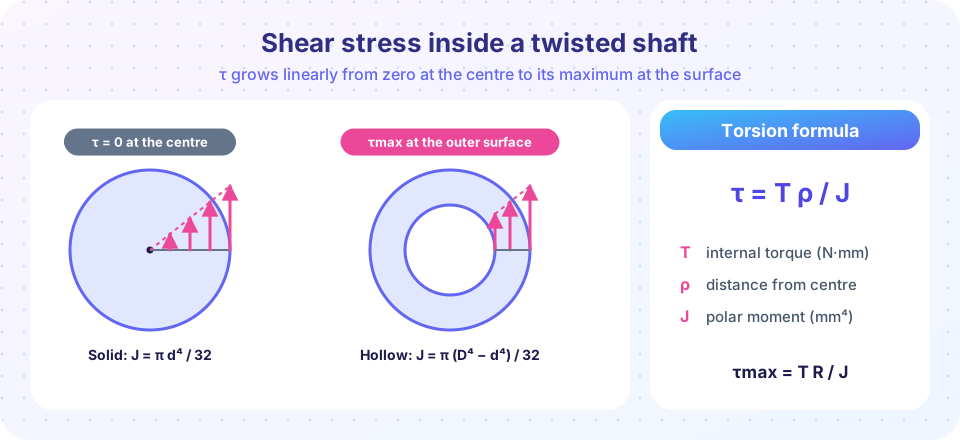
So the strain is proportional to ρ: zero on the axis and γ_max = R φ / L at the surface. By Hooke's law τ = G γ = G φ ρ / L, so the stress is also proportional to ρ: τ = τ_max ρ / R. The torque is the sum of the moments of the stresses on the section: T = ∫ ρ τ dA = (τ_max / R) ∫ ρ² dA = τ_max J / R. Solve for the stress:
τ = T ρ / J, and τ_max = T R / J.
The polar moment of area
For a solid circular section of diameter d: J = π d⁴ / 32.
For a hollow section with outer diameter D and inner diameter d: J = π (D⁴ − d⁴) / 32.
Since J grows with the fourth power of the diameter, a small increase in diameter has a big effect: raising d by 10% raises J by 46%. This is also why material near the axis is wasted: it sits close to the axis and contributes little to J.
Example 1: solid and hollow shafts
A shaft transmits T = 1.2 kN·m = 1.2 × 10⁶ N·mm.
Solid, d = 50 mm: J = π × 50⁴ / 32 = 613 592 mm⁴. τ_max = 1.2 × 10⁶ × 25 / 613 592 = 48.9 MPa.
Hollow, D = 50 mm, d = 30 mm: J = π (50⁴ − 30⁴) / 32 = π (6 250 000 − 810 000) / 32 = 534 071 mm⁴. τ_max = 1.2 × 10⁶ × 25 / 534 071 = 56.2 MPa.
The hollow shaft's stress is only 15% higher, but its cross-section area is π/4 (2500 − 900) = 1257 mm², against 1963 mm² for the solid shaft: 36% less material for a 15% increase in stress. This is why drive shafts and bicycle cranks are hollow.
Example 2: sizing a shaft
Find the diameter of a solid shaft carrying T = 800 N·m with τ_allow = 40 MPa. Since τ_max = T R / J = 16 T / (π d³):
d³ = 16 T / (π τ_allow) = 16 × 800 000 / (π × 40) = 101 859 mm³, so d = 46.7 mm.
You would round up to a standard diameter such as 48 or 50 mm.
Press Run (or Ctrl + Enter) to see the result here.
Program input · what you'd type while the program runs
Type the answers before you press Run, one per line. Each time the program reads a line (with input()), it gets the next line from this box.
Common misconceptions
"The torsion formula works for any cross-section." It does not. Square and rectangular bars warp, and their stress is highest at the middle of each side, not at the corners; tables give separate formulas.
"A hollow shaft is weaker per unit stress." At the same outer diameter it has a slightly higher stress but uses much less material. Per unit mass it is far more efficient.
"J is the same as the moment of inertia I used in bending." For circular shafts J = 2 I, but they measure different things: J resists twist about the axis, I resists bending about a diameter.
Check your understanding
Quick check · 5 questions
of 5 answered You scored / 5 · perfect!
-
1. What is J for a solid circular shaft of diameter d?
J = π d⁴ / 32; π d⁴ / 64 is the bending moment of inertia I. -
2. A 50 mm solid shaft carries 1.2 kN·m. The maximum shear stress is about…
τ = T R / J = 1.2 × 10⁶ × 25 / 613 592 = 48.9 MPa. -
3. Where in a solid shaft is the torsional shear stress greatest?
Stress is proportional to the distance from the axis, so it peaks at the surface. -
4. If the diameter of a solid shaft increases by 10% (same torque), τ_max changes by about…
τ ∝ 1/d³, and 1/1.1³ = 0.751, so the stress falls by about 25%. -
5. Which is NOT an assumption of the torsion formula?
The loading is a torque about the axis, not an axial force.
Summary
τ = T ρ / J; the maximum isτ_max = T R / Jat the outer surface.J = π d⁴ / 32(solid),J = π (D⁴ − d⁴) / 32(hollow).- Stress is zero at the axis, so hollow shafts save material for little extra stress.
- For sizing,
d = (16 T / (π τ_allow))^(1/3).
Track your progress
Create a free account to tick off lessons and pick up where you left off on any device.
of Strength of Materials lessons completed