


















Lesson 48 of 49 · Projects and Practice
Cheat sheet: all the formulas on one page
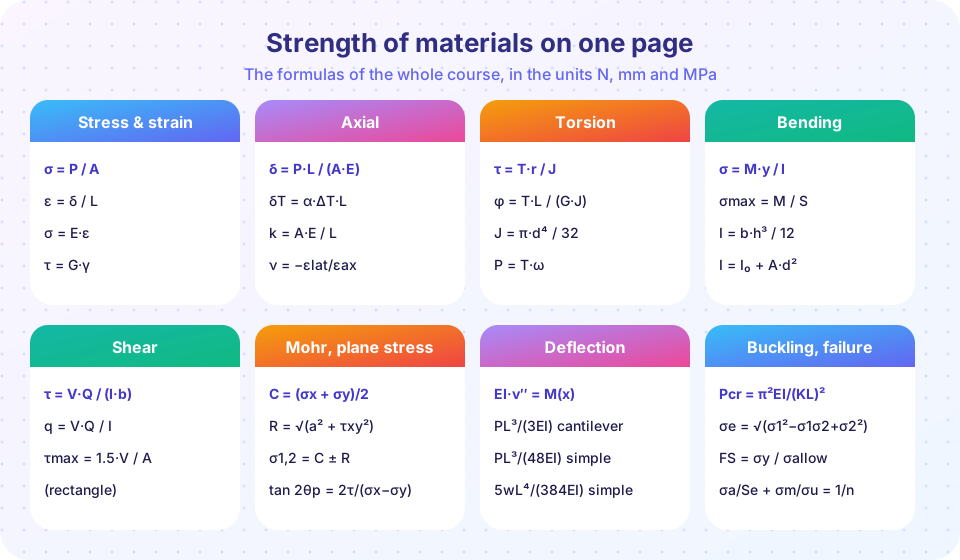
One-page strength of materials formula sheet: stress, strain, axial, torsion, bending, shear, Mohr's circle, deflection, buckling and failure, with units and a toolbox.
When you design something, you rarely need to derive anything. You need the right formula, in the right units, quickly. This page is your one-page summary. It has the poster below, a table of which formula answers which question, notes on sign conventions and units, and a small code toolbox you can reuse.
What you will learn
- Which formula answers which type of question.
- The sign conventions and units to apply before you substitute.
- How to wrap the formulas in a reusable code toolbox.
Units
Use N, mm and MPa (1 MPa = 1 N/mm²; 1 kN/m = 1 N/mm; 1 kN·m = 10⁶ N·mm; 1 GPa = 1000 MPa). In SI base units, use N, m and Pa. Never mix.
Which formula answers which question?
| Question | Use |
|---|---|
How much stress in a bar pulled with force P? |
σ = P/A |
| How much does a bar stretch? | δ = P·L/(A·E) |
| How much does a bar stretch with a temperature change? | δT = α·ΔT·L (if free to expand) |
How much shear stress in a shaft carrying torque T? |
τ = T·r/J, J = πd⁴/32 (solid) |
| How far does a shaft twist? | φ = T·L/(G·J) |
| What power does a shaft transmit? | P = T·ω |
| How much bending stress at a section? | σ = M·y/I; maximum M/S |
| How much shear stress in a beam? | τ = V·Q/(I·b); rectangle peak 1.5·V/A |
| How many nails or how much glue? | q = V·Q/I; spacing s = F/q |
| What are the principal stresses? | σ1,2 = (σx + σy)/2 ± √(((σx − σy)/2)² + τxy²) |
| How much does a beam deflect? | Table: PL³/(3EI), wL⁴/(8EI), PL³/(48EI), 5wL⁴/(384EI) |
| When does a slender column buckle? | Pcr = π²EI/(K·L)² |
| Does a ductile part yield? | von Mises σe ≤ σy/n, or Tresca σ1 − σ3 ≤ σy/n |
| Will a notched part survive many cycles? | Kf = 1 + q(Kt − 1), Goodman σa/Se + σm/σu = 1/n |
Signs and conventions
- Tension positive, compression negative (for axial stress).
- Sagging positive moment (smile): compression on top, tension on the bottom.
- Positive shear: pushes the left piece of a cut beam up.
- Torque: follow the right-hand rule and state the direction; shear stress is largest at the outer surface.
- Mohr's circle: moving the element by
θmoves the point on the circle by2θin the same direction.
Typical values (orders of magnitude only)
| Material | E |
G |
σy (typical) |
|---|---|---|---|
| Structural steel | about 200 GPa | about 80 GPa | around 250 MPa |
| Aluminum alloys | about 70 GPa | about 26 GPa | roughly 100 to 400 MPa |
| Copper | about 110 GPa | about 45 GPa | depends strongly on temper |
Use these for sanity checks only. For design, take the values for the actual grade from its specification.
Common misconceptions
- "A formula sheet replaces understanding." Every formula has assumptions (linear elastic, small deflection, prismatic member, slender, long). If your problem breaks them, the formula may not hold.
- "I can always use the maximum values together." Maximum moment and maximum shear occur at different places; the critical point depends on the stress combination.
- "Use any units for E." E must be in the same system as the stress: 200 GPa is 200 000 MPa.
Try it
First, a reusable toolbox: Python functions for the most used formulas, ready to copy into your own scripts. Then a few calls as a demonstration.
Press Run (or Ctrl + Enter) to see the result here.
Program input · what you'd type while the program runs
Type the answers before you press Run, one per line. Each time the program reads a line (with input()), it gets the next line from this box.
Second, a "which formula?" chooser. Pick a type of question and the tool names the formula, with its main assumption.
Press Run (or Ctrl + Enter) to see the console output here.
No output.
Check your understanding
Quick check · 4 questions
of 4 answered You scored / 4 · perfect!
-
1. A moment of 24 kN·m is used in a formula with I in mm⁴. By what factor must you multiply 24 to get N·mm?
1 kN·m = 10³ N × 10³ mm = 10⁶ N·mm. -
2. Which formula gives the maximum shear stress of a rectangular beam section?
For a rectangle, the shear stress peaks at the neutral axis at 1.5 times the average V/A. -
3. Which formula would you use to find the elongation of a steel bar heated by 40 °C while free to expand? (α is the expansion coefficient)
Free thermal expansion gives δT = α ΔT L, with no stress. -
4. A column's buckling load is calculated with I about the strong axis of a rectangular section. What is wrong?
A column buckles about the axis with the smallest second moment of area.
Summary
- Match the question to the formula (the table above), check its assumptions, convert to N–mm–MPa, then substitute.
- Know the sign conventions: tension positive, sagging moment positive,
2θon Mohr's circle. - Typical values: steel
E ≈ 200 GPa, aluminumE ≈ 70 GPa; use them only for sanity checks. - The toolbox functions make the formulas reusable, but understanding when each applies is the real skill.
Next: Where to go next
Track your progress
Create a free account to tick off lessons and pick up where you left off on any device.
of Strength of Materials lessons completed