


















Lesson 14 of 49 · Axial Loading
Statically Indeterminate Axial Members
Solve bars fixed between two walls and composite bars of two materials using equilibrium, compatibility and force-deformation relations, with worked numerical examples.
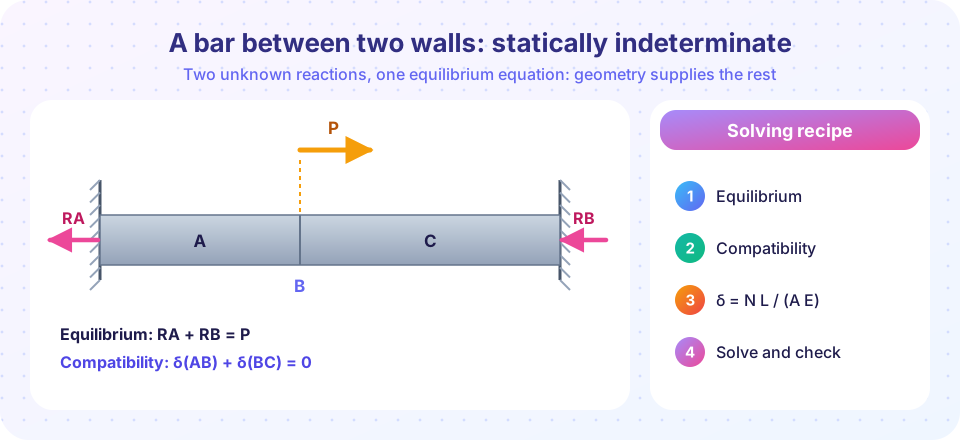
So far every unknown force could be found from equilibrium alone. Then you meet a bar fixed to a wall at both ends with a load in the middle. There are two unknown wall reactions but only one useful equation (ΣF = 0 along the axis). Statics cannot solve it. Such problems are statically indeterminate, and the way out is to look at the geometry of deformation.
What you will learn
- Why some problems cannot be solved by statics alone.
- The three-part recipe: equilibrium, compatibility, force-deformation.
- How to solve a bar between two walls.
- How to solve a composite bar of two materials.
Key terms
Statically indeterminate: more unknown forces than independent equilibrium equations.
Degree of indeterminacy: the number of extra unknowns.
Compatibility equation: a geometric condition on displacements, such as "the total length cannot change".
Composite bar: a bar made of two or more materials acting together.
The recipe
- Equilibrium. Write all the equilibrium equations you can.
- Compatibility. Write a condition on the deformations that the supports and connections enforce.
- Force-deformation. Replace each deformation using
δ = N L / (A E). - Solve the resulting equations together, then compute stresses and check.
You supply as many compatibility conditions as the degree of indeterminacy. A bar fixed at both ends is one degree indeterminate: one extra condition.
Example 1: a bar between two walls
A uniform bar (A = 500 mm², E = 200 GPa) is fixed to rigid walls at A and C and loaded by P = 60 kN at B, where AB = a = 300 mm and BC = b = 500 mm.
Equilibrium: RA + RB = P. (Both walls resist the load.)
Compatibility: the walls do not move, so the total length is unchanged: δ_AB + δ_BC = 0. The force in AB is a tension N_AB = RA; the force in BC is a compression N_BC = −RB.
Force-deformation: RA a / (A E) − RB b / (A E) = 0, so RA a = RB b.
Solve: substitute RA = RB b / a into RA + RB = P:
RB = P a / (a + b) = 60 × 300 / 800 = 22.5 kN, RA = P b / (a + b) = 37.5 kN.
Stresses: σ_AB = 37 500 / 500 = +75 MPa (tension) and σ_BC = −22 500 / 500 = −45 MPa (compression). Displacement of B: δ_B = RA a / (A E) = 37 500 × 300 / (500 × 200 000) = 0.1125 mm, towards C.
The shorter portion AB carries the larger share of the load because it is stiffer: indeterminate structures send force along the stiffest path. This is a deep idea. It explains why stiff members attract load, why a rigid wall draws load from a flexible one, and why a bad estimate of stiffness gives a wrong estimate of force.
Example 2: a composite bar
A short concrete column is reinforced with steel bars and carries P = 400 kN through a rigid cap, so both materials shorten equally. Steel: A_s = 1200 mm², E_s = 200 GPa. Concrete: A_c = 40 000 mm², E_c = 25 GPa.
Equilibrium: F_s + F_c = P.
Compatibility: equal strain (or equal shortening of equal lengths): F_s / (A_s E_s) = F_c / (A_c E_c).
The ratio is F_s / F_c = (A_s E_s) / (A_c E_c) = (1200 × 200 000) / (40 000 × 25 000) = 0.24.
So F_s = 400 × 0.24 / 1.24 = 77.4 kN and F_c = 322.6 kN. The stresses are σ_s = 77 420 / 1200 = 64.5 MPa and σ_c = 322 580 / 40 000 = 8.06 MPa. Steel is stressed eight times as much as the concrete (the ratio of the moduli, 200 / 25 = 8), but it carries only a fifth of the load because there is so little of it.
Press Run (or Ctrl + Enter) to see the result here.
Program input · what you'd type while the program runs
Type the answers before you press Run, one per line. Each time the program reads a line (with input()), it gets the next line from this box.
Common misconceptions
"Reactions split equally between two supports." They split in inverse proportion to the segment lengths for a uniform bar, so the closer wall takes more.
"Compatibility is a new law of physics." It is only geometry: parts that are connected must move together without gaps or overlaps.
"Indeterminate problems are rare." Most real structures are indeterminate; redundancy is a safety feature because load can find another path.
Check your understanding
Quick check · 5 questions
of 5 answered You scored / 5 · perfect!
-
1. A bar fixed at both ends and loaded axially in the middle has how many equilibrium equations (axial direction)?
Only ΣF = 0 along the axis helps; with RA and RB both unknown the problem is indeterminate. -
2. In the recipe, the compatibility equation expresses…
It states how the deformations must fit together, such as total length unchanged. -
3. For a uniform bar between walls with P at B (a = 300, b = 500 mm), what is RB?
RB = P a / (a + b) = 60 × 300 / 800 = 22.5 kN. -
4. In a composite column of steel and concrete under a rigid cap, the stiffer material…
Equal strain with a larger E gives a larger stress, σ = E ε. -
5. Doubling the area of the steel in the composite column would…
The steel's share is A_s E_s / (A_s E_s + A_c E_c), which grows when A_s grows.
Summary
- Indeterminate problems need equilibrium, compatibility and force-deformation relations.
- A bar between two walls splits the load in inverse proportion to segment length; stiffer paths attract force.
- In composites with equal strain, force shares are proportional to
A E. - Check by verifying that the deformations fit.
Next: Thermal Stress
Track your progress
Create a free account to tick off lessons and pick up where you left off on any device.
of Strength of Materials lessons completed