


















Lesson 4 of 49 · Getting Started
Units, Assumptions and the Engineer's Toolkit
Master the units of strength of materials (N, mm, MPa), conversions to psi, and the six standard assumptions behind every formula in this course.
Two things quietly decide whether a strength calculation is right: the units you use and the assumptions built into the formula. A correct formula with a millimetre mixed up with a metre gives an answer a million times wrong, and a correct calculation applied outside its assumptions gives a confident wrong answer. This lesson fixes both.
What you will learn
- The SI units for force, length, stress, modulus and torque, with their prefixes.
- The "N, mm, MPa" shortcut and when to use it.
- How to convert to psi and ksi.
- The six standard assumptions and what happens when they fail.
Key terms
Pascal (Pa): one newton per square metre. Too small for structures, so we use MPa and GPa.
Megapascal (MPa): 10⁶ Pa, which equals 1 N/mm².
Isotropic: having the same properties in every direction.
Saint-Venant's principle: far from where a load is applied, the stress depends only on the resultant of the load, not on how it is applied.
SI units and prefixes
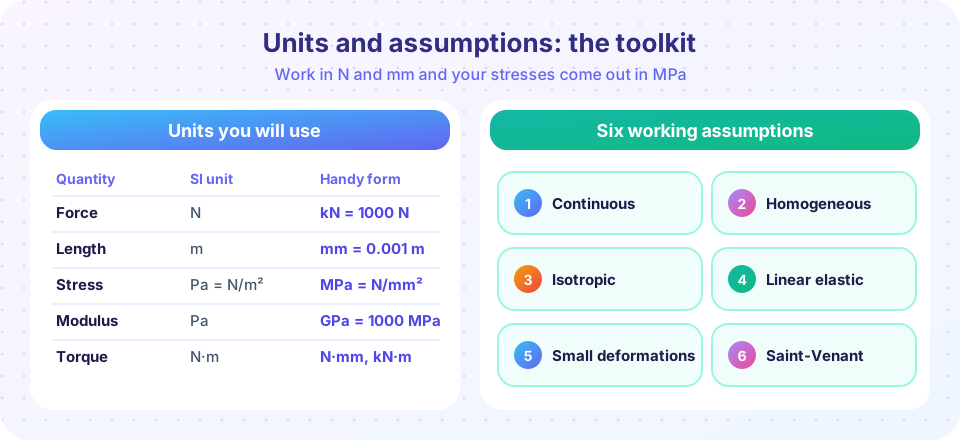
| Quantity | Symbol | SI unit | Practical unit |
|---|---|---|---|
| Force | P, F | newton, N | kN (1000 N) |
| Length | L | metre, m | mm (0.001 m) |
| Area | A | m² | mm² (10⁻⁶ m²) |
| Stress | σ, τ | pascal, Pa (N/m²) | MPa (N/mm²) |
| Modulus | E, G | Pa | GPa (1000 MPa) |
| Moment, torque | M, T | N·m | kN·m, N·mm |
| Angle | φ | radian | degree |
Prefixes jump by factors of 1000: milli (m, 10⁻³), kilo (k, 10³), mega (M, 10⁶), giga (G, 10⁹). Careful with squares: 1 m² = 1 000 000 mm², not 1000.
The N, mm, MPa shortcut
1 MPa = 1 N/mm². So if you enter forces in newtons and lengths in millimetres, stresses come out in MPa and moduli in MPa (steel: 200 000 MPa = 200 GPa). The calculation never needs a power of ten:
σ = P / A = 50 000 N / 314 mm² = 159 MPa
Moments and torques then come out in N·mm, and an area moment of inertia in mm⁴. The shortcut is why most engineers working in the metric system choose these three units. When a problem gives kN and m, convert once at the start and stay in N and mm.
US customary units
You will meet pounds-force (lbf), inches, psi (lbf/in²) and ksi (1000 psi) in American and some international drawings. Useful factors:
1 lbf = 4.448 N1 in = 25.4 mm(exact)1 psi = 6.895 kPa, so1 ksi = 6.895 MPa
For example, structural steel with a yield strength of 36 ksi is about 248 MPa, which is why "250 MPa steel" is its metric cousin.
The six working assumptions
The formulas in this course describe an idealized material and shape. Knowing the idealization tells you when to distrust a result.
- Continuous. The material has no gaps; we treat it as a continuum. This is excellent for metals, fine for most concrete, and needs care for foams and composites.
- Homogeneous. The same properties at every point. Plain steel is; reinforced concrete is not (we treat it by combining materials in chapter 3).
- Isotropic. The same properties in every direction. Rolled steel is nearly so; wood and fibre composites are strongly directional.
- Linear elastic. Stress is proportional to strain, and the part returns to its shape when the load is removed. It holds below yield and fails beyond it.
- Small deformations. Displacements are tiny compared with the dimensions, so we can write equilibrium on the undeformed shape. Slender columns and cables violate this.
- Saint-Venant's principle. Our simple formulas give the right stress at a distance of about one member width from where loads are applied or the shape changes suddenly. Near a bolt hole or a clamp, the real stress is more complicated (see stress concentrations in chapter 3).
Two habits that prevent most errors
- Carry units through every line. If a result of
δ = P L / (A E)does not come out in mm, something is inconsistent. - Sanity-check magnitudes. Steel stresses at working load are of the order of 100 MPa; deflections of beams are millimetres, not metres.
Press Run (or Ctrl + Enter) to see the result here.
Program input · what you'd type while the program runs
Type the answers before you press Run, one per line. Each time the program reads a line (with input()), it gets the next line from this box.
Common misconceptions
"1 m² is 1000 mm²." It is 1 000 000 mm², because both sides are multiplied by 1000.
"The formulas always apply." Each one has an assumption list. A tapered bar, a plastic beam, or a stress next to a hole breaks the simple formula, and later lessons show the corrections.
"mm and m can be mixed if I convert at the end." Convert before calculating, and carry one consistent set (N, mm, MPa) through the whole problem.
Check your understanding
Quick check · 5 questions
of 5 answered You scored / 5 · perfect!
-
1. 1 MPa equals which of these?
1 MPa = 10⁶ N/m² = 1 N/mm², because 1 m² is 10⁶ mm². -
2. A force of 50 000 N acts on 400 mm². What is the stress?
50 000 N / 400 mm² = 125 N/mm² = 125 MPa. -
3. Which assumption fails for a typical piece of timber?
Wood is much stiffer and stronger along the grain than across it, so it is not isotropic. -
4. What does Saint-Venant's principle tell you?
At about one member width from the loaded area, the detailed way the load is applied no longer changes the stress. -
5. 36 ksi is closest to which stress?
36 × 6.895 ≈ 248 MPa.
Summary
- Use N, mm and MPa and you never need powers of ten: 1 MPa = 1 N/mm².
- 1 m² = 10⁶ mm²; 1 ksi = 6.895 MPa; 1 in = 25.4 mm.
- Six assumptions underlie the formulas: continuous, homogeneous, isotropic, linear elastic, small deformations, Saint-Venant.
- Carry units through every step and check that magnitudes look reasonable.
Next: Chapter 1 Review
Track your progress
Create a free account to tick off lessons and pick up where you left off on any device.
of Strength of Materials lessons completed