


















Lesson 15 of 49 · Axial Loading
Thermal Stress and Thermal Expansion
Compute free thermal expansion δT = αLΔT, the compressive stress in a bar that cannot expand, and the stress when a small gap closes, with worked steel examples.
Materials grow when heated and shrink when cooled. Railway tracks, bridge decks, pipelines, engine blocks and glass windows all have to cope with that. If the part is free to move, the temperature change just changes its size and produces no stress. If it is held, the "stored" expansion turns into force. This lesson shows how to calculate both cases.
What you will learn
- Thermal strain and free expansion
δT = α L ΔT. - Why free expansion causes no stress.
- Stress in a fully restrained bar,
σ = −E α ΔT. - How to handle a partial restraint such as a small gap.
Key terms
Coefficient of thermal expansion α: the strain per degree of temperature change, in 1/°C (or 1/K).
Thermal strain ε_T: the strain caused by temperature change alone, ε_T = α ΔT.
Restraint: any support or connection that prevents free expansion.
Mechanical strain: the strain that produces stress, equal to the total strain minus the thermal strain.
Free expansion
For a temperature rise ΔT (in °C or K, the same size), a bar of length L grows by
δT = α L ΔT.
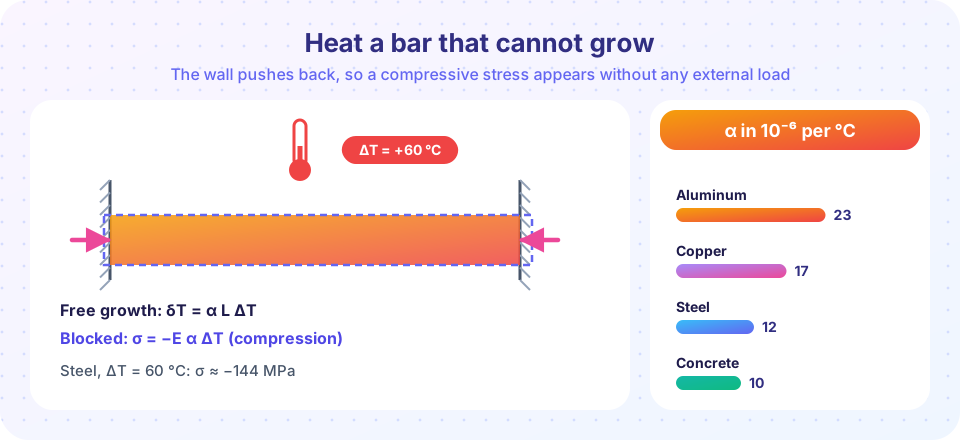
Typical coefficients, in 10⁻⁶ per °C: aluminum about 23, copper about 17, steel about 12, concrete about 10. A 10 m steel rail heated by 40 °C grows by 12 × 10⁻⁶ × 10 000 × 40 = 4.8 mm. If nothing prevents it, there is no stress at all. Heat changes the size of a free body without loading it.
Restrained expansion
Now fix the ends between two rigid walls, then heat the bar by ΔT. The total length cannot change, so the total strain is zero. The total strain is the thermal strain plus the mechanical (stress-producing) strain:
0 = α ΔT + σ / E
so
σ = −E α ΔT
The minus sign shows compression for a temperature rise. For steel (E = 200 000 MPa, α = 12 × 10⁻⁶ /°C) heated by 60 °C:
σ = −200 000 × 12 × 10⁻⁶ × 60 = −144 MPa.
That is more than half the yield strength of a mild steel, and the result does not depend on the bar's length or cross-section. A thick short bar and a thin long bar develop the same stress; only the force σ A differs. This is why expansion joints exist, and why a long welded rail in hot sun can buckle sideways rather than crush.
A gap: partial restraint
Suppose a 1 m steel bar has a 0.5 mm gap before a rigid wall, and it is heated by 50 °C.
- Free expansion:
δT = 12 × 10⁻⁶ × 1000 × 50 = 0.6 mm. - The bar closes the 0.5 mm gap, and 0.1 mm of expansion is prevented.
- The mechanical strain is
−0.1 / 1000 = −1 × 10⁻⁴. - The stress is
σ = E ε = 200 000 × (−1 × 10⁻⁴) = −20 MPa.
A small gap soaks up most of the expansion, so a small change in the gap changes the stress dramatically. This is the idea behind expansion gaps in pavements and bridges.
Different materials, same temperature
When two materials with different α are joined (a bimetallic strip, a steel bolt in an aluminum housing), they try to expand by different amounts. The mismatch produces stress even though no external load acts. A hot aluminum cylinder head clamped by steel bolts, for instance, loads the bolts more as the engine warms. Combined with the composite-bar method from the previous lesson (equilibrium plus compatibility with thermal strains), you can solve such systems.
Press Run (or Ctrl + Enter) to see the result here.
Program input · what you'd type while the program runs
Type the answers before you press Run, one per line. Each time the program reads a line (with input()), it gets the next line from this box.
Common misconceptions
"Heating a bar always creates stress." Only if the expansion is prevented. A free bar simply gets longer.
"A longer bar develops more thermal stress when fully restrained." The stress E α ΔT is independent of length and area. What grows with length is the free expansion, which matters when you design gaps.
"Thermal strain and mechanical strain are the same." Thermal strain is the unstressed size change; only the mechanical part produces stress via Hooke's law.
Check your understanding
Quick check · 5 questions
of 5 answered You scored / 5 · perfect!
-
1. A free steel bar (α = 12 × 10⁻⁶ /°C) of 5 m is heated by 40 °C. The growth is…
δT = 12 × 10⁻⁶ × 5000 × 40 = 2.4 mm. -
2. A fully restrained steel bar (E = 200 GPa, α = 12 × 10⁻⁶) is heated by 60 °C. The stress is…
σ = −E α ΔT = −200 000 × 12 × 10⁻⁶ × 60 = −144 MPa: compression. -
3. What is the thermal stress in a free bar?
A free bar expands without any stress. -
4. Which does the fully restrained thermal stress NOT depend on?
σ = −E α ΔT has no length or area in it. -
5. A 1 m steel bar has a 0.5 mm gap and would grow 0.6 mm. The stress after contact is…
Only 0.1 mm is prevented: ε = −0.1 / 1000, σ = 200 000 × (−1 × 10⁻⁴) = −20 MPa.
Summary
- Free expansion:
δT = α L ΔT, with no stress. - Fully restrained:
σ = −E α ΔT, independent of length and area. - With a gap, only the blocked part of the expansion produces stress.
- Mismatched coefficients stress joined materials even without external load.
Next: Stress Concentrations
Track your progress
Create a free account to tick off lessons and pick up where you left off on any device.
of Strength of Materials lessons completed