


















Lesson 12 of 49 · Axial Loading
Axial Loading: The Big Picture
Preview chapter 3: bars loaded along their axis, how internal force changes along a stepped bar, and the lessons on deformation, indeterminate bars, heat and stress concentration.
Rods, cables, truss members, columns, bolts and piston rods all carry load along their axis. Axial loading is the simplest case in strength of materials, which makes it the best place to practise the full chain of reasoning: load, internal force, stress, strain, deformation. Chapter 3 follows that chain through bars that change size, bars that cannot be solved by statics alone, bars that are heated, and bars with holes.
What you will learn
- How internal force varies along a bar with several loads and sections.
- The four topics of this chapter and how they connect.
- What a complete axial-loading analysis looks like.
Key terms
Axial force diagram: a plot of the internal axial force N against position along a bar.
Segment: a stretch of bar with constant force, area and material.
Statically indeterminate: a problem with more unknowns than the equilibrium equations can solve.
Compatibility: the geometric condition that deformations must fit together.
The big picture
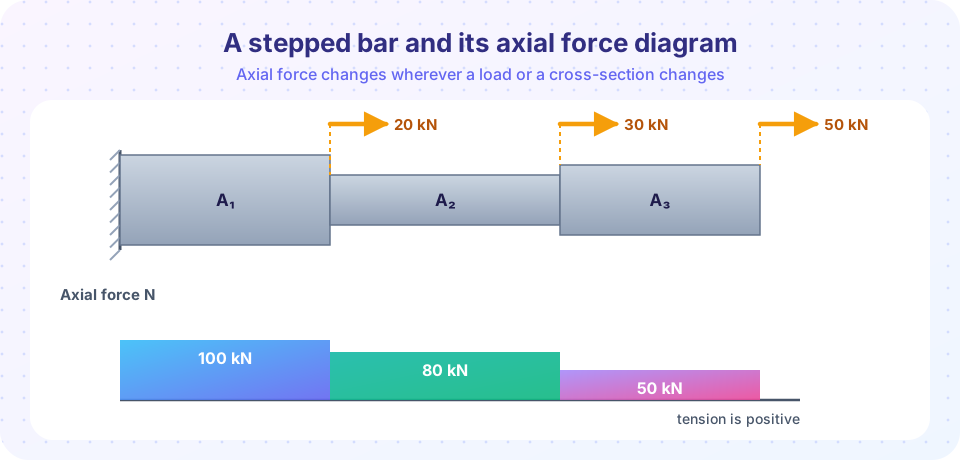
In the picture, a bar fixed to a wall has three segments with areas A₁, A₂, A₃ and three pulls at the junctions: 20 kN at B, 30 kN at C and 50 kN at D. Cutting near each segment and keeping the free side shows:
- segment AB:
N = 20 + 30 + 50 = 100 kN - segment BC:
N = 30 + 50 = 80 kN - segment CD:
N = 50 kN
The stress in each segment is σ = N / A. A thinner segment under a large force is the likely trouble spot, so both N and A matter: the weakest point is the segment where N / A is largest, not necessarily where N is largest. The elongation of each segment is δ = N L / (A E), and the total elongation is the sum of the segments.
The path of the chapter
- Deformation
- Indeterminate bars
- Heat
- Holes and notches
What each lesson covers
- Axial Deformation:
δ = P L / (A E), stepped and tapered bars, and the stiffness of a bar. - Statically Indeterminate Axial Members: bars between two walls and composite bars, with equilibrium plus compatibility.
- Thermal Stress: free expansion, restrained bars and gaps.
- Stress Concentrations: holes, notches and the factor Kt.
- Chapter 3 Review: the summary sheet and a mixed quiz.
Try it
Press Run (or Ctrl + Enter) to see the result here.
Program input · what you'd type while the program runs
Type the answers before you press Run, one per line. Each time the program reads a line (with input()), it gets the next line from this box.
Common misconceptions
"The largest force is always the critical section." The critical section has the highest stress N / A. A thin segment with a smaller force can be more stressed than a thick one with a bigger force.
"Elongation depends only on the load." It also depends on length, area and modulus. A long thin bar stretches much more than a short thick one under the same load.
Check your understanding
Quick check · 4 questions
of 4 answered You scored / 4 · perfect!
-
1. A bar has loads of 20, 30 and 50 kN at B, C and D, pulling away from the fixed end A. What is N in segment BC?
The piece beyond a cut in BC carries the loads at C and D: 30 + 50 = 80 kN. -
2. Segment CD has N = 50 kN and A = 450 mm². Its stress is…
σ = 50 000 / 450 = 111.1 MPa. -
3. Where is a stepped bar most likely to fail?
Failure relates to stress, which depends on both force and area. -
4. Which topic uses 'compatibility'?
Compatibility is the geometric condition that supplies the extra equation when statics is not enough.
Summary
- Internal axial force changes at every load; plot it and compute
σ = N / Asegment by segment. - Elongation is
N L / (A E)per segment and adds up along the bar. - The chapter adds indeterminate bars, thermal effects and stress concentrations.
- The critical section is where
N / Ais highest.
Next: Axial Deformation
Track your progress
Create a free account to tick off lessons and pick up where you left off on any device.
of Strength of Materials lessons completed