


















Lesson 35 of 49 · Deflection and Buckling
Superposition and standard cases
Use the four standard beam cases and superposition to find deflections quickly, then solve a propped cantilever, a statically indeterminate beam, with numbers.
Integration works for any beam, but it is slow. In practice engineers keep a handful of results in their heads and in handbooks, and use one powerful principle to combine them: superposition. Because the elastic curve equation EI·v″ = M(x) is linear, the deflection caused by several loads equals the sum of the deflections caused by each load alone. That one fact lets you solve complicated loadings by adding simple cases, and it also gives a clean way to solve beams that statics alone cannot.
What you will learn
- The deflection and slope of the four standard cases.
- When superposition is valid and how to apply it to combined loadings.
- How to solve a propped cantilever by treating the prop as an unknown load.
- Which deflection limits are common, and how to check one.
Key terms
- Superposition: summing the results of separate loads; valid for linear elastic beams with small deflections.
- Statically indeterminate beam: a beam with more unknown reactions than the equilibrium equations can solve.
- Redundant: an extra support reaction that is treated as an unknown load.
- Compatibility condition: a geometric requirement, such as zero deflection at a prop, that supplies the missing equation.
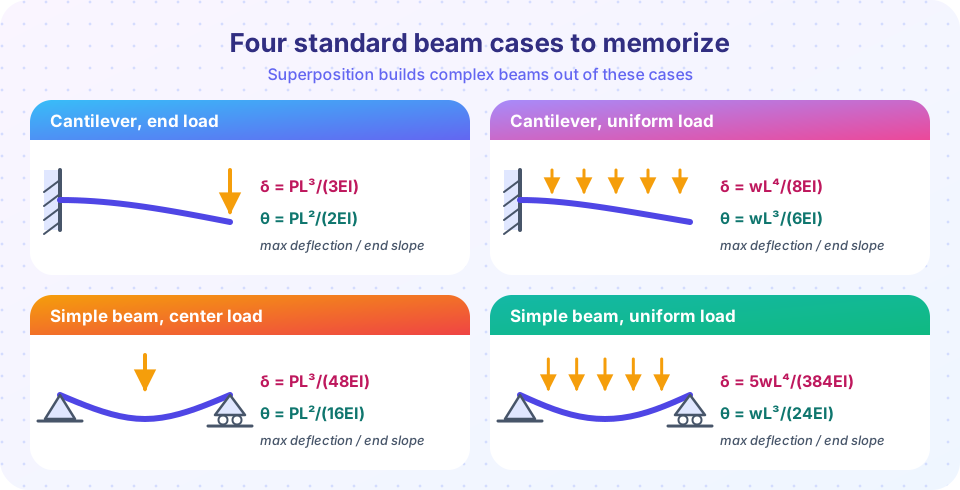
The four standard cases
| Beam and load | Maximum deflection | Maximum slope |
|---|---|---|
Cantilever, load P at the free end |
PL³/(3EI) |
PL²/(2EI) |
Cantilever, uniform load w |
wL⁴/(8EI) |
wL³/(6EI) |
Simple beam, load P at midspan |
PL³/(48EI) |
PL²/(16EI) |
Simple beam, uniform load w |
5wL⁴/(384EI) |
wL³/(24EI) |
Patterns help you remember them. Point loads give L³, distributed loads give L⁴ (the total load wL times L³). Cantilevers are far more flexible than simple beams: compare PL³/3EI with PL³/48EI, a factor of 16, which is why a diving board is so bouncy. The weird 5/384 factor for the uniform load comes from integrating a quartic.
Superposition in action
A steel cantilever (E = 200 GPa, I = 66.7 × 10⁶ mm⁴) of length L = 2 m carries a 5 kN load at the tip and a uniform load of w = 2 kN/m = 2 N/mm along its length. The tip deflection is the sum of the two cases.
Point load:    δ₁ = PL³/(3EI)  = 5000 × 2000³ / (3 × 200 000 × 66.7×10⁶) = 1.00 mm
Uniform load:  δ₂ = wL⁴/(8EI) = 2 × 2000⁴ / (8 × 200 000 × 66.7×10⁶)    = 0.30 mm
Total:         δ  = 1.30 mm
Superposition is valid as long as (1) the material is linearly elastic, (2) slopes are small, and (3) the geometry does not change in a way that matters, so the loads act where you think they do. It is not valid when the loads cause large deflections, or when an axial compression makes the deflection feed back into the bending moment (the beam-column problem, related to buckling).
Statically indeterminate beams: the propped cantilever
Add a roller at the free end of the cantilever above, which carries the uniform load only. Statics gives three equations (ΣFy, ΣM) for the wall reaction, the wall moment and the roller reaction: one too many. We need a compatibility condition: the tip deflection is zero.
The method: remove the redundant support, find the deflection it would have had, then apply the redundant reaction R as a load that pushes the deflection back to zero.
Uniform load alone, tip deflection (down):   wL⁴/(8EI)
Prop force R alone, tip deflection (up):     R L³/(3EI)

Compatibility: wL⁴/(8EI) − R L³/(3EI) = 0   →   R = 3wL/8
With w = 2 N/mm and L = 2000 mm: R = 3 × 2 × 2000/8 = 1500 N. The reactions then follow from statics: the wall carries wL − R = 4000 − 1500 = 2500 N and a moment wL²/2 − R·L = 4×10⁶ − 3×10⁶ = 1×10⁶ N·mm. Note that this moment equals wL²/8, a quarter of the unpropped value wL²/2: the prop reduces the peak moment by a factor of four. That is why continuous and propped beams are so economical.
Deflection limits
Serviceability limits are written in the design codes and depend on use. As typical examples, floors that carry plaster are often limited to L/360, roofs to L/240, and machinery frames to much smaller values. Check the code that applies to your project: these numbers vary by country and material. For our 4 m example, L/360 = 11.1 mm, so the 2 mm deflection computed in the overview comfortably passes.
Common misconceptions
- "Superposition always works." Only for linear systems: linear material and small deflections.
- "The cantilever and the simple beam of the same length deflect similarly." A cantilever with an end load deflects 16 times more than a simple beam with a center load.
- "Indeterminate beams are stronger because they have more supports, so I can skip analysis." More supports reduce the peak moment but also introduce reactions you must size for, and settlement of a support changes the loads.
- "Use the formula for the wrong load case." Check the picture twice: end load versus uniform load, center versus off-center.
Try it
First, a calculator that evaluates the four standard cases for your own data and applies superposition for a combined load.
Press Run (or Ctrl + Enter) to see the result here.
Program input · what you'd type while the program runs
Type the answers before you press Run, one per line. Each time the program reads a line (with input()), it gets the next line from this box.
Second, the propped cantilever as a plot. The curve for the uniform load alone ends 0.3 mm below the original line; subtracting the effect of the prop force brings the tip back to zero.
Press Run (or Ctrl + Enter) to see the result here.
Program input · what you'd type while the program runs
Type the answers before you press Run, one per line. Each time the program reads a line (with input()), it gets the next line from this box.
Check your understanding
Quick check · 5 questions
of 5 answered You scored / 5 · perfect!
-
1. A simply supported beam carries a uniform load w. Its maximum deflection is...
5wL⁴/(384EI) is the midspan deflection. wL³/(24EI) is the end slope. -
2. Which condition must hold for superposition of deflections to be valid?
Superposition relies on linearity of the governing equations. -
3. A cantilever has tip deflection 3.0 mm from an end load and 1.0 mm from a uniform load. What is the total tip deflection?
Add the separate effects: 3.0 + 1.0 = 4.0 mm. -
4. For a propped cantilever with a uniform load w, what is the prop reaction R at the free end?
Equate wL⁴/(8EI) with RL³/(3EI): R = 3wL/8. -
5. How many times larger is the tip deflection of a cantilever (end load P) than the midspan deflection of a simple beam (center load P) of the same length, EI and load?
(PL³/3EI) / (PL³/48EI) = 48/3 = 16.
Summary
- The four standard cases: cantilever end load
PL³/3EI, cantilever uniform loadwL⁴/8EI, simple beam center loadPL³/48EI, simple beam uniform load5wL⁴/384EI. - Superposition adds the effects of separate loads for linear, small-deflection problems.
- A statically indeterminate beam is solved by removing a redundant, finding its deflection, and demanding compatibility.
- A propped cantilever with a uniform load has
R = 3wL/8at the prop and its wall moment iswL²/8. - Check the result against the deflection limit set by the design code (for example
L/360).
Track your progress
Create a free account to tick off lessons and pick up where you left off on any device.
of Strength of Materials lessons completed