


















Lesson 21 of 49 · Torsion
Indeterminate Shafts and Thin-Walled Tubes
Solve shafts fixed at both ends with compatibility of twist, then learn closed thin-walled tubes with shear flow and Bredt's formula τ = T/(2Aₘt), compared with open sections.
Two more cases complete the picture of torsion. The first repeats the logic of the axial chapter: a shaft fixed at both ends cannot be solved by statics alone, and the missing equation comes from the geometry of twist. The second is a different shape: a thin-walled tube, such as an aircraft fuselage skin or a box girder, which resists torque very differently depending on whether the section is closed or open.
What you will learn
- How to solve a shaft fixed at both ends.
- The shear flow in a closed thin-walled tube and Bredt's formula.
- How to find the angle of twist of a thin-walled tube.
- Why an open thin section is far weaker in torsion than a closed one.
Key terms
Shear flow q: shear force per unit length of wall, q = τ t, constant around a closed thin-walled section in torsion.
Mean area Aₘ: the area enclosed by the centre line of the tube wall.
Closed section: a tube whose wall forms a complete loop.
Open section: a section with a slit or free edges, such as a channel or a slit tube.
Shafts fixed at both ends
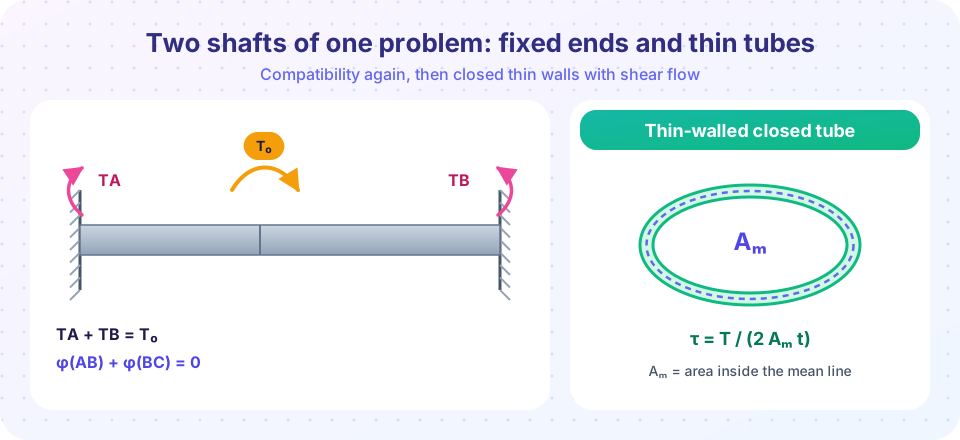
A shaft fixed to walls at A and C, loaded with a torque T₀ at B. Treat it exactly like the axial bar between two walls:
- Equilibrium:
TA + TB = T₀. - Compatibility: the walls do not rotate, so the total twist from A to C is zero:
φ_AB + φ_BC = 0. - Torque-twist:
TA a / (G J) − TB b / (G J) = 0for a uniform shaft, givingTA a = TB b.
Solving: TA = T₀ b / (a + b) and TB = T₀ a / (a + b). The nearer wall takes more torque. For T₀ = 2 kN·m, a = 0.4 m and b = 0.6 m: TA = 2 × 0.6 / 1.0 = 1.2 kN·m and TB = 0.8 kN·m. Each segment can then be checked with τ = T R / J, and the twist of B is φ_B = TA a / (G J).
The same method handles a shaft with two different materials or diameters (use each G J) and a composite shaft where a tube is bonded over a rod: equal twist, so the torques share in proportion to G J.
Closed thin-walled tubes
For a closed section with a thin wall of thickness t, we assume the shear stress is uniform across the thickness and parallel to the wall. Equilibrium of a small slice of the wall shows that the shear flow q = τ t is constant around the loop. Taking moments of the shear flow about any point gives the torque:
T = 2 q Aₘ
where Aₘ is the area enclosed by the mid-line of the wall. Replacing q with τ t:
τ = T / (2 Aₘ t) (Bredt's formula)
The stress is largest where the wall is thinnest. The angle of twist per unit length follows from energy considerations:
φ = T L / (4 Aₘ² G) ∮ ds / t
For a circular tube of constant thickness the integral gives the circumference over t, which reduces to the familiar φ = T L / (G J) with J = 2π r³ t.
Example. A circular tube with mean radius r = 40 mm and wall thickness t = 3 mm carries T = 1.5 kN·m. Then Aₘ = π × 40² = 5027 mm² and
τ = 1.5 × 10⁶ / (2 × 5027 × 3) = 49.7 MPa.
Why closed beats open
Cut a lengthwise slit in that same tube. The section is now open, and the shear flow can no longer circulate around the loop; the wall behaves like a thin strip that is twisted. For a thin strip of length b (the developed length) and thickness t, τ ≈ 3 T / (b t²). With b = 2π × 40 = 251 mm and the same torque:
τ ≈ 3 × 1.5 × 10⁶ / (251.3 × 9) = 1990 MPa
about 40 times the stress of the closed tube, and the twist is far larger too (it scales with 1 / t³). This is a classic result and the reason a slit pipe, an I-beam or a channel twists so easily: use box or tube sections where torsion matters.
Press Run (or Ctrl + Enter) to see the result here.
Program input · what you'd type while the program runs
Type the answers before you press Run, one per line. Each time the program reads a line (with input()), it gets the next line from this box.
Common misconceptions
"A tube and a slit tube twist the same." A slit destroys the closed loop and reduces torsional stiffness by a factor of order (t / r)², here about 1/1000 or less.
"In a thin tube the stress is highest where the wall is thick." τ = T / (2 Aₘ t) is highest at the thinnest part, because shear flow is constant and τ = q / t.
"The wall torque is shared equally in an indeterminate shaft." It is shared in inverse proportion to the segment length (for equal G J): the nearer wall carries more.
Check your understanding
Quick check · 5 questions
of 5 answered You scored / 5 · perfect!
-
1. A uniform shaft fixed at both ends has a torque T₀ at distance a from A and b from C. TA equals…
From TA a = TB b and TA + TB = T₀, TA = T₀ b / (a + b). -
2. What is constant around a closed thin-walled section in torsion?
Equilibrium of a wall slice gives a constant shear flow q. -
3. A circular tube has mean radius 40 mm, t = 3 mm and carries 1.5 kN·m. Bredt's formula gives about…
Aₘ = π × 40² = 5027 mm², τ = 1.5 × 10⁶ / (2 × 5027 × 3) = 49.7 MPa. -
4. Why is a slit tube so weak in torsion?
Without a closed loop the wall acts like a thin strip, giving high stress and large twist. -
5. In Bredt's formula, Aₘ is…
Aₘ is the area bounded by the centre line of the wall thickness.
Summary
- A shaft fixed at both ends needs equilibrium (
TA + TB = T₀) plus compatibility (total twist zero). - Closed thin-walled tubes carry a constant shear flow:
T = 2 q Aₘ,τ = T / (2 Aₘ t). - Twist of a closed tube:
φ = T L / (4 Aₘ² G) ∮ ds / t. - Open thin sections are dramatically weaker and more flexible in torsion than closed ones.
Next: Chapter 4 Review
Track your progress
Create a free account to tick off lessons and pick up where you left off on any device.
of Strength of Materials lessons completed