


















Lesson 13 of 49 · Axial Loading
Axial Deformation: δ = PL/AE
Derive and use δ = PL/AE for the elongation of axially loaded bars, extend it to stepped and tapered bars, and understand axial stiffness with worked numerical examples.
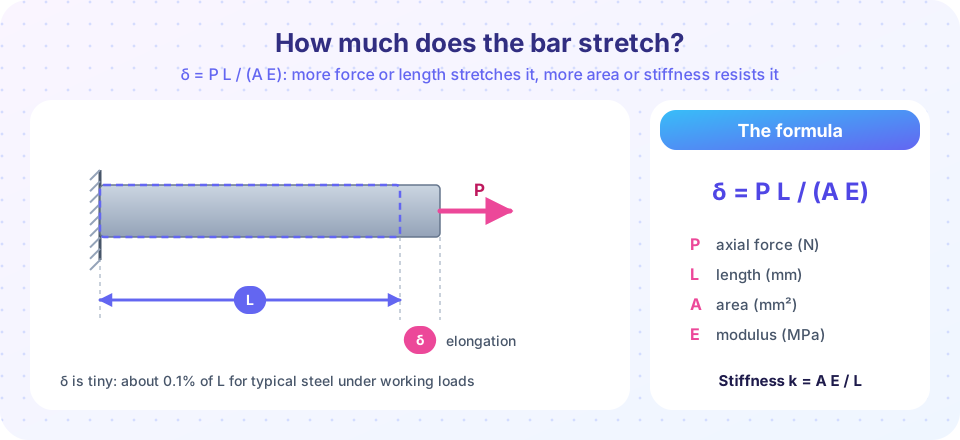
How much does a loaded bar stretch? Combine the three ideas you already know: stress σ = P / A, Hooke's law σ = E ε and strain ε = δ / L. Substituting gives the formula that every engineer has memorized:
δ = P L / (A E)
It tells you the elongation in terms of load, geometry and material. Everything that follows in the chapter builds on it.
What you will learn
- How to derive and apply
δ = P L / (A E). - How to sum the deformations of a stepped bar.
- How to treat a tapered bar.
- What axial stiffness
k = A E / Lmeans.
Key terms
Elongation δ: change in length of a bar, positive for tension.
Axial stiffness k: force needed per unit elongation, k = A E / L, in N/mm.
Flexibility: the inverse of stiffness, elongation per unit force, L / (A E).
Stepped bar: a bar made of segments with different areas, forces or materials.
Derivation
Start from ε = δ / L and σ = E ε. Replace σ by P / A:
P / A = E δ / L, so δ = P L / (A E).
The assumptions are the ones you know: a straight bar, uniform area and material, an axial load through the centroid, stresses below the proportional limit. The formula uses the load carried by the bar, so for a segment inside a bar it is the internal force N.
What the formula says
- Longer bars stretch more, in direct proportion to
L. - Thicker bars (larger
A) stretch less. - Stiffer materials (larger
E) stretch less. - Doubling the load doubles the elongation, as long as the material stays elastic: the relation between
Pandδis a straight line, like a spring.
Rearranging gives the axial stiffness k = P / δ = A E / L. A steel bar of 100 mm² and 1 m length has k = 100 × 200 000 / 1000 = 20 000 N/mm, so each kilonewton stretches it by 0.05 mm.
Stepped bars
If forces, areas or moduli change along the bar, treat each segment separately and add the elongations:
δ = Σ Nᵢ Lᵢ / (Aᵢ Eᵢ)
Take the bar from the chapter overview, steel with E = 200 GPa = 200 000 MPa:
| Segment | N (kN) | L (mm) | A (mm²) | δ = N L / (A E) |
|---|---|---|---|---|
| AB | 100 | 300 | 600 | 100 000 × 300 / (600 × 200 000) = 0.2500 mm |
| BC | 80 | 400 | 300 | 80 000 × 400 / (300 × 200 000) = 0.5333 mm |
| CD | 50 | 250 | 450 | 50 000 × 250 / (450 × 200 000) = 0.1389 mm |
The total is 0.9222 mm. The free end D moves 0.92 mm away from the wall. Notice that the thin segment BC contributes most of the elongation although its force is not the largest.
Tapered bars
When the area changes gradually, apply the formula to a thin slice of length dx and integrate: δ = ∫ N dx / (A(x) E). For a conical bar (a rod whose diameter varies linearly from d₁ to d₂ over length L) under a force P:
δ = 4 P L / (π E d₁ d₂)
For d₁ = 30 mm, d₂ = 20 mm, L = 500 mm, P = 30 kN, E = 200 GPa:
δ = 4 × 30 000 × 500 / (π × 200 000 × 30 × 20) = 0.159 mm
The result is comparable to a straight bar of the average diameter, but it is not equal: a taper concentrates the flexibility near the thin end.
Press Run (or Ctrl + Enter) to see the result here.
Program input · what you'd type while the program runs
Type the answers before you press Run, one per line. Each time the program reads a line (with input()), it gets the next line from this box.
Common misconceptions
"P in the formula is the external load." It is the internal axial force in the segment. For a segment inside a stepped bar it differs from the load at the end.
"δ = P L / (A E) works beyond yield." It assumes linear elasticity. Past yield, the strain grows without a proportional increase in stress and the formula underestimates the stretch.
"Elongation is the strain." The elongation is a length in mm; the strain is the ratio δ / L and has no unit.
Check your understanding
Quick check · 5 questions
of 5 answered You scored / 5 · perfect!
-
1. A steel bar (E = 200 GPa) has A = 100 mm², L = 1 m and carries 10 kN. The elongation is…
δ = 10 000 × 1000 / (100 × 200 000) = 0.5 mm. -
2. If the length of a bar doubles with everything else fixed, the elongation…
δ is proportional to L. -
3. In a stepped bar, the total elongation is…
Each segment stretches independently, and the lengths add up. -
4. What is the stiffness of a bar?
k = P / δ = A E / L, force per unit elongation. -
5. Which bar stretches most under the same force: steel 100 mm², aluminum 100 mm², or aluminum 200 mm² (same length)?
Aluminum 100 mm² has the lowest A × E, so it stretches most.
Summary
δ = P L / (A E): more load or length stretches the bar more; more area or modulus resists.- For stepped bars add
N L / (A E)for each segment; for tapered bars integrate. - Axial stiffness is
k = A E / L. - The formula holds for straight, elastic, axially loaded bars.
Track your progress
Create a free account to tick off lessons and pick up where you left off on any device.
of Strength of Materials lessons completed