


















Lesson 9 of 49 · Stress and Strain
Strain and the Stress-Strain Curve
Understand normal and shear strain, read a tensile-test stress-strain curve for ductile steel, and learn yield strength, ultimate strength, ductility and toughness.
Stress tells you how hard the material is being loaded. Strain tells you how much it responds. Plot one against the other for a real specimen pulled to destruction and you get the stress-strain curve, the single most informative graph in the subject. It gives the stiffness, the strength, the ductility and the toughness of a material at a glance.
What you will learn
- The definitions of normal strain and shear strain.
- How a tensile test produces a stress-strain curve.
- The meaning of proportional limit, yield strength, ultimate strength and fracture.
- How to find yield strength with the 0.2% offset method.
- The difference between ductile and brittle materials.
Key terms
Normal strain ε: elongation divided by original length, ε = δ / L.
Shear strain γ: the change in angle between two lines that were perpendicular, in radians.
Yield strength σ_y: the stress at which permanent (plastic) deformation begins.
Ultimate tensile strength σ_u: the highest engineering stress on the curve.
Ductility: how much a material can stretch before fracture, often given as percent elongation.
Toughness: the energy per unit volume absorbed up to fracture, the area under the curve.
Strain
If a bar of original length L is stretched by δ, the normal strain is ε = δ / L. A 2.5 m wire that stretches by 3 mm has ε = 3 / 2500 = 0.0012, which can also be written 0.12% or 1200 microstrain (µε). Strain is dimensionless. Tensile strain is positive; compressive strain is negative.
Shear strain measures distortion rather than stretch. Take a square element; shear turns it into a rhombus, and the change in the corner angle (in radians) is γ. If the top edge of a 50 mm tall block slides 0.5 mm sideways relative to the bottom, γ ≈ 0.5 / 50 = 0.01 rad. For small angles tan γ ≈ γ.
The tensile test
A standard specimen, often a round bar with a marked gauge length, is gripped in a testing machine and pulled slowly. The machine records the force and an extensometer measures the elongation. Engineers then convert: σ = P / A₀ (using the original area) and ε = δ / L₀. This is the engineering stress-strain curve.
Reading the curve of a ductile steel
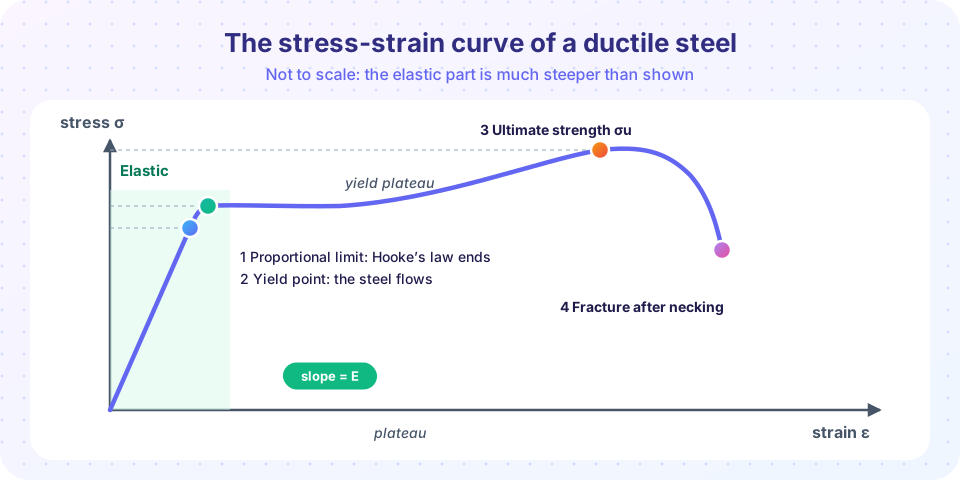
- Elastic region (0 to point 1). The curve is a straight line. Remove the load and the specimen returns to its original length. The slope of the line is Young's modulus E (next lesson). The end of the line is the proportional limit; for steel it nearly coincides with the elastic limit.
- Yield (point 2). The curve flattens: the strain grows with almost no increase in stress, as planes of atoms slip. Mild steel has a clear yield plateau at about 250 MPa for common structural grades.
- Strain hardening. After the plateau the steel gets stronger as it deforms, so the stress rises again. Here the strain is large (typically several percent) and permanent.
- Ultimate strength (point 3). The curve peaks at
σ_u, perhaps 400 MPa for mild steel. Past this, a local narrowing (necking) begins and the load the specimen carries falls. - Fracture (point 4). The specimen breaks. The engineering stress at fracture is lower than the peak because the original area is still used, although the real stress in the narrow neck is higher.
If you unload a specimen from the hardening region, the unloading line is parallel to the elastic line. The specimen keeps a permanent set. When you reload, the new yield point is higher: this is work hardening.
Yield strength without a plateau
Aluminium, high-strength steel and many other metals show no sharp yield plateau. The convention is the 0.2% offset method. Draw a line parallel to the elastic slope, starting at ε = 0.002 on the strain axis. The stress where this line cuts the curve is the offset yield strength, usually written σ_0.2. It is the stress that leaves a permanent strain of 0.2% after unloading.
Ductile and brittle
A ductile material (mild steel, aluminium, copper) can stretch a lot before breaking: elongations of 15-40% at fracture, with clear warning in the form of necking. A brittle material (cast iron, glass, concrete in tension, ceramics) breaks with little strain, often below 1%, and with no warning. Brittle materials are usually much stronger in compression than in tension: concrete, for example, is used in compression and reinforced with steel for tension.
Press Run (or Ctrl + Enter) to see the result here.
Program input · what you'd type while the program runs
Type the answers before you press Run, one per line. Each time the program reads a line (with input()), it gets the next line from this box.
Press Run (or Ctrl + Enter) to see the result here.
Program input · what you'd type while the program runs
Type the answers before you press Run, one per line. Each time the program reads a line (with input()), it gets the next line from this box.
Common misconceptions
"The curve drops after the peak, so the steel got weaker." The engineering stress divides by the original area. Past the peak the specimen narrows, so the force falls even though the true stress in the neck keeps rising until fracture.
"Yield means failure." Yield means permanent deformation begins. For a structure that must stay straight, it is failure; for a crash barrier that is meant to absorb energy, it is the working mode.
"Brittle materials are weak." Glass and concrete are brittle but strong in compression. Brittle means little strain before fracture, not low strength.
Check your understanding
Quick check · 5 questions
of 5 answered You scored / 5 · perfect!
-
1. A 2.5 m wire stretches by 3 mm. The strain is…
ε = 3 mm / 2500 mm = 0.0012, or 1200 microstrain. It has no unit. -
2. What does the slope of the straight elastic part of the curve give?
The ratio σ / ε in the elastic range is the modulus of elasticity E. -
3. How is the 0.2% offset yield strength found?
The intersection of the offset line with the curve is the stress that leaves 0.2% permanent strain. -
4. Which material is typically brittle?
Cast iron fractures at small strains with little warning. -
5. The area under the whole curve represents…
Stress × strain has units of energy per unit volume, so the area is the energy absorbed per unit volume.
Summary
- Normal strain is
ε = δ / L; shear strain γ is the angle change in radians. - The tensile test gives a curve with an elastic line (slope E), yield, strain hardening, ultimate strength and fracture.
- Without a yield plateau, use the 0.2% offset yield strength.
- Ductile materials stretch and give warning; brittle ones break with little strain.
Track your progress
Create a free account to tick off lessons and pick up where you left off on any device.
of Strength of Materials lessons completed