


















Lesson 1 of 49 · Getting Started
Course Map: How Strength of Materials Works
Meet Strength of Materials: the nine-chapter plan, who the course is for, what you need first, and a hands-on first check of whether a steel bar will hold.
Every bridge, bicycle frame, aircraft wing and paperclip has to survive the forces it meets. Strength of materials (also called mechanics of materials) is the branch of engineering that answers one question over and over: will this part hold? To answer it you calculate how the load travels through the part, how much the material is stressed, how much it deforms, and how close that is to failure.
This course is written for upper-secondary students, first-year engineering and technology students, makers, and adults refreshing the subject. It follows the common core of university and diploma courses worldwide. All formulas use SI units; where US customary units (psi, ksi) matter, we say so.
What you will learn
- What strength, stiffness and stability mean, and why they are three different questions.
- How the course is organized into nine chapters, and what each one adds.
- What background you need and how to study the lessons.
- How a first back-of-the-envelope strength check works.
Key terms
Load: a force, moment or torque applied to a part from outside.
Stress: internal force per unit area, measured in pascals (Pa) or megapascals (MPa).
Strain: deformation divided by original size; it has no unit.
Factor of safety: the ratio of what a part can carry to what it is expected to carry.
Three questions, three words
Engineers split "will it hold?" into three separate checks.
- Strength. Does the material break or permanently deform? This is a comparison between the stress in the part and a limit such as the yield strength.
- Stiffness. Does it deflect too much? A floor that is strong enough but bounces like a trampoline is a failure for the people living upstairs. Stiffness checks compare a deflection with an allowable value.
- Stability. Does it suddenly bend sideways? A slender column can buckle long before the material is crushed. You meet this in chapter 7.
A good design passes all three. Most lessons in this course isolate one of them first and combine them later.
The nine chapters
Foundations (chapters 1-3)
Twisting and bending (4-5)
Combining and bending shape (6-7)
Design (8-9)
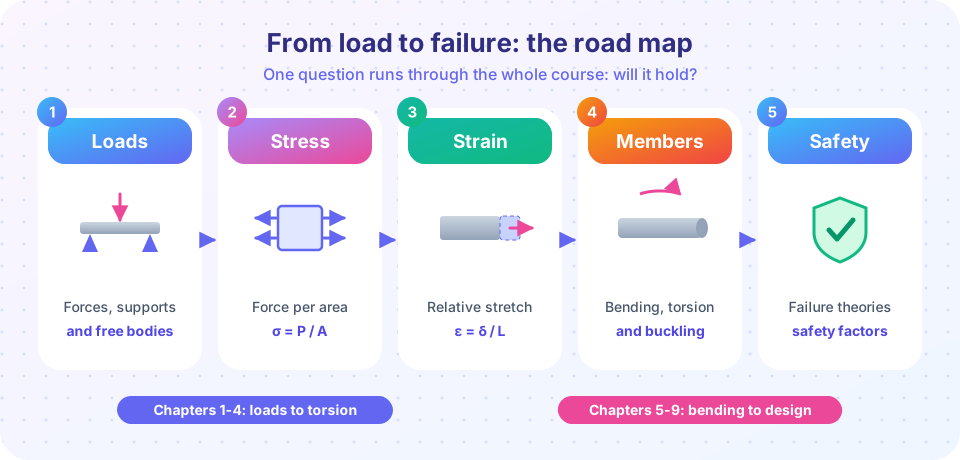
Chapters 1-4 (this part of the course) take you from the forces on a structure to a twisted shaft. Chapters 5-9 add bending, combined loading, deflection, buckling and design.
What you need first
You need algebra, basic trigonometry, and the idea of a vector (a force has a size and a direction). You do not need calculus for chapters 1-4. A little statics helps, and chapter 1 reviews exactly the parts we use.
How to study
- Draw first. Almost every problem starts with a sketch of the part and a free-body diagram. Skipping the sketch is the most common source of wrong answers.
- Write units on every number. A result of "159" means nothing; "159 MPa" can be checked.
- Estimate before you calculate. Ask whether the answer is plausible. A steel bar that stretches by a metre under a person's weight is a sign of a mistake.
- Run the examples. Every lesson has live code or widgets. Change the numbers and watch what happens.
A first strength check
Here is the whole course in miniature. A round steel rod must carry a 50 kN pull. Its yield strength is 250 MPa. How thin can it be?
The stress in a pulled rod is the force divided by the cross-section area, σ = P / A. With A = π d² / 4, the smallest diameter that just reaches yield is d = √(4 P / (π σ_y)). A real design keeps a margin, so you divide the yield strength by a factor of safety such as 1.5 first.
Press Run (or Ctrl + Enter) to see the result here.
Program input · what you'd type while the program runs
Type the answers before you press Run, one per line. Each time the program reads a line (with input()), it gets the next line from this box.
Common misconceptions
"Stronger material always means a stiffer part." No. Strength is the stress at which a material fails; stiffness is how much it deforms per unit stress. High-strength steel and ordinary steel have almost the same stiffness (about 200 GPa), so swapping the grade will not stop a part from bending.
"If it does not break, it is safe." A part that yields has been permanently deformed, and a part that cracks slowly under repeated loading can fail at a stress far below its static strength. Safety means keeping a margin from all of these.
Check your understanding
Quick check · 4 questions
of 4 answered You scored / 4 · perfect!
-
1. Which question does a stiffness check ask?
Stiffness is about deformation under load. Breaking is a strength question and sudden sideways collapse is stability. -
2. A 50 kN pull acts on a rod with a cross-section area of 250 mm². What is the stress?
σ = P / A = 50 000 N / 250 mm² = 200 N/mm² = 200 MPa. -
3. What is a factor of safety?
A factor of safety of 1.5 means the part could carry 1.5 times the expected load before reaching its limit. -
4. Which unit should you expect for stress?
Stress is force per area. 1 MPa is 1 newton per square millimetre.
Summary
- Strength of materials asks whether a part is strong enough, stiff enough and stable.
- Stress is force per area, strain is deformation per length, and a factor of safety is the margin you keep.
- The course goes from loads and stress (chapters 1-3) through torsion (4) and bending (5-7) to failure theories and design (8-9).
- Draw, label units and estimate first; then calculate.
Track your progress
Create a free account to tick off lessons and pick up where you left off on any device.
of Strength of Materials lessons completed