


















Lesson 10 of 49 · Stress and Strain
Hooke's Law and Material Properties
Use Hooke's law σ = Eε, Poisson's ratio and the shear modulus G to calculate elongation and lateral contraction, and compare the stiffness of common engineering materials.
In the elastic region the stress-strain curve is a straight line, and the slope of that line is a property of the material. This is Hooke's law, first stated for springs by Robert Hooke in 1676 ("ut tensio, sic vis", loosely "as the extension, so the force") and generalised to solids by Thomas Young and later Augustin-Louis Cauchy. With it you can turn a stress into a strain and then into a displacement.
What you will learn
- Hooke's law for tension and for shear, and the meaning of E and G.
- Poisson's ratio and the lateral contraction of a stretched bar.
- The relation between E, G and ν.
- How to compare materials by stiffness, strength and weight.
Key terms
Young's modulus E: the ratio of normal stress to normal strain in the elastic range, in GPa.
Shear modulus G: the ratio of shear stress to shear strain, in GPa.
Poisson's ratio ν: the negative ratio of lateral strain to axial strain.
Isotropic: properties the same in all directions; then only two of E, G and ν are independent.
Hooke's law
For normal stress below the proportional limit:
σ = E ε
For shear stress:
τ = G γ
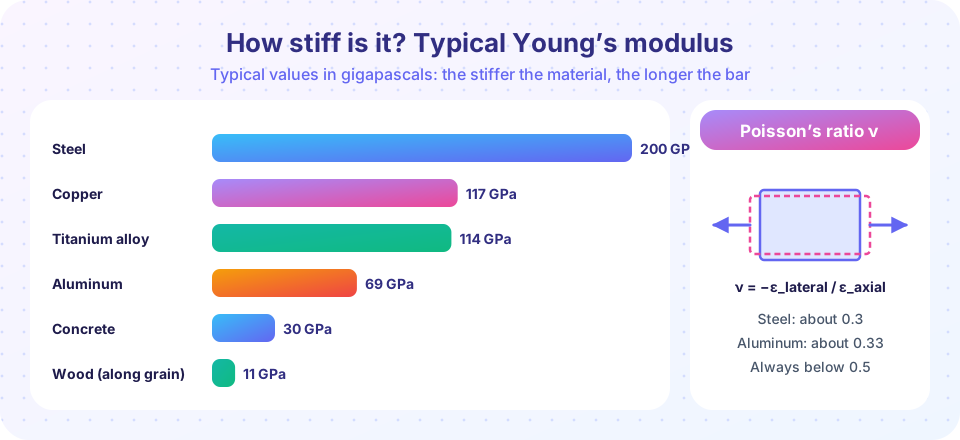
E has the same unit as stress (typically GPa) because strain is dimensionless. A larger E means a stiffer material: for the same stress it strains less. Typical values: steel 200 GPa, titanium alloys about 114 GPa, copper about 117 GPa, aluminum about 69 GPa, concrete about 30 GPa (varies a lot), timber along the grain about 11 GPa (varies with species). The modulus of all steels, from mild to the strongest alloys, is within a few percent of 200 GPa. That is why a stronger steel can carry more load but is no stiffer, and why a bridge designed for deflection rarely gains from a better grade.
Poisson's ratio
Stretch a rubber band and it gets thinner. All materials do this, in proportion. If the axial strain is ε_axial, the lateral strain is
ε_lateral = −ν ε_axial
The minus sign says that the lateral strain has the opposite sign of the axial. The ratio ν is between 0 and 0.5 for ordinary materials: about 0.3 for steel, 0.33 for aluminum, about 0.2 for concrete, 0.5 for an incompressible material like rubber. Cork is close to 0, which is why it seals bottles without bulging.
The shear modulus
For an isotropic material, only two of the three constants are independent:
G = E / (2 (1 + ν))
For steel, E = 200 GPa and ν = 0.3 give G = 200 / 2.6 = 76.9 GPa. Textbooks often round it to 77 or 80 GPa. This relationship is a good check on data you find in tables.
Example: a stretched steel rod
A steel rod of diameter 12 mm and length 1.2 m carries a tension of 15 kN. E = 200 GPa, ν = 0.3.
- Area:
A = π × 12² / 4 = 113.1 mm². - Stress:
σ = 15 000 / 113.1 = 132.6 MPa. - Strain:
ε = σ / E = 132.6 / 200 000 = 6.63 × 10⁻⁴. - Elongation:
δ = ε L = 6.63 × 10⁻⁴ × 1200 = 0.796 mm. - Lateral strain:
−0.3 × 6.63 × 10⁻⁴ = −1.99 × 10⁻⁴, so the diameter shrinks by0.0024 mm.
The elongation is less than a millimetre; the diameter change is a few micrometres. This is why we can assume small deformations.
Comparing materials
Stiffness is only one criterion. Designers also look at specific stiffness E / ρ (stiffness per mass), strength, cost and corrosion. Steel, aluminum and titanium have nearly the same specific stiffness, around 25-26 MN·m/kg, which is why aircraft designers choose between them on other grounds such as strength-to-weight, fatigue and manufacturing.
Press Run (or Ctrl + Enter) to see the result here.
Program input · what you'd type while the program runs
Type the answers before you press Run, one per line. Each time the program reads a line (with input()), it gets the next line from this box.
Common misconceptions
"Stronger steel is stiffer." Strength and stiffness are different properties. Almost all steels have E ≈ 200 GPa regardless of strength.
"Poisson's ratio can be any number." For stable isotropic materials it lies between −1 and 0.5. Most real materials are between 0 and 0.5, and a few engineered auxetic structures are negative.
"Hooke's law always holds." It stops at the proportional limit. Rubber, concrete and soils are nonlinear almost from the start, and metals leave the straight line at yield.
Check your understanding
Quick check · 5 questions
of 5 answered You scored / 5 · perfect!
-
1. A steel bar has a stress of 100 MPa. What is its strain (E = 200 GPa)?
ε = σ / E = 100 / 200 000 = 5 × 10⁻⁴. -
2. A bar stretches by 0.001 in the axial direction and ν = 0.3. The lateral strain is…
ε_lateral = −ν ε_axial = −0.3 × 0.001 = −0.0003: the bar becomes thinner. -
3. Which relation links E, G and ν for an isotropic material?
G = E / (2(1 + ν)); with E = 200 GPa and ν = 0.3 this gives about 77 GPa. -
4. The same load acts on identical rods of steel and aluminum (E = 200 and 69 GPa). The aluminum rod stretches…
δ is proportional to 1/E, and 200 / 69 ≈ 2.9. -
5. Which statement about steels is true?
All steels sit near 200 GPa; alloying changes strength far more than stiffness.
Summary
- Hooke's law:
σ = E εandτ = G γin the elastic range. - Poisson's ratio relates lateral to axial strain:
ε_lat = −ν ε_axial. - For isotropic materials,
G = E / (2 (1 + ν)). - Compare materials by stiffness
E, strength, density and cost, remembering that steel grades differ in strength but not in stiffness.
Next: Chapter 2 Review
Track your progress
Create a free account to tick off lessons and pick up where you left off on any device.
of Strength of Materials lessons completed