


















Lesson 27 of 49 · Bending of Beams
Chapter 5 review: bending of beams
Review the beam analysis chain from reactions to shear, moment and bending stress, with a recap table, a beam-checker tool and a ten-question quiz.
You now own the central workflow of beam design. This review pulls the four ideas of the chapter into one picture, one table and one tool, then tests you with ten questions.
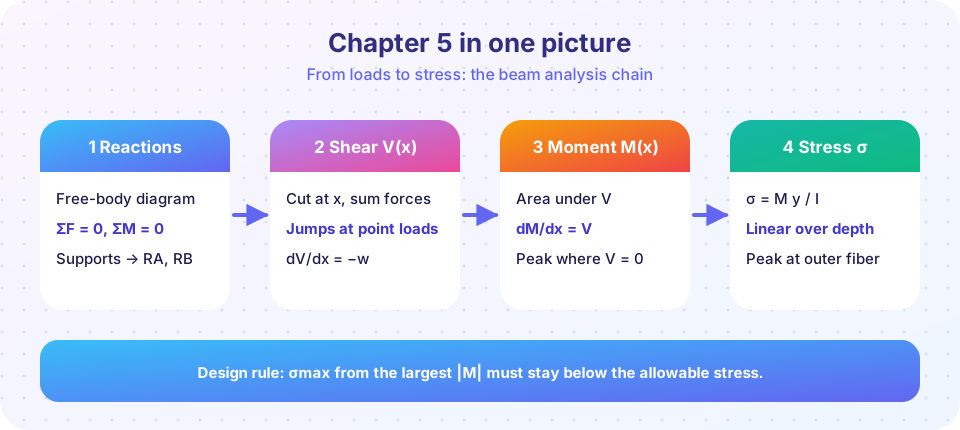
Recap table
| Idea | Formula or rule | Remember |
|---|---|---|
| Reactions | ΣF = 0, ΣM = 0 |
Replace supports by forces first |
| Shear and load | dV/dx = −w |
Point load: jump in V |
| Moment and shear | dM/dx = V |
Mmax where V = 0 |
| Simple span results | PL/4 (center load), wL²/8 (uniform) |
Cantilever: PL, wL²/2 |
| Flexure formula | σ = M·y/I |
Zero at the neutral axis |
| Max stress | σmax = M·c/I = M/S |
Check tension and compression |
| Rectangle | I = bh³/12, S = bh²/6 |
Depth is cubed |
| Circle | I = πd⁴/64, S = πd³/32 |
d is the diameter |
| Parallel axis | I = I₀ + A·d² |
I₀ about the part's own centroid |
| Design | S_req = Mmax/σallow |
Convert units first |
Try it
This tool carries out the whole chain for a simply supported beam with a uniform load: reactions, peak moment, section modulus and the safety check. Change the numbers and see how the verdict changes.
Press Run (or Ctrl + Enter) to see the result here.
Program input · what you'd type while the program runs
Type the answers before you press Run, one per line. Each time the program reads a line (with input()), it gets the next line from this box.
Plot the same beam's stress along its length to see where it is most heavily used.
Press Run (or Ctrl + Enter) to see the result here.
Program input · what you'd type while the program runs
Type the answers before you press Run, one per line. Each time the program reads a line (with input()), it gets the next line from this box.
Check your understanding
Quick check · 9 questions
of 9 answered You scored / 9 · perfect!
-
1. A simply supported 4 m beam carries a 10 kN/m uniform load. What is Mmax?
wL²/8 = 10 × 16 / 8 = 20 kN·m. -
2. A cantilever of length 2 m has a 5 kN tip load. What is the moment at the wall?
M = P L = 5 × 2 = 10 kN·m, hogging. -
3. The slope of the shear diagram at a point equals...
dV/dx = −w. -
4. Where is bending stress largest in a rectangular beam?
σ = My/I is largest at the largest |y|, the outer faces. -
5. A solid circular shaft has d = 40 mm. What is I?
I = π d⁴/64 = π × 40⁴ / 64 = π × 2 560 000 / 64 ≈ 125 700 mm⁴, which is 125.7 × 10³ mm⁴. -
6. Which pair lists the correct tension and compression sides for a sagging beam?
Sagging stretches the bottom and squeezes the top. -
7. The parallel-axis theorem adds which term to a part's own I₀?
I = I₀ + A d². -
8. A beam must resist Mmax = 18 kN·m with σallow = 90 MPa. What S is needed?
S = 18 × 10⁶ / 90 = 200 × 10³ mm³. -
9. Doubling a rectangular beam's depth (same width) multiplies its I by...
I = b h³/12, so doubling h multiplies I by 2³ = 8.
Summary
- Beam analysis runs in a fixed order: reactions, then
VandM, then stress, then comparison with the allowable value. dV/dx = −wanddM/dx = Vlet you sketch diagrams and find the peak moment quickly.σ = M·y/Iis linear iny; the section modulusS = I/cturns it intoσmax = M/S.Igrows with the cube of depth; build composite sections with the parallel-axis theorem.
Track your progress
Create a free account to tick off lessons and pick up where you left off on any device.
of Strength of Materials lessons completed