


















Lesson 5 of 49 · Getting Started
Chapter 1 Review: Getting Started
Review loads, supports, free-body diagrams, internal forces, units and assumptions with a one-page summary, recap table and a ten-question mixed quiz.
Chapter 1 gave you the vocabulary and habits that everything else rests on. You can now describe the forces on a structure, find the support reactions, expose the internal forces by cutting, and keep your units straight. Chapter 2 turns the internal force into stress and the deformation into strain.
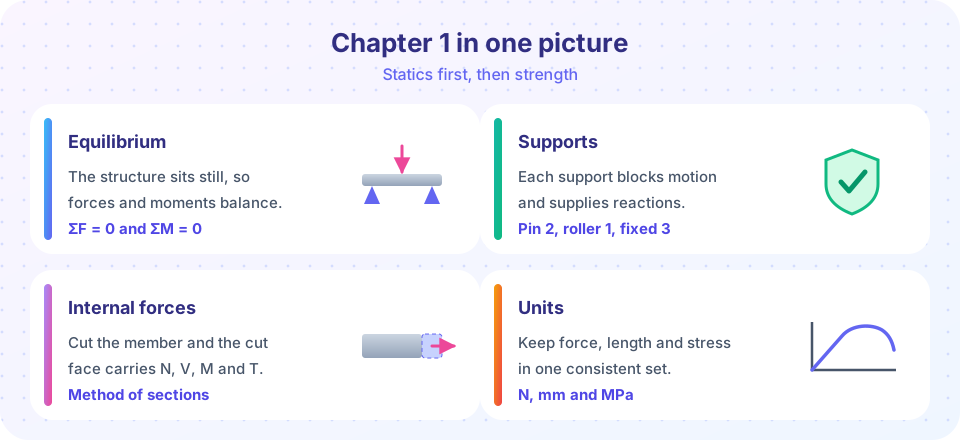
Recap table
| Lesson | Key idea | Formula or rule |
|---|---|---|
| Course map | Strength, stiffness, stability | n = capacity / demand |
| Loads and supports | FBD and reactions | ΣFx = 0, ΣFy = 0, ΣM = 0 |
| Internal forces | Cut and keep one piece | N, V, M, T from equilibrium |
| Units and assumptions | One consistent system | 1 MPa = 1 N/mm² |
Worked recap: one problem, four ideas
A simply supported beam 4 m long carries a uniform load of 6 kN/m over its whole length.
- Resultant:
W = 6 × 4 = 24 kN, at 2 m from either end. - Reactions: by symmetry
Ay = By = 12 kN. - Internal forces at midspan (
x = 2 m, left piece):V = 12 − 6 × 2 = 0andM = 12 × 2 − 6 × 2 × 1 = 12 kN·m. - Units: that moment is
12 × 10⁶ N·mm, ready for the bending formulas in chapter 5.
Zero shear at the midspan is not a coincidence: the moment is largest where the shear passes through zero, which chapter 5 proves.
Press Run (or Ctrl + Enter) to see the result here.
Program input · what you'd type while the program runs
Type the answers before you press Run, one per line. Each time the program reads a line (with input()), it gets the next line from this box.
Press Run (or Ctrl + Enter) to see the result here.
Program input · what you'd type while the program runs
Type the answers before you press Run, one per line. Each time the program reads a line (with input()), it gets the next line from this box.
Check your understanding: chapter 1
Quick check · 10 questions
of 10 answered You scored / 10 · perfect!
-
1. A pin support in a plane problem supplies how many reactions?
A pin blocks translation in both directions, giving two force components. -
2. A uniform load of 5 kN/m acts over 3 m. What is the resultant?
W = w × length = 5 × 3 = 15 kN, acting at the middle of the 3 m. -
3. Which equation set is needed for a planar free body?
A static plane body must balance in both force directions and in rotation. -
4. In the method of sections you should take moments about…
That point eliminates the unknown N and V from the moment equation. -
5. Which positive-sign statement matches this course?
Tension is positive; M is positive when the beam sags. -
6. 50 kN acts on 250 mm². The stress in MPa is…
50 000 N / 250 mm² = 200 N/mm² = 200 MPa. -
7. Which is NOT one of the six standard assumptions?
Stress is often not uniform. The assumptions are about the material and the size of the deformations. -
8. A negative reaction value in your solution means…
The sign only compares the true direction with your assumption. -
9. Which pairing is correct?
T is the internal moment about the axis of a shaft. N stretches or compresses, V slides, M bends. -
10. 1 ksi equals approximately…
1 ksi = 1000 psi = 6.895 MPa.
Summary
- Draw the free-body diagram, count the reactions, and solve with
ΣFx,ΣFy,ΣM. - Cut the member to find N, V, M and T, and choose the simpler piece.
- Work in N, mm and MPa, and remember the six assumptions.
- You are ready to define stress and strain.
Track your progress
Create a free account to tick off lessons and pick up where you left off on any device.
of Strength of Materials lessons completed