


















Lesson 30 of 49 · Shear and Combined Loading
Combined axial, bending and torsion
Superpose axial, bending, shear and torsional stresses at a critical point. Includes eccentric loads, the middle-third rule and a bent, twisted shaft.
Most real members feel more than one kind of load at once. A hook carries a weight with the load line offset from the stem, so the stem is stretched and bent. A crankshaft is bent by the connecting rod and twisted by the engine torque. A chimney is squeezed by its own weight and bent by wind. For all of these, one powerful idea does most of the work: superposition. As long as the material is linearly elastic and deformations are small, you may find the stress caused by each load alone and then add them at the point you care about.
What you will learn
- The recipe for a combined-loading problem: loads, stresses, critical point, element.
- How axial force and bending combine for an eccentric load, and the middle-third rule.
- How a shaft in bending and torsion gives both
σandτat one point. - When shear from the transverse force can be neglected.
Key terms
- Superposition: adding stresses from separate loads; valid for linear, small-deformation problems.
- Critical point: the point where the combined stress is greatest, often on the surface.
- Eccentric load: an axial force whose line of action does not pass through the centroid.
- Stress element: a tiny cube showing the normal and shear stresses acting at a point.
The recipe
- Find the internal loads at the section of interest (axial
N, shearsV, bendingM, torqueT) with a free-body diagram. - Find the stress from each:
N/A(axial),M·y/I(bending),V·Q/(I·b)(shear),T·r/J(torsion). - Pick the critical point(s). Usually a point on the surface at the section with the largest moment or torque.
- Draw a stress element at that point and add the normal stresses together and the shear stresses together, with careful signs.
- Evaluate: find the principal stresses and the maximum shear stress (next lesson), then compare with a failure criterion (Chapter 8).
Normal stresses add with normal stresses and shear stresses with shear stresses; you never add a normal stress to a shear stress.
Axial plus bending: the eccentric load
A short column of 100 × 100 mm square section is compressed by P = 50 kN acting e = 20 mm from the centroid. Move the force to the centroid and add a moment: M = P·e = 50 000 × 20 = 1.0 × 10⁶ N·mm.
- Axial:
σ = −P/A = −50 000 / 10 000 = −5 MPa(compression). - Bending:
σ = ± M/SwithS = b h²/6 = 166.7 × 10³ mm³, so±6.0 MPa.
The face nearer the load gets −5 − 6 = −11 MPa. The far face gets −5 + 6 = +1 MPa, tension, even though the load is compressive. Masonry and concrete are weak in tension, so engineers want to avoid this. The stress on the far face is zero when P/A = P·e/S, that is, e = S/A = h/6 for a rectangle. Keep the load inside the middle third of the depth and the whole section stays in compression. For circular sections the limit is d/8.
Bending plus torsion: the shaft
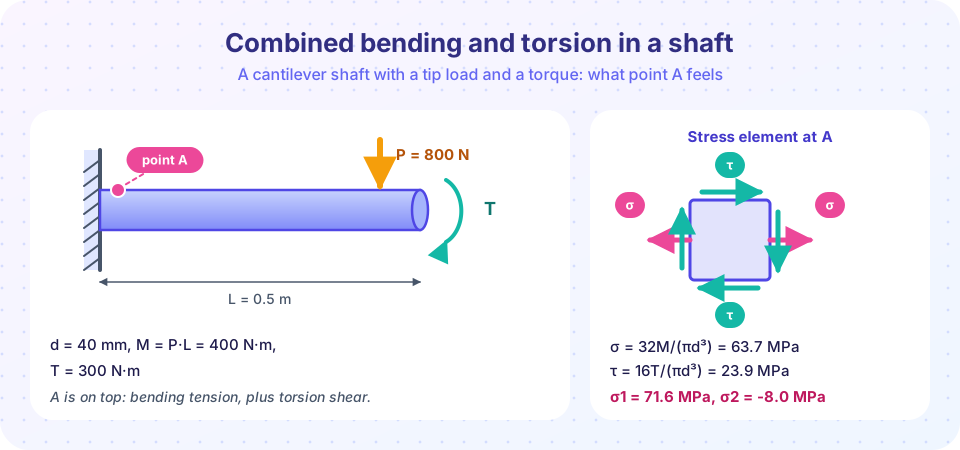
A solid shaft of diameter d = 40 mm carries M = 400 N·m and T = 300 N·m at the wall (the figure above). The section properties are I = π d⁴/64 and J = π d⁴/32, so the extreme-fiber stresses are
σ = M·c/I = 32·M/(π d³) = 32 × 400 000 / (π × 64 000) = 63.7 MPa
τ = T·c/J = 16·T/(π d³) = 16 × 300 000 / (π × 64 000) = 23.9 MPa
At the top surface of the shaft at the wall (point A), the element has a normal stress σ = 63.7 MPa along the axis and a shear stress τ = 23.9 MPa. The transverse shear stress V·Q/(I·b) from the tip load is zero at the top surface, so it does not matter at A. (At the neutral axis it is 4V/(3A) for a solid circle and could be added to the torsion shear there, but the surface point is the critical one.)
The principal stresses follow from the in-plane formulas you meet in the next lesson:
σ1,2 = σ/2 ± √((σ/2)² + τ²) = 31.8 ± 39.8 = 71.6 MPa and −8.0 MPa
τmax = √((σ/2)² + τ²) = 39.8 MPa
The combined state is worse than either load alone: the principal stress 71.6 MPa exceeds the bending stress 63.7 MPa, and the maximum shear stress 39.8 MPa is much larger than the torsion shear stress 23.9 MPa.
For shafts, designers often use an equivalent quantity, for example √(M² + T²) for the maximum shear criterion, so a single number captures the load severity. You will see why in Chapter 8.
When can I ignore transverse shear?
For slender beams (span at least 8 to 10 times the depth) the shear stress is tiny compared with bending stress, and at the extreme fibers it is zero anyway. Include shear when you look at points near the neutral axis, at thin webs, in short deep beams, and at the joints of built-up sections.
Common misconceptions
- "Just add all the stress numbers." Normal and shear stresses are different components; combine them with the stress-transformation formulas, not by adding.
- "Signs do not matter." Tension versus compression decides whether stresses help or cancel each other. Check each face.
- "The maximum bending stress is always the critical point." With torsion or axial force, the critical point can move, and the worst stress state may involve shear.
- "A compressive load cannot cause tension." An eccentric compressive load can, as the example shows.
Try it
An eccentric-load explorer: change e and see the stress on both faces of a 100 × 100 mm column. The cases e = 0, e = h/6 and e = 20 mm show compression only, the boundary, and tension appearing.
Press Run (or Ctrl + Enter) to see the result here.
Program input · what you'd type while the program runs
Type the answers before you press Run, one per line. Each time the program reads a line (with input()), it gets the next line from this box.
Now the same idea as a picture: the stress across the depth for several eccentricities.
Press Run (or Ctrl + Enter) to see the result here.
Program input · what you'd type while the program runs
Type the answers before you press Run, one per line. Each time the program reads a line (with input()), it gets the next line from this box.
Finally, the shaft calculator. It follows the recipe and prints each step; change d, M and T to see how the diameter affects everything (the stresses scale with 1/d³).
Press Run (or Ctrl + Enter) to see the console output here.
No output.
Check your understanding
Quick check · 4 questions
of 4 answered You scored / 4 · perfect!
-
1. A 100 × 100 mm column carries 50 kN compression at e = 30 mm. What is the stress on the far face?
M = 50 000 × 30 = 1.5 × 10⁶ N·mm and M/S = 1.5 × 10⁶ / 166.7 × 10³ = 9 MPa. The far face is −5 + 9 = +4 MPa, tension. -
2. For a rectangular section, the load stays in the middle third when e is at most...
Zero stress on the far face needs P/A = P e/S, so e = S/A = h/6. -
3. A shaft has σ = 60 MPa from bending and τ = 20 MPa from torsion at the same surface point. Which statement is right?
Normal and shear stresses are different components. The principal stresses come from σ/2 ± √((σ/2)² + τ²). -
4. Why is transverse shear usually ignored at the top surface of a shaft in bending?
At the outer surface there is no area beyond the cut, so Q and τ vanish.
Summary
- Superposition adds stresses from separate loads when the material is elastic and deformations are small.
- Combine normal stresses with normal stresses and shear stresses with shear stresses; choose the critical point first.
- An eccentric axial load equals the same load at the centroid plus a moment
M = P·e; keep it within the middle third to avoid tension. - A shaft in bending and torsion has
σ = 32M/(πd³)andτ = 16T/(πd³)at the surface; the principal stresses exceed either alone.
Track your progress
Create a free account to tick off lessons and pick up where you left off on any device.
of Strength of Materials lessons completed