


















Lesson 36 of 49 · Deflection and Buckling
Euler buckling of columns
Understand Euler column buckling: critical load, effective length factors, slenderness ratio, the Euler and Johnson curves, with worked steel column examples.
Press down on the end of a plastic ruler standing on a table. At first it just gets shorter, a little. Then suddenly it bows sideways and flips out of line, long before the plastic could be crushed. That sudden sideways collapse is buckling. It is a failure of stability, not of strength, and it is the main way that slender compression members fail: pillars, struts in trusses, piston rods, scaffolding poles, the legs of a table, and the thin web of a plate girder.
The first person to solve the problem was the Swiss mathematician Leonhard Euler, in 1744. His result is so clean that it is still the starting point for every column design.
What you will learn
- Where the Euler load
Pcr = π²EI/(K·L)²comes from and what it assumes. - How end conditions change the effective length
K·L. - How to compute the slenderness ratio and the critical stress.
- When Euler's formula applies, and what to do for short columns.
Key terms
- Critical load
Pcr: the compressive load at which a perfect column becomes unstable. - Effective length
K·L: the length of an equivalent pinned-pinned column. - Radius of gyration
r = √(I/A): a measure of how the area is spread about the axis. - Slenderness ratio
K·L/r: the single number that controls buckling.
Euler's idea
Imagine a perfectly straight, perfectly centered, pinned-pinned column under compression P. Suppose it is pushed slightly sideways by an amount v(x). The load now has a lever arm v and creates a moment M = −P·v at each section, so the elastic curve equation gives
EI · v″ = −P · v → v″ + (P/EI) v = 0
This equation has the solution v = A sin(kx) with k² = P/EI. The ends must stay in place, so v(L) = 0 and sin(kL) = 0, which requires kL = nπ. The smallest load that allows a bent shape is for n = 1:
Pcr = π² · E · I / L²
Below Pcr the straight column is stable: if you nudge it, it springs back. At Pcr the straight shape is only just stable and a bent shape is possible at the same load. Above it the column collapses sideways. Notice what is not in the formula: the strength of the material. Only E, I and L matter. A high-strength steel column of the same shape has the same Pcr as a mild-steel one.
The weak axis rules
I depends on the axis. A column buckles about the axis with the smallest I, so for a flat bar you always use Imin. This is the ruler example: it buckles in the direction of its thin dimension.
End conditions: effective length
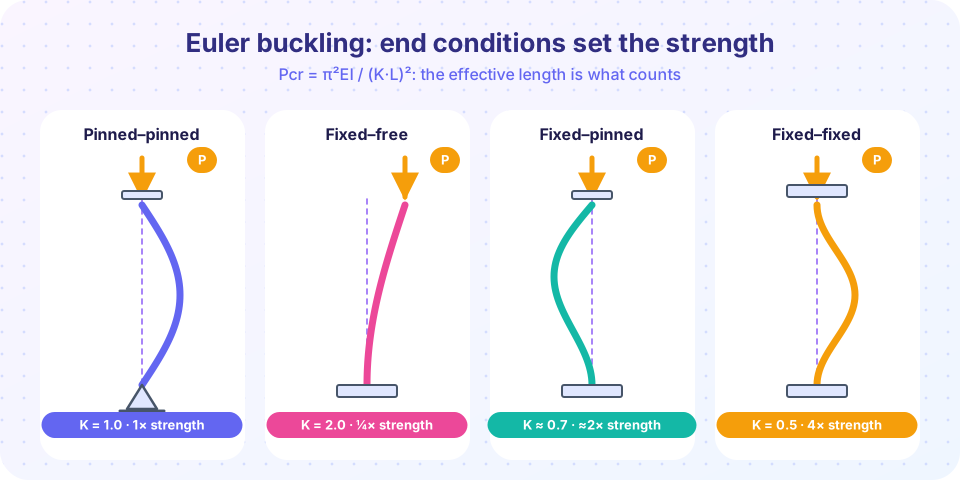
Replacing the pins by other supports changes the shape of the buckled curve. The easy way to remember the result is the effective length, the distance between inflection points of the buckled shape, expressed as K·L:
| Ends | K |
Strength relative to pinned-pinned |
|---|---|---|
| Pinned – pinned | 1.0 | 1 |
| Fixed – free (flagpole) | 2.0 | ¼ |
| Fixed – pinned | 0.7 (exactly 0.699) | about 2 |
| Fixed – fixed | 0.5 | 4 |
Then Pcr = π²EI/(K·L)² in every case. Real supports are never perfectly fixed or perfectly pinned, so design codes use somewhat more conservative values.
Slenderness and critical stress
Dividing Pcr by the area gives the critical stress. With I = A·r²:
σcr = Pcr / A = π² · E / (K·L/r)²
The slenderness ratio K·L/r is all that matters. Notice the figure: stress falls with the square of the slenderness. Since the formula assumes elastic behavior, it only applies when σcr is below the proportional limit or yield stress. For structural steel with E = 200 GPa and σy = 250 MPa, the boundary is
(K·L/r)_c = π · √(2E/σy) = π · √(2 × 200 000 / 250) = π × 40 ≈ 126
- Long columns (
K·L/rabove about 126): Euler's formula applies. - Intermediate columns: imperfections and residual stresses make real columns weaker than Euler's value predicts; design codes use empirical curves. One classic curve is the Johnson parabola,
σcr = σy − (σy²/(4π²E)) · (K·L/r)², which meets the Euler curve smoothly at the transition. For a steel column withK·L/r = 60it givesσcr = 250 − 28.5 = 221.5 MPa. - Short columns: they fail by yielding or crushing,
σ = σy.
Worked examples
A slender round rod. A steel rod (E = 200 GPa) of diameter 40 mm and length 3 m, pinned at both ends:
I = π d⁴/64 = 125.7 × 10³ mm⁴      A = 1257 mm²      r = d/4 = 10 mm
Pcr = π² × 200 000 × 125 700 / 3000² = 27.6 kN
σcr = 27 600 / 1257 = 22 MPa        K·L/r = 300
The critical stress is far below yield, so the formula is valid: this rod fails at 22 MPa even though steel can take over ten times more! If both ends were fixed, K = 0.5 and Pcr = 110 kN, four times larger.
A flat bar. A 20 × 60 mm bar, 1.5 m long, pinned: the weak axis has I = 60 × 20³/12 = 40 × 10³ mm⁴, so Pcr = π² × 200 000 × 40 000 / 1500² = 35.1 kN. Bending about the strong axis would have given nine times as much, but the bar chooses the weak way.
Design. The allowed load is Pcr / FS. With a factor of safety of 2.5 against buckling, the rod above may carry 27.6/2.5 = 11 kN.
Common misconceptions
- "A stronger steel makes a column stronger." In the Euler range
Pcrdepends onE, not on yield strength, andEis nearly the same for all steels. - "Buckling happens at the point of yielding." Slender columns buckle long before yielding. The stress at buckling can be a small fraction of the yield stress.
- "A column is stable if it carries less than Pcr by any margin." Real columns have imperfections (initial crookedness, load offset); the actual strength is lower than the ideal
Pcr, which is why safety factors are bigger for columns. - "Doubling the length halves the load." It cuts the load to a quarter, because
Pcr ∝ 1/L².
Try it
The first TryIt computes Pcr, the slenderness ratio and the critical stress for the round rod and the flat bar under each end condition. Change the numbers to explore.
Press Run (or Ctrl + Enter) to see the result here.
Program input · what you'd type while the program runs
Type the answers before you press Run, one per line. Each time the program reads a line (with input()), it gets the next line from this box.
The second TryIt draws the whole picture: Euler's hyperbola for slender columns, the Johnson parabola for intermediate ones and the yield cutoff for short ones.
Press Run (or Ctrl + Enter) to see the result here.
Program input · what you'd type while the program runs
Type the answers before you press Run, one per line. Each time the program reads a line (with input()), it gets the next line from this box.
Check your understanding
Quick check · 6 questions
of 6 answered You scored / 6 · perfect!
-
1. A pinned-pinned column has Pcr = 40 kN. What is Pcr if its length is doubled?
Pcr ∝ 1/L², so doubling L divides Pcr by 4: 40/4 = 10 kN. -
2. Which end condition gives the highest buckling load?
K = 0.5 for fixed–fixed gives Pcr = π²EI/(0.5L)², four times the pinned–pinned value. -
3. A rectangular bar 10 × 40 mm is used as a column. About which axis does it buckle?
It buckles about the axis with the smallest I, so Imin = 40 × 10³/12 = 3333 mm⁴. -
4. A flagpole-type column is fixed at the base and free at the top (K = 2). Compared with a pinned-pinned column of the same size, its buckling load is...
Pcr = π²EI/(2L)² = ¼ π²EI/L². -
5. Euler's formula for the critical load contains which material property?
Pcr = π²EI/(KL)² depends on E, not on strength. -
6. A steel column has slenderness KL/r = 100 and E = 200 GPa. What is the Euler critical stress?
σcr = π² E/(KL/r)² = 9.87 × 200 000 / 10 000 = 197 MPa. This is below the 250 MPa yield, but it is in the region where the Johnson curve gives a lower, more realistic value.
Summary
- A perfect column buckles at
Pcr = π²EI/(K·L)²: it depends on stiffnessEIand length, not on strength. - End conditions are captured by the effective length factor
K: 1 (pinned–pinned), 2 (fixed–free), about 0.7 (fixed–pinned), 0.5 (fixed–fixed). - The slenderness ratio
K·L/rcontrolsσcr = π²E/(K·L/r)²; Euler's formula applies above a transition (about 126 for 250 MPa steel). - Columns buckle about the weak axis and imperfections lower the real strength, so design uses safety factors and empirical curves for intermediate columns.
Next: Chapter 7 review
Track your progress
Create a free account to tick off lessons and pick up where you left off on any device.
of Strength of Materials lessons completed