


















Lesson 18 of 49 · Torsion
Torsion: The Big Picture
Preview chapter 4: how a torque twists a shaft, the three formulas for shear stress, angle of twist and power, and the lessons that follow.
A screwdriver, a car's drive shaft, a wind-turbine main shaft, a bolt being tightened and a key turning in a lock all carry torque, a moment about the axis of the member. Torque twists. A twisted member develops shear stress and rotates one end relative to the other, and the two questions of the chapter are the familiar ones: is the stress too high? and does it twist too much?
What you will learn
- What torsion does to a shaft.
- The three formulas of the chapter: shear stress, angle of twist and power.
- How the five lessons connect.
Key terms
Torque T: a moment about the longitudinal axis, in N·m or N·mm.
Angle of twist φ: the rotation of one end of a shaft relative to the other, in radians.
Polar moment of area J: a geometric property of a cross-section that measures its resistance to twist, in mm⁴.
Shear modulus G: the material's resistance to shear deformation, in GPa.
What torsion does
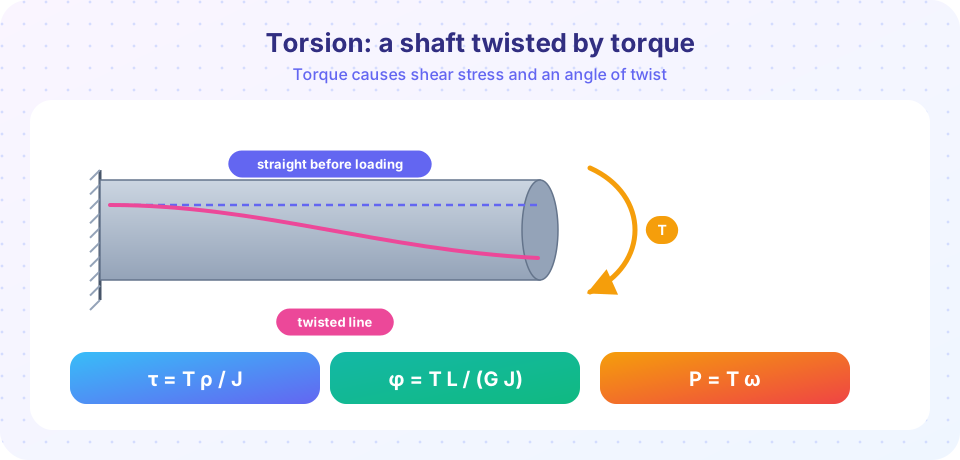
Hold one end of a rubber rod and twist the other. Straight lines drawn along its surface curl into spirals; circular cross-sections stay flat and circular, simply rotating relative to each other. Every thin ring inside the rod is being sheared, with the shear strain greatest at the surface and zero at the centre. This is the key picture of the chapter.
The three formulas
- Stress:
τ = T ρ / J, whereρis the distance from the axis. The maximum is at the surface,τ_max = T R / J. - Twist:
φ = T L / (G J), the angular counterpart ofδ = P L / (A E). - Power:
P = T ω, the link between torque, speed and the power a shaft transmits.
Notice the parallel with axial loading: T plays the role of P, φ of δ, G of E and J of A. You already know the methods; here they are applied to rotation.
The chapter at a glance
Torsion of circular shafts
Twist and power
Harder cases
What each lesson covers
- The Torsion Formula for Circular Shafts: the assumptions, the stress distribution, solid and hollow shafts and shaft sizing.
- Angle of Twist and Power Transmission:
φ = T L / (G J), rpm to rad/s and shaft design for a motor. - Indeterminate Shafts and Thin-Walled Tubes: fixed-fixed shafts and closed thin sections.
- Chapter 4 Review: the summary sheet and a mixed quiz.
Try it
Press Run (or Ctrl + Enter) to see the result here.
Program input · what you'd type while the program runs
Type the answers before you press Run, one per line. Each time the program reads a line (with input()), it gets the next line from this box.
Common misconceptions
"Torque and force are the same kind of quantity." Torque is a moment: force times distance, N·m. It twists rather than pulls.
"The centre of a shaft carries the most stress." In torsion the shear stress is zero on the axis and largest at the outer surface, so hollow shafts waste less material than solid ones.
Check your understanding
Quick check · 4 questions
of 4 answered You scored / 4 · perfect!
-
1. Which formula gives the shear stress in a circular shaft at distance ρ from the axis?
The torsion formula is τ = T ρ / J. -
2. Where is the shear stress zero in a solid twisted circular shaft?
Shear strain grows linearly with distance from the axis, so it is zero at the centre. -
3. In the axial-torsion analogy, which pair corresponds?
T plays the role of P; φ of δ, G of E and J of A. -
4. What does P = T ω give?
Power is torque times angular speed in rad/s.
Summary
- Torque twists a shaft, causing shear stress that grows linearly from the axis.
- Three formulas drive the chapter:
τ = T ρ / J,φ = T L / (G J)andP = T ω. - There is a direct analogy with axial loading: T, φ, G, J replace P, δ, E, A.
- Later lessons add indeterminate shafts and thin-walled tubes.
Track your progress
Create a free account to tick off lessons and pick up where you left off on any device.
of Strength of Materials lessons completed