


















Lesson 32 of 49 · Shear and Combined Loading
Chapter 6 review: shear and combined loading
Review transverse shear stress, shear flow, combined loads and Mohr's circle with a recap table, a plane-stress calculator and a nine-question quiz.
This chapter moved you from single loads to the real situation: several loads act together and the stress at a point must be rebuilt, rotated and compared with a limit. Here is the whole chapter on one page.
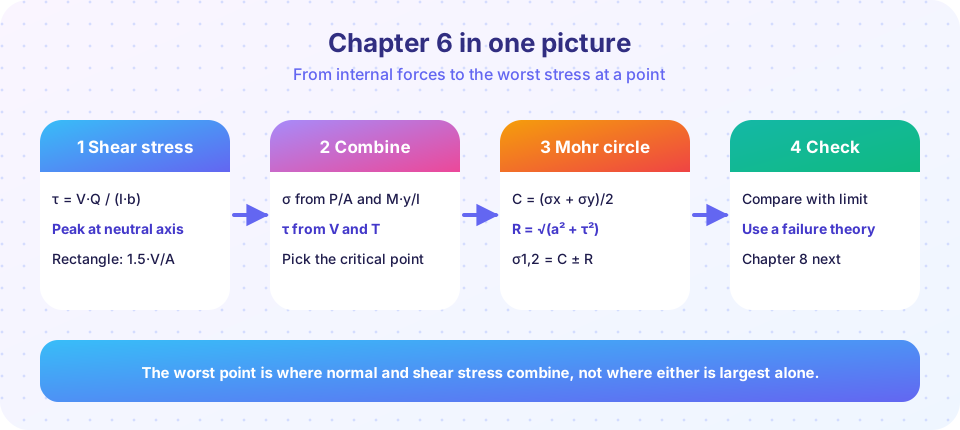
Recap table
| Topic | Key result | Watch for |
|---|---|---|
| Transverse shear | τ = V·Q/(I·b) |
b is the width at the level you examine |
| Rectangle | τmax = 1.5·V/A at the neutral axis |
Zero at the top and bottom faces |
| I-section | Web carries most of V |
τ ≈ V/(web area) |
| Shear flow | q = V·Q/I, spacing s = F/q |
Q for the area on one side of the joint |
| Superposition | Add stresses at a point | Normal with normal, shear with shear |
| Eccentric load | M = P·e; no tension if e ≤ h/6 |
Middle-third rule |
| Shaft | σ = 32M/(πd³), τ = 16T/(πd³) |
Critical point is on the surface |
| Principal stresses | σ1,2 = C ± R |
R = τmax in the plane |
| Mohr's circle | Rotation θ moves a point by 2θ |
Absolute τmax includes σ3 = 0 |
Try it
This plane-stress calculator takes any σx, σy, τxy, finds the principal stresses and angles, the maximum in-plane shear and the absolute maximum shear. Try a pure shear state (σx = σy = 0, τxy = 40) and a uniaxial state.
Press Run (or Ctrl + Enter) to see the result here.
Program input · what you'd type while the program runs
Type the answers before you press Run, one per line. Each time the program reads a line (with input()), it gets the next line from this box.
Second, the shear-versus-bending check for a short beam: when does shear stress start to matter? For a simply supported rectangular beam with a center load, the ratio of bending stress to shear stress depends only on the span-to-depth ratio. The plot shows it.
Press Run (or Ctrl + Enter) to see the result here.
Program input · what you'd type while the program runs
Type the answers before you press Run, one per line. Each time the program reads a line (with input()), it gets the next line from this box.
For a rectangular beam with a center load the ratio is σmax/τmax = 2L/h, so for a slender beam (L/h = 10) bending stress is about twenty times the shear stress.
Check your understanding
Quick check · 9 questions
of 9 answered You scored / 9 · perfect!
-
1. A rectangular beam has V = 24 kN and A = 24 000 mm². What is τmax?
τmax = 1.5 V/A = 1.5 × 24 000 / 24 000 = 1.5 MPa. -
2. At a nailed joint, V = 6 kN, Q = 100 × 10³ mm³ and I = 10 × 10⁶ mm⁴. What is the shear flow?
q = VQ/I = 6000 × 100 000 / 10 × 10⁶ = 60 N/mm. -
3. With that shear flow, each nail carries 900 N. What spacing is needed?
s = F/q = 900/60 = 15 mm. -
4. For σx = 40, σy = −40, τxy = 30 MPa, what is σ1?
C = 0 and R = √(40² + 30²) = 50, so σ1 = +50 MPa and σ2 = −50 MPa. -
5. A rectangular column has h = 240 mm. The load must stay within the middle third. What is the largest eccentricity?
e ≤ h/6 = 240/6 = 40 mm. -
6. Rotating the element by 20° rotates the point on Mohr's circle by...
The circle angle is twice the element angle. -
7. Four planks are glued into one beam. Compared with the loose planks, the stiffness (I) is multiplied by...
Glued I = b(4t)³/12 = 64 bt³/12 against 4 bt³/12 for the loose stack: a ratio of 16 = n². -
8. Which statement about shear stress in a rectangular beam is correct?
At the free faces Q = 0, so τ = 0. The maximum is at the neutral axis. -
9. The principal stresses of a plane stress state are σ1 = 100 and σ2 = 40 MPa. What is the absolute maximum shear stress?
Both are positive, so σ3 = 0 is the smallest: τabs = (100 − 0)/2 = 50 MPa.
Summary
- Beams carry shear stress
τ = V·Q/(I·b): parabolic in a rectangle (peak1.5·V/A), almost uniform in an I-beam web. - Shear flow
q = V·Q/Isizes fasteners and glue lines. - Superposition combines axial, bending, shear and torsion stresses at the critical point; eccentric loads add
M = P·e. - Principal stresses and
τmaxcome fromC ± Rand Mohr's circle; shear is zero on principal planes. - Always include
σ3 = 0for the absolute maximum shear stress.
Track your progress
Create a free account to tick off lessons and pick up where you left off on any device.
of Strength of Materials lessons completed