


















Lesson 16 of 49 · Axial Loading
Stress Concentrations: Holes, Notches and Fillets
Learn why holes and sharp corners raise local stress, how to use the stress concentration factor Kt with net-section stress, and design habits that reduce stress peaks.
The formula σ = P / A assumes the force flows smoothly through the bar. That is true far from any hole, notch or sudden change in shape. Near such features the force lines crowd together like traffic squeezing past a roadworks barrier, and the local stress rises well above the average. This is a stress concentration, and it is behind many real failures: the square windows of the 1950s Comet airliners, cracks starting at keyways and sharp fillets in shafts, and fatigue breaks at bolt holes.
What you will learn
- What stress concentration is and why it happens.
- The stress concentration factor
Ktand the nominal stress. - A worked example for a plate with a central hole.
- Why it matters more for brittle and fatigue-loaded parts than for ductile static loading.
- Design habits that reduce it.
Key terms
Stress concentration: a local rise in stress at a hole, notch, fillet or other discontinuity.
Nominal stress σ_nom: the stress calculated by the simple formula on the relevant section (often the net section).
Stress concentration factor Kt: the ratio σ_max / σ_nom.
Net section: the cross-section that remains after removing the hole.
Why it happens
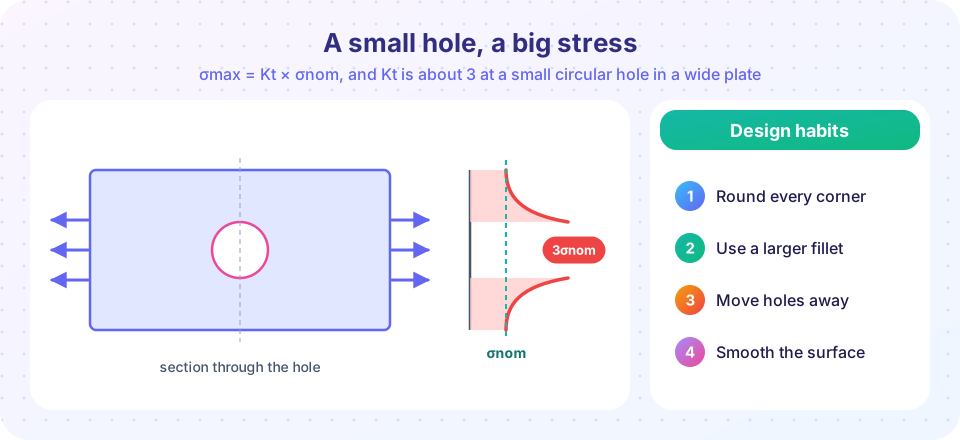
Imagine the force as streams of "flow lines" through a plate. A hole forces the lines to detour around it. Next to the hole they are squeezed together, which means higher stress there; away from the hole, they spread out again. The peak occurs at the edge of the hole on the line perpendicular to the load, and its size depends on the shape of the discontinuity, not its absolute size: a sharper corner or a thinner ellipse gives a higher peak.
The factor Kt
σ_max = Kt × σ_nom
The value of Kt depends on the geometry only (for linear elastic behaviour). It comes from theory, finite-element analysis or experiments, and is tabulated in handbooks such as Peterson's Stress Concentration Factors. For an infinitely wide plate with a small circular hole, the theory (Kirsch, 1898) gives exactly Kt = 3.
For a finite plate of width w with a central hole of diameter d, with the nominal stress based on the net section σ_nom = P / ((w − d) t), a commonly used curve fit to the published chart values is
Kt ≈ 3.00 − 3.14 (d/w) + 3.667 (d/w)² − 1.527 (d/w)³
so for a very small hole Kt tends to 3, as it should. Treat this as an engineering estimate and consult a handbook for important designs.
Example: a plate with a hole
A plate 100 mm wide and 10 mm thick has a central hole of 20 mm diameter, and is pulled by P = 40 kN.
- Net area:
(100 − 20) × 10 = 800 mm². - Nominal (net) stress:
σ_nom = 40 000 / 800 = 50 MPa. d / w = 0.2, soKt ≈ 3.00 − 0.628 + 0.147 − 0.012 = 2.51.- Peak stress:
σ_max = 2.51 × 50 ≈ 125 MPa.
Without the correction you would have said "50 MPa, plenty of margin". With it, you know the local stress is 2.5 times higher. For a ductile steel under a single static load, the material at the hole yields locally, the stress redistributes, and the part usually still carries the load. For brittle materials and for fatigue (millions of small load cycles), the peak stress is the one that starts the crack, and Kt matters directly.
Notches and fillets
Any abrupt change creates a concentration: a keyway, a groove for a retaining ring, a thread root, a step in a shaft. At a stepped bar, the factor depends on the ratio of diameters and on the fillet radius r: the smaller the radius, the higher Kt. Typical values range from about 1.5 for a generous fillet to 3 and beyond for a sharp inside corner. The most effective remedy is cheap: make the radius larger.
Design habits
- Round every corner. Use the largest fillet that fits.
- Use a gentle transition. Taper rather than step.
- Keep holes away from high-stress regions and from edges and one another.
- Smooth the surface. Scratches and tool marks are tiny notches. Polishing raises fatigue life.
Press Run (or Ctrl + Enter) to see the result here.
Program input · what you'd type while the program runs
Type the answers before you press Run, one per line. Each time the program reads a line (with input()), it gets the next line from this box.
Common misconceptions
"A small hole is harmless." Kt for a small circular hole in a wide plate is 3 regardless of how small the hole is. Size changes the volume affected, not the peak ratio.
"Stress concentration reduces the strength of every part equally." Ductile materials under a single static load tolerate it because of local yielding. Brittle materials and fatigue-loaded parts do not.
"A hole should be moved to the centre of the plate." The central position is not automatically best; what matters is the distance from edges and other features, and the local stress field.
Check your understanding
Quick check · 5 questions
of 5 answered You scored / 5 · perfect!
-
1. What is the stress concentration factor Kt?
Kt is the ratio of the peak local stress to the nominal stress. -
2. For an infinitely wide plate with a small circular hole in tension, Kt equals…
Kirsch's classical solution gives exactly 3. -
3. A plate (w = 100 mm, t = 10 mm, d = 20 mm) carries 40 kN. The net-section nominal stress is…
σ_nom = 40 000 / ((100 − 20) × 10) = 50 MPa. -
4. Which cure reduces stress concentration at a shoulder in a shaft?
A generous radius lets the force lines turn gently. -
5. Where does stress concentration matter most?
Cracks start at the highest local stress; ductile static parts relieve it by yielding.
Summary
- Holes, notches and shoulders raise the local stress:
σ_max = Kt σ_nom. - A small circular hole in a wide plate has
Kt = 3; use the net section for the nominal stress. - It matters most for brittle materials and fatigue.
- Round corners, taper transitions, keep holes away from edges and smooth surfaces.
Next: Chapter 3 Review
Track your progress
Create a free account to tick off lessons and pick up where you left off on any device.
of Strength of Materials lessons completed