


















Lesson 3 of 49 · Getting Started
Internal Forces and the Method of Sections
Learn how to cut a member in your mind and find the internal axial force, shear force, bending moment and torque from equilibrium, with worked beam and bar examples.
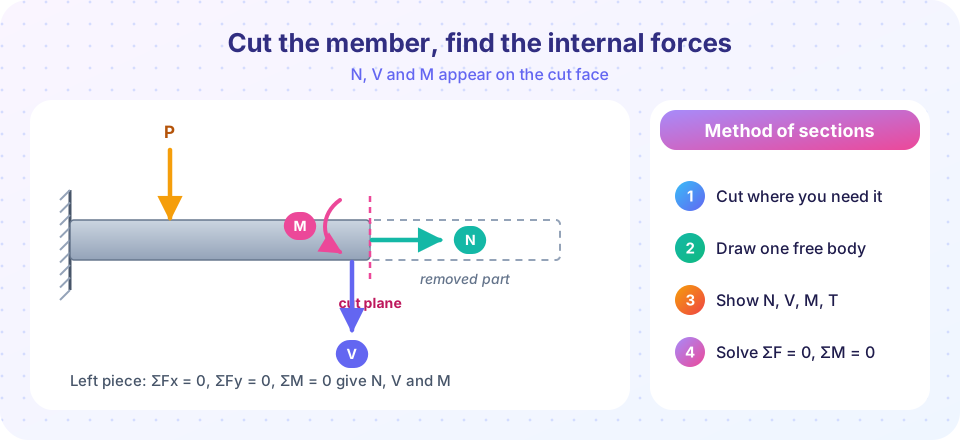
Supports and loads are the outside of the story. Strength depends on what happens inside the material: how much force each cross-section must transmit. The way to expose these hidden forces is the method of sections: cut the member with an imaginary plane, throw one piece away, and replace it by the forces it exerted on the piece you keep. Because the kept piece is still in equilibrium, those internal forces follow from ΣF = 0 and ΣM = 0.
What you will learn
- The four internal resultants in a plane problem: N, V, M, and T for shafts.
- The sign conventions used in this course.
- How to find them with the method of sections.
- Why you should pick the simpler piece of the cut member.
Key terms
Axial (normal) force N: the internal force along the member axis; positive when it pulls (tension).
Shear force V: the internal force across the member axis, trying to slide one side past the other.
Bending moment M: the internal moment about an axis in the cross-section, trying to bend the member.
Torque T: the internal moment about the member axis, trying to twist it.
The four internal resultants
Imagine cutting a beam at a section. The two pieces touch along the cut face, and each pushes on the other with a distribution of tiny forces. Adding up that distribution gives, at the centre of the face, up to four resultants.
- N acts along the axis.
- V acts in the plane of the cut face, perpendicular to the axis.
- M is a moment about an axis in the cross-section (it bends the member).
- T is a moment about the member axis (it twists it).
Newton's third law says the forces on the two cut faces are equal and opposite. So the same N, V, M exist on both sides, drawn in opposite directions.
Sign conventions
Signs are conventions, and any consistent set works. In this course:
- N is positive in tension (the cut face is pulled away from the material).
- V is positive when it tends to rotate the piece you are looking at clockwise. On the right face of a left piece it points down.
- M is positive when it makes the beam sag (curve like a smile), compressing the top fibres.
If your answer comes out negative, the real direction is opposite to the one you drew. That is information, not an error.
The recipe
- Find the support reactions on the whole member first, unless one piece has no support.
- Cut at the section of interest. Choose the piece with fewer loads and, ideally, no unknown reactions.
- Draw that piece's free-body diagram with all external loads and N, V, M (and T) on the cut face.
- Write
ΣFx = 0for N,ΣFy = 0for V, andΣM = 0about the cut section's centre for M.
The moment equation should be taken about the cut section. That keeps N and V out of it, because both pass through the point.
Example 1: a bar under several axial loads
A bar runs from a wall at A through B and C to a free end D. Loads of 20 kN, 30 kN and 50 kN pull away from the wall at B, C and D.
- Cut between C and D: the free-end piece carries only the 50 kN, so
N = +50 kN. - Cut between B and C: the piece to the right carries 30 + 50, so
N = +80 kN. - Cut between A and B: the piece to the right carries 20 + 30 + 50, so
N = +100 kN.
Choosing the piece away from the wall means you never need the wall reaction. Plotting N along the bar gives the axial force diagram you saw in the chapter 3 preview.
Example 2: shear and moment in a beam
Take the 6 m beam from the previous lesson: pin A at 0 m, roller B at 6 m, a 10 kN load at 2 m, and a 4 kN/m load from 3 m to 5 m. The reactions were Ay = 9.333 kN and By = 8.667 kN. Cut at x = 4 m and keep the left piece.
On the left piece act: Ay up, P = 10 kN down at 2 m, and the part of the uniform load between 3 m and 4 m, which is 4 × 1 = 4 kN down at 3.5 m.
ΣFy = 0:9.333 − 10 − 4 − V = 0, so with our conventionV = −4.667 kN.ΣMabout the cut:M = 9.333 × 4 − 10 × 2 − 4 × 0.5 = 15.333 kN·m.
Now check with the right piece: By = 8.667 kN up at 2 m from the cut and the remaining 4 kN of the uniform load (from 4 m to 5 m) at 0.5 m from the cut: M = 8.667 × 2 − 4 × 0.5 = 15.333 kN·m. Same answer. Always check with the other piece when it is cheap.
Press Run (or Ctrl + Enter) to see the result here.
Program input · what you'd type while the program runs
Type the answers before you press Run, one per line. Each time the program reads a line (with input()), it gets the next line from this box.
Common misconceptions
"Internal forces are the same everywhere in a member." They change with position. The N diagram of a bar steps at every load, and the moment in a beam usually varies continuously.
"The method of sections needs the support reactions." Not if you keep the piece that has no support. For a cantilever, cut and keep the free end and the wall reaction is never needed.
"Shear force is the same as the load." It is the net transverse force on one side of the cut, which includes reactions as well as loads.
Check your understanding
Quick check · 4 questions
of 4 answered You scored / 4 · perfect!
-
1. A bar has loads of 20, 30 and 50 kN pulling away from a wall at points B, C and D. What is N between the wall and B?
The piece beyond the cut carries all three loads: 20 + 30 + 50 = 100 kN, in tension. -
2. At which point should you take moments to find M at a cut section?
Moments about the cut section remove N and V from the equation, because both act through that point. -
3. In the worked example, what is V at x = 4 m by the convention used here?
V = 9.333 − 10 − 4 = −4.667 kN. The negative sign shows it points opposite to the assumed positive direction. -
4. Which internal resultant tries to twist a shaft?
Torque T is the internal moment about the member axis.
Summary
- Cutting a member exposes internal N, V, M and T, found from equilibrium of the kept piece.
- N is positive in tension; M is positive when it makes a beam sag.
- Choose the simpler piece, take moments about the cut, and check with the other piece.
- Plotting N, V or M against position gives the diagrams that locate the critical sections.
Track your progress
Create a free account to tick off lessons and pick up where you left off on any device.
of Strength of Materials lessons completed