


















Lesson 47 of 49 · Projects and Practice
Glossary of strength of materials
A–Z glossary of strength of materials terms such as stress, strain, section modulus, neutral axis, buckling and von Mises, with a concept map and flashcards.
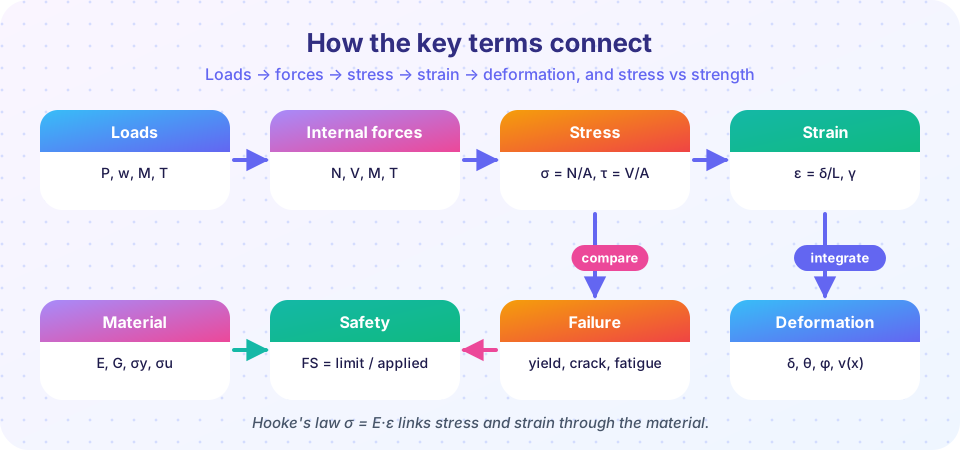
Every field has its own language, and mechanics of materials has a lot of it. This glossary collects the terms of the whole course in alphabetical order, with a one-line definition for each and the symbol you will usually see. Use the concept map to see how the ideas connect, and the flashcards to test yourself.
What you will learn
- The precise meaning of the main terms, and the symbols that go with them.
- Which terms are easily confused (stress and strain, moment and second moment,
σandτ). - How the terms connect in a single chain of reasoning.
Reading the table
Symbols are the ones used in this course. Units are given in the N–mm–MPa system. When two terms look alike, such as bending moment and moment of inertia, read both entries.
Terms A to Z
| Term | Meaning |
|---|---|
Allowable stress (σallow) |
The largest stress permitted in design, the failure strength divided by the factor of safety |
| Axial load | A force acting along the axis of a member, causing tension or compression |
Bearing stress (σb) |
Compressive contact stress between two bodies, such as a pin and the wall of its hole: F/(d·t) |
Bending moment (M) |
The internal moment at a cross-section that resists bending of a beam |
| Brittle | Fracturing with little plastic strain and little warning |
| Buckling | Sudden sideways instability of a slender member under compression |
| Cantilever | A beam fixed at one end and free at the other |
| Centroid | The geometric center of an area; the neutral axis passes through it |
| Creep | Slow, time-dependent deformation under constant load, most important at high temperature |
Critical load (Pcr) |
The compressive load at which a perfect column buckles |
| Ductile | Able to deform plastically a lot before fracturing, giving warning |
| Elastic | Returning to the original shape when the load is removed |
Endurance limit (Se) |
The stress amplitude below which a material (notably steel) can survive a very large number of cycles |
Factor of safety (FS, n) |
The ratio of strength to the applied load or stress; a margin for uncertainty |
| Fatigue | Failure caused by repeated loading at stresses below the static strength |
Flexural rigidity (EI) |
The product of modulus and second moment of area; resistance to bending deflection |
| Hooke's law | In the elastic range stress is proportional to strain: σ = E·ε |
Modulus of elasticity (E) |
Young's modulus, the slope of the elastic part of the stress-strain curve |
| Neutral axis | The line in a bent section where the bending stress and strain are zero |
Normal stress (σ) |
Stress perpendicular to the surface: force per unit area |
Poisson's ratio (ν) |
The ratio of lateral to axial strain magnitude, about 0.3 for steel |
Principal stresses (σ1, σ2) |
The maximum and minimum normal stresses, acting on planes with no shear stress |
Radius of gyration (r) |
√(I/A); used with the slenderness ratio for columns |
Second moment of area (I) |
∫y² dA; the shape property that controls bending stiffness and strength |
Section modulus (S) |
I/c; the maximum bending stress is M/S |
Shear flow (q) |
Shear force per unit length along a joint: V·Q/I |
Shear force (V) |
The internal force along a cut, perpendicular to the beam axis |
Shear modulus (G) |
The ratio of shear stress to shear strain, τ = G·γ |
Shear stress (τ) |
Stress parallel to the surface |
Slenderness ratio (KL/r) |
The number that controls buckling: larger means more slender |
Strain (ε) |
Deformation per unit length, δ/L, with no units |
| Stress | Internal force per unit area, in MPa (N/mm²) |
Stress concentration (Kt) |
The factor by which a hole, notch or fillet raises the local stress |
| Superposition | Adding the effects of separate loads, valid for linear, small-deflection problems |
Torque (T) |
A twisting moment about the axis of a shaft |
| Tresca criterion | Yielding begins when the maximum shear stress reaches σy/2 |
Ultimate strength (σu) |
The maximum engineering stress on the stress-strain curve |
| Von Mises criterion | Yielding begins when √(σ1² − σ1σ2 + σ2²) reaches σy (plane stress) |
Yield strength (σy) |
The stress at which permanent deformation begins |
Easily confused pairs
- Bending moment
Mand second moment of areaI.Mis a load effect (N·mm);Iis a shape property (mm⁴). - Stress and pressure. Both have the units of force per area, but pressure acts on the outside of a body and is always compressive, while stress is the internal reaction and can be tension, compression or shear.
- Strength and stiffness. Strength is how much stress a material can take (
σy,σu); stiffness is how much it deforms (E). A steel and an aluminum beam of the same shape have similar yield-to-weight ratios but very different stiffness. - Yield strength and ultimate strength. Yield is the beginning of permanent deformation; ultimate is the peak of the engineering curve. Design usually uses yield.
- Failure and breakage. A part has failed when it can no longer do its job, which may be long before it breaks.
Try it
These flashcards show a definition; try to name the term and press the button to reveal it.
Check your understanding
Quick check · 4 questions
of 4 answered You scored / 4 · perfect!
-
1. Which term describes a shape property with units of mm⁴?
I = ∫y² dA has units of length to the fourth power. Section modulus is mm³ and bending moment is N·mm. -
2. What does a Poisson's ratio of 0.3 mean?
ν = −ε_lateral/ε_axial; for steel it is about 0.3. -
3. Which pair are both load effects (internal forces) rather than shape properties?
Shear force V and bending moment M are internal forces; I, S, A and r describe the section. -
4. A material that fractures with little warning and almost no plastic deformation is...
That is the definition of brittle behavior.
Summary
- The glossary lists the terms of the course in alphabetical order, with symbols and units.
- Distinguish load effects (
N,V,M,T), section properties (A,I,S,r), material properties (E,G,ν,σy,σu) and responses (σ,τ,ε,δ). - The concept map ties them together: loads, internal forces, stress, strain, deformation, failure and safety.
Next: Cheat sheet
Track your progress
Create a free account to tick off lessons and pick up where you left off on any device.
of Strength of Materials lessons completed