


















Lesson 45 of 49 · Projects and Practice
Project 2: design an A-frame bracket
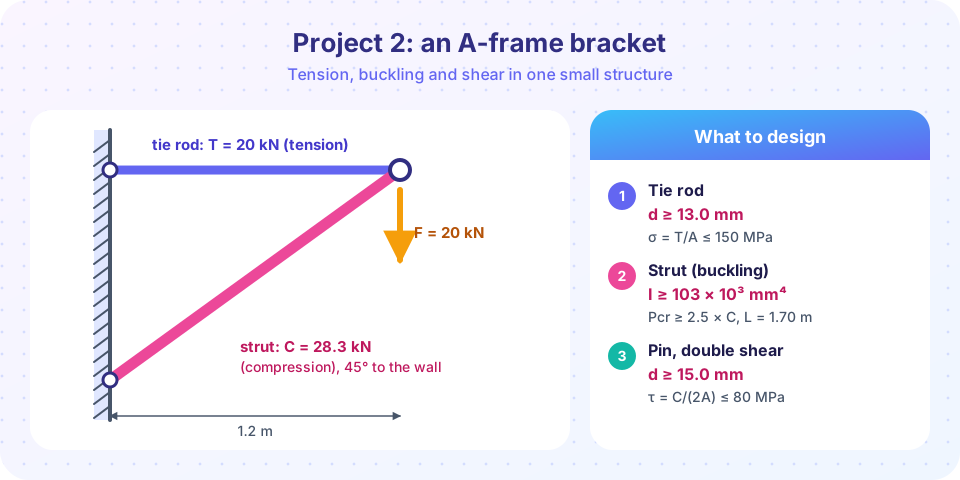
Design a wall bracket: find member forces by statics, size a tie rod for tension, a tube strut for buckling and a pin in double shear, then study the angle.
Hoists, signs, awnings and cranes all rest on a simple idea: a horizontal member pulls on the wall, an inclined member pushes against it, and together they carry a load hanging from the joint. Designing this bracket takes you through three different failure modes with three different formulas: tension in the rod, buckling in the strut and shear in the pin. It also shows how geometry, here the angle of the strut, changes every force in the structure.
What you will learn
- How to find member forces from joint equilibrium.
- How to size a tension rod from
σ = T/A, including a stiffness check. - How to choose a tube strut so that
Pcr/C ≥ FS. - How to size a pin in double shear and check bearing.
Key terms
- Two-force member: a member loaded only at its ends, so its force acts along its axis.
- Joint equilibrium:
ΣFx = 0,ΣFy = 0at a pin joint. - Double shear: a pin carrying load across two cut planes, so each resists half the force.
- Bearing stress: the compressive contact stress between a pin and the plate around it,
σb = F/(d·t).
The brief
A 20 kN vertical load hangs from a joint. A horizontal tie rod runs from the joint back to the wall, and an inclined strut runs from the joint down to the wall at 45° to the wall. The horizontal distance from the wall to the joint is 1.2 m, so the strut's vertical rise is also 1.2 m. Material: steel, E = 200 GPa, allowable tensile stress 150 MPa, allowable pin shear stress 80 MPa, allowable bearing stress 200 MPa. The strut needs a factor of safety of 2.5 against buckling, with pinned ends.
Step 1: member forces
At the joint three forces meet: the load F = 20 kN down, the tie pulling horizontally toward the wall (force T), and the strut pushing along its axis, up and away from the wall (force C, with components C·cos45° horizontally and C·sin45° vertically). Equilibrium:
vertical:    C · sin 45° = F      →   C = 20 / 0.7071 = 28.28 kN   (compression)
horizontal:  T = C · cos 45°      →   T = 20 kN                    (tension)
Members that carry a load only at their ends (two-force members) must carry it along their axis, so we can ignore bending in the tie and the strut.
Step 2: tie rod
A_required = T / σallow = 20 000 / 150 = 133.3 mm² → d = √(4A/π) = 13.0 mm
Choose a standard 14 mm rod (A = 153.9 mm²). Its stress is 20 000/153.9 = 130 MPa. Check the stretch with the axial deformation formula: δ = T·L/(A·E) = 20 000 × 1200 / (153.9 × 200 000) = 0.78 mm, small enough for most brackets.
Step 3: strut
The strut length is L = 1.2 / cos45° = 1.697 m. For a pinned-pinned strut with a factor of safety of 2.5:
Pcr ≥ 2.5 × 28.28 = 70.7 kN
I ≥ Pcr·L² / (π² E) = 70 710 × 1697² / (9.87 × 200 000) = 103 × 10³ mm⁴
A solid round bar would need d ≥ 38 mm. A tube is much better. Here are candidate tubes (the sizes are invented for the exercise). To avoid local buckling of a thin wall we use this simple rule for the course: D/t ≤ 25 (real codes give their own limits).
The program below computes I, area and the actual buckling factor for each candidate, and picks the lightest. For the chosen tube also check compression yielding: σ = C/A.
Step 4: pin
The pin connecting the strut end to the wall bracket is loaded across two shear planes, so each plane carries half of C:
τ = C / (2A_pin) ≤ 80 MPa → A_pin ≥ 28 280 / 160 = 176.8 mm² → d ≥ 15.0 mm
Choose a 16 mm pin (A = 201 mm², τ = 70 MPa). Then check bearing on each ear of the wall bracket, which carries C/2 = 14.14 kN over the area d × t:
t ≥ (C/2) / (d × σb,allow) = 14 140 / (16 × 200) = 4.4 mm → use a 6 mm plate
Common misconceptions
- "The strut is checked for crushing." A slender strut buckles long before the material crushes. Compare
σ = C/Awith yield, but let buckling govern. - "The tie and strut carry the same force." They carry different forces:
T = F/tanθandC = F/sinθ, whereθis the strut's angle with the horizontal. - "Pins only fail in shear." They can also fail in bearing, bending and tear-out of the plate. Check each.
- "A bigger factor of safety on one part is always safer." The structure is only as strong as its weakest part: aim for a consistent set of margins.
Try it
First, a calculator for all three parts with candidate tubes.
Press Run (or Ctrl + Enter) to see the result here.
Program input · what you'd type while the program runs
Type the answers before you press Run, one per line. Each time the program reads a line (with input()), it gets the next line from this box.
The second TryIt explores the geometry: how the forces and the required strut size change as the strut angle varies, with the span fixed.
Press Run (or Ctrl + Enter) to see the result here.
Program input · what you'd type while the program runs
Type the answers before you press Run, one per line. Each time the program reads a line (with input()), it gets the next line from this box.
Both forces fall steadily as the strut gets steeper. But with the horizontal span fixed, a steeper strut is also longer, and a longer strut buckles more easily, so the required moment of area has a shallow minimum near 35° (where tan θ = 1/√2). A steeper strut also takes more vertical room, so the geometry is a compromise.
Check your understanding
Quick check · 4 questions
of 4 answered You scored / 4 · perfect!
-
1. A 30 kN load hangs from the joint of a tie and a strut at 45° to the horizontal. What is the force in the tie?
T = F/tan 45° = 30 kN, and the strut force is C = F/sin 45° = 42.4 kN. -
2. A pin in double shear carries 40 kN. Its diameter is 20 mm (A = 314 mm²). What is the shear stress?
τ = F/(2A) = 40 000/628 = 63.7 MPa, because two cross-sections share the load. -
3. Why is a tube better than a solid bar for a strut of the same area?
Material far from the axis raises I, and Pcr is proportional to I. -
4. The strut angle with the horizontal is reduced from 45° to 30°. What happens to the strut force for the same load?
C = F/sinθ: 1/sin45° = 1.41 and 1/sin30° = 2.
Summary
- Joint equilibrium gives the member forces:
C = F/sinθ,T = F/tanθ. - Tie rod:
A ≥ T/σallow, plus a check of its elongationT·L/(A·E). - Strut:
Pcr = π²EI/L² ≥ FS · C; use tubes and limitD/tto avoid local buckling. - Pin in double shear:
τ = C/(2A); check bearingσb = (C/2)/(d·t)on each ear. - Geometry matters: a flatter strut means larger forces; with the span fixed, the required strut
Ihas a shallow minimum near 35°.
Track your progress
Create a free account to tick off lessons and pick up where you left off on any device.
of Strength of Materials lessons completed