


















Lesson 29 of 49 · Shear and Combined Loading
Transverse shear stress in beams: τ = VQ/(Ib)
Learn the shear formula τ = VQ/(Ib), find where beam shear stress peaks, and compute shear flow to space nails and glue lines in built-up beams.
A beam with a bending moment that changes along its length must also carry a shear force, and that shear force produces a shear stress on the cross-section. The formula that gives it, often called the Jourawski formula after the Russian engineer Dmitry Jourawski who published it in the 1850s, is as important as the flexure formula. It tells you where a beam is most likely to split along its grain, where a glue line works hardest, and how far apart to space nails in a built-up beam.
What you will learn
- How to use
τ = V·Q / (I·b)and whatQmeans. - Why the maximum shear stress of a rectangle is
1.5·V/A. - How to compute shear flow
q = V·Q/Iand size nail or glue spacing. - When shear stress governs, and when you may ignore it.
Key terms
- Shear force
V: the internal vertical force at the section, from the shear diagram. - First moment of area
Q:Q = A′·ȳ′, the area above (or below) the level you are looking at, times the distance of its centroid from the neutral axis. - Width
b: the width of the section at the level where you computeτ. - Shear flow
q: shear force per unit length along the beam,q = V·Q/I(N/mm).
Where the formula comes from
Cut a short piece of beam of length dx. Because the bending moment is M on one face and M + dM on the other, the bending stresses on the two faces differ a little. Imagine slicing off the top part of the piece, down to a level y₁. The difference in the horizontal forces on its two end faces must be balanced by a horizontal shear force along the cut face. Working it out with σ = M·y/I and dM = V·dx gives
τ = V · Q / (I · b)
Q = ∫ y dA  over the part of the section beyond the level (= A′ · ȳ′)
The shear stress on the horizontal cut equals the vertical shear stress on the cross-section at the same level (complementary shear, a pair of equal stresses on perpendicular planes).
The shape of the result follows from Q: at the top face there is no area beyond the cut, so Q = 0 and τ = 0. At the neutral axis, Q is largest, so usually τ is largest there too.
The rectangle
For a rectangle of width b and height h, the area above the neutral axis is b·h/2 with its centroid h/4 above the axis, so
Q_max = (b·h/2)(h/4) = b·h²/8
τ_max = V · (b h²/8) / ((b h³/12) · b) = 1.5 · V/(b·h) = 1.5 · V/A
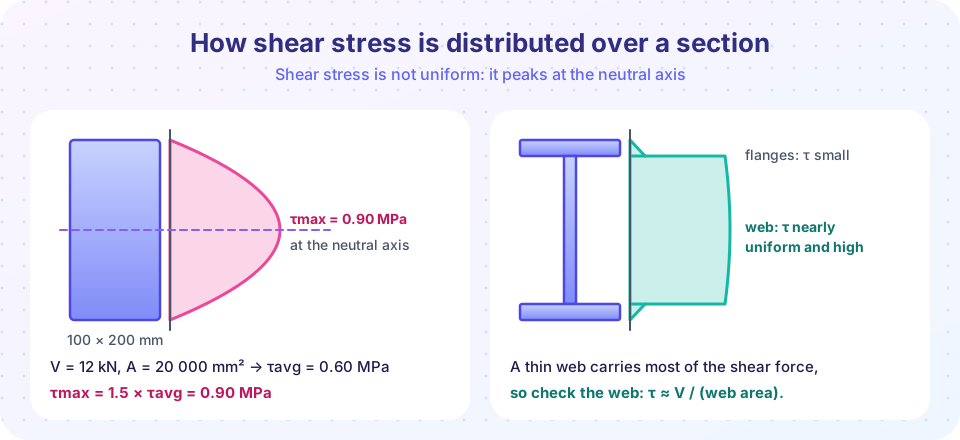
The peak is 50% above the average V/A. For a beam with V = 12 kN and a 100 × 200 mm section, τavg = 12 000/20 000 = 0.60 MPa and τmax = 0.90 MPa. Compare that with the bending stress of 36 MPa from the previous lessons: for a normal beam the shear stress is tiny. It only becomes important when the beam is short and deep, or when the material is weak in shear (timber along the grain, glue lines, a thin web).
At height y above the neutral axis, τ(y) = 1.5·(V/A)·(1 − (2y/h)²), a parabola.
I-sections and T-sections
For an I-beam, the flange is wide, so b is large there and τ is small. In the thin web, b is small and τ is large and nearly constant. The web carries most of the shear force (the figure shows this), and a quick design check is to divide V by the web area t_web·h.
Take the T-section from the last lesson (flange 120 × 20, web 20 × 100, centroid 82.7 mm above the bottom, I = 5.674 × 10⁶ mm⁴) with V = 12 kN. At the neutral axis, take the area below it: the web from 0 to 82.7 mm, so A′ = 20 × 82.7 = 1654 mm², ȳ′ = 41.4 mm, Q = 68.4 × 10³ mm³. With b = 20 mm:
τ = 12 000 × 68 400 / (5.674×10⁶ × 20) = 7.2 MPa
Notice that the stress is more than eight times that of the rectangle even though the load is the same: the web is thin.
Shear flow: glue lines and nails
In a built-up beam the layers are joined by fasteners. What the fastener row must carry is the shear flow, the shear force per unit length that crosses the joint:
q = V · Q / I (units: N/mm)
Here Q is the first moment of the area on one side of the joint, taken about the neutral axis of the whole section. Note that b has dropped out: the fasteners carry force no matter how wide the joint is.
Example. Three planks, each 100 mm wide and 40 mm thick, are stacked and nailed into a beam 100 mm × 120 mm. The shear force is V = 3 kN. At the upper joint the area above is one plank: A′ = 4000 mm², ȳ′ = 40 mm, so Q = 160 × 10³ mm³. I = 100 × 120³/12 = 14.4 × 10⁶ mm⁴. So
q = 3000 × 160 000 / 14.4×10⁶ = 33.3 N/mm
If one nail can carry 1000 N in shear, the spacing is s = F/q = 1000/33.3 = 30 mm. A nail every 30 mm along the beam, in each joint.
Common misconceptions
- "Shear stress is uniform,
V/A." It is zero at the free faces and peaks in the middle.V/Ais only an average. - "Shear stress is largest at the outer fibers, like bending stress." At the outer fibers it is zero. Bending and shear peak at different places, which is why combined stress needs care.
- "Use the width of the whole section for
b." Use the width at the level where you ask the question. Where the section narrows,bis small andτjumps. - "The formula applies to all shapes." It assumes a section that is fairly deep compared with its width and where
τis roughly uniform acrossb. For thin-walled open sections, such as channels, shear also twists the beam (shear center).
Try it
First, plot the parabolic shear stress through a 100 × 200 mm rectangle and check that the maximum is 1.5 V/A.
Press Run (or Ctrl + Enter) to see the result here.
Program input · what you'd type while the program runs
Type the answers before you press Run, one per line. Each time the program reads a line (with input()), it gets the next line from this box.
Second, a shear-flow calculator for a stack of equal planks. Change the number of planks, the shear force or the nail capacity and see the spacing.
Press Run (or Ctrl + Enter) to see the result here.
Program input · what you'd type while the program runs
Type the answers before you press Run, one per line. Each time the program reads a line (with input()), it gets the next line from this box.
You can verify joint 1: Q = 4000 × 40 = 160 × 10³ mm³, q = 33.3 N/mm, spacing 30 mm.
Check your understanding
Quick check · 5 questions
of 5 answered You scored / 5 · perfect!
-
1. A rectangular beam has V = 30 kN and A = 15 000 mm². What is the maximum shear stress?
τmax = 1.5 V/A = 1.5 × 30 000 / 15 000 = 3.0 MPa. -
2. Where is the transverse shear stress zero in a rectangular beam?
At the free faces Q = 0, so τ = 0 there. -
3. In the shear flow formula q = VQ/I, what does Q describe?
Q = A′·ȳ′ for the part of the section on one side of the joint. -
4. A joint has q = 25 N/mm. Each nail carries 750 N. What is the maximum spacing?
s = F/q = 750/25 = 30 mm. -
5. Why does the web of an I-beam carry most of the shear?
The flanges are wide, so τ there is small. The web is narrow, so τ is high.
Summary
τ = V·Q/(I·b);Qis the first moment of the area beyond the level of interest, about the neutral axis.- For a rectangle
τmax = 1.5·V/A, a parabola with zero stress at the faces. - In I-sections the web carries nearly all the shear, with roughly uniform
τ. - Shear flow
q = V·Q/Isizes nails, bolts, welds and glue lines in built-up beams:s = F/q. - Shear stress is usually small compared with bending stress, unless the beam is short and deep or the section is thin-webbed.
Track your progress
Create a free account to tick off lessons and pick up where you left off on any device.
of Strength of Materials lessons completed