


















Lesson 46 of 49 · Projects and Practice
Practice set: ten mixed problems
Ten mixed strength of materials problems on bending, shear, eccentric loads, Mohr's circle, von Mises, deflection, buckling and fatigue, with answers and a checker.
Reading about a method is not the same as being able to use it. This lesson gives you ten problems that mix the chapters of the second half of the course, plus a small answer checker. Try each problem with pencil and paper first, then compare. Use N, mm and MPa throughout, and take E = 200 GPa for steel unless the problem says otherwise.
What you will learn
- How to recognize which chapter's method a mixed problem needs.
- How to check a result against a sensible size.
- How to avoid the common slips: units, sign, wrong axis, wrong formula.
How to use this set
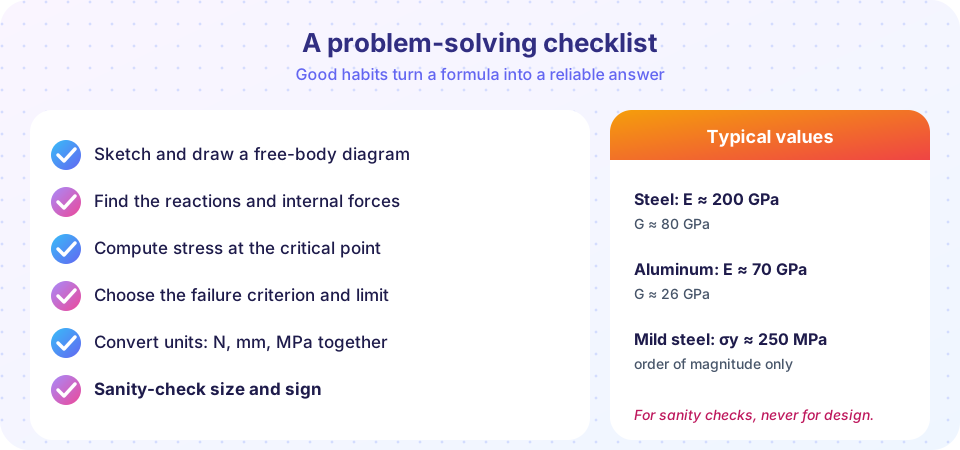
- Draw a sketch and a free-body diagram for every problem, even when it seems unnecessary.
- Write the formula first, then the numbers with units, then the answer.
- Round only at the end. Answers are given to three significant figures.
The problems
- Beam bending. A simply supported beam of span 4 m carries a uniform load of 15 kN/m. Its section is a rectangle 80 mm wide and 160 mm deep. Find the maximum bending stress.
- Cantilever. A cantilever 1.2 m long carries a 3 kN load at its free end. The section is a solid round bar of diameter 60 mm. Find the maximum bending stress at the wall.
- Shear in a rectangle. A rectangular beam 60 mm × 120 mm carries a shear force of 18 kN. Find the maximum shear stress.
- Shear in a T-section. The T-section of Chapter 5 (flange 120 × 20 mm, web 20 × 100 mm,
I = 5.674 × 10⁶ mm⁴, centroid 82.7 mm above the bottom) carriesV = 12 kN. Find the shear stress at the neutral axis, where the web width is 20 mm. - Eccentric load. A square column 120 mm × 120 mm carries a compressive load of 60 kN acting 15 mm from the centroid, along one axis. Find the stress on the two faces (negative for compression).
- Principal stresses. A plane stress state has
σx = 60,σy = −20,τxy = 40MPa. Findσ1,σ2, the maximum in-plane shear stress and the principal angleθp. - Von Mises. For the stress state of problem 6 and a steel with
σy = 250 MPa, find the von Mises equivalent stress and the factor of safety against yielding. - Deflection. An aluminum cantilever (
E = 70 GPa) of length 1.5 m withI = 8 × 10⁶ mm⁴carries a 2 kN load at its tip. Find the tip deflection. - Buckling. A solid round steel column of diameter 30 mm and length 1 m is pinned at both ends. Find the Euler critical load. What is it if both ends are fixed?
- Fatigue. A steel part has
σu = 600 MPaand a working endurance limitSe = 200 MPa. In service it sees a stress amplitudeσa = 90 MPaon top of a mean stressσm = 80 MPa. Find the factor of safety with the modified Goodman line.
Answers and key steps
Try to solve them yourself before reading on.
Mmax = wL²/8 = 15 × 16/8 = 30 kN·m;S = bh²/6 = 80 × 160²/6 = 341.3 × 10³ mm³;σ = 30 × 10⁶/341.3 × 10³ = 87.9 MPa.M = P·L = 3000 × 1200 = 3.6 × 10⁶ N·mm;σ = 32M/(πd³) = 32 × 3.6 × 10⁶/(π × 216 000) = 170 MPa.τmax = 1.5·V/A = 1.5 × 18 000/7200 = 3.75 MPa.Q = 20 × 82.7²/2 = 68.4 × 10³ mm³(the web below the neutral axis);τ = VQ/(Ib) = 12 000 × 68.4 × 10³/(5.674 × 10⁶ × 20) = 7.24 MPa.A = 14 400 mm², soP/A = 4.17 MPa;M = 60 000 × 15 = 0.9 × 10⁶ N·mm;S = 120³/6 = 288 × 10³ mm³givesM/S = 3.13 MPa. Near face−7.29 MPa, far face−1.04 MPa. Both are compressive becausee = 15 mmis less thanh/6 = 20 mm.C = 20 MPa,R = √(40² + 40²) = 56.6 MPa:σ1 = 76.6 MPa,σ2 = −36.6 MPa,τmax = 56.6 MPa,tan 2θp = 2 × 40/80 = 1, soθp = 22.5°.σe = √(σx² − σxσy + σy² + 3τxy²) = √(3600 + 1200 + 400 + 4800) = √10 000 = 100 MPa;n = 250/100 = 2.5.δ = PL³/(3EI) = 2000 × 1500³/(3 × 70 000 × 8 × 10⁶) = 4.02 mm.I = π × 30⁴/64 = 39.76 × 10³ mm⁴;Pcr = π²EI/L² = 9.87 × 200 000 × 39 760/1000² = 78.5 kN; with fixed ends (K = 0.5) it is four times larger,314 kN.σa/Se + σm/σu = 90/200 + 80/600 = 0.45 + 0.133 = 0.583, son = 1/0.583 = 1.71.
Common mistakes to look for in your own work
- Units. Mixing kN·m with mm⁴ (problems 1, 2, 5) gives answers wrong by a factor of 1000.
- Wrong axis. In problem 9 a round section has the same
Iabout every axis, but a rectangle does not: use the smaller one. - Missing
σ3 = 0. In Tresca checks of plane stress, always include the zero stress in the third direction. - Using the full width in
τ = VQ/(Ib). Use the width where you evaluate the stress (problem 4). - Forgetting that shear is shared in double shear. Each plane carries half the force.
Try it
The answer checker below has ten input boxes. Type your answers (in the units shown) and press Check. A result within 2% counts as correct.
The second TryIt solves all ten problems with code, so you can see where each number comes from and rerun them with your own data.
Press Run (or Ctrl + Enter) to see the result here.
Program input · what you'd type while the program runs
Type the answers before you press Run, one per line. Each time the program reads a line (with input()), it gets the next line from this box.
Check your understanding
Quick check · 4 questions
of 4 answered You scored / 4 · perfect!
-
1. In problem 5, why are both faces in compression?
The bending stress (3.13 MPa) is smaller than the axial stress (4.17 MPa), so no tension appears. -
2. Problem 8 uses aluminum. If steel (E = 200 GPa) were used instead, the tip deflection would be...
Deflection scales with 1/E: 4.02 × 70/200 = 1.41 mm. -
3. Which problem number needs the radius of the section only through I = πd⁴/64 and the formula Pcr = π²EI/L²?
Problem 9, Euler buckling of a round column. -
4. A student gets 87 900 MPa in problem 1. What is the most likely mistake?
A factor of 1000 almost always means a unit slip.
Summary
- Mixed problems test whether you can choose the right method: bending, shear, combined loads, Mohr's circle, a failure criterion, deflection, buckling or fatigue.
- Work in N, mm, MPa; draw a sketch; write the formula before the numbers.
- Check each answer for size and sign: if it is off by exactly 1000, suspect a unit slip.
- Keep a list of your own mistakes. They repeat.
Next: Glossary
Track your progress
Create a free account to tick off lessons and pick up where you left off on any device.
of Strength of Materials lessons completed