


















Lesson 11 of 49 · Stress and Strain
Chapter 2 Review: Stress and Strain
Review normal stress, shear and bearing stress, strain, the stress-strain curve and Hooke's law with a summary sheet, recap table and a ten-question mixed quiz.
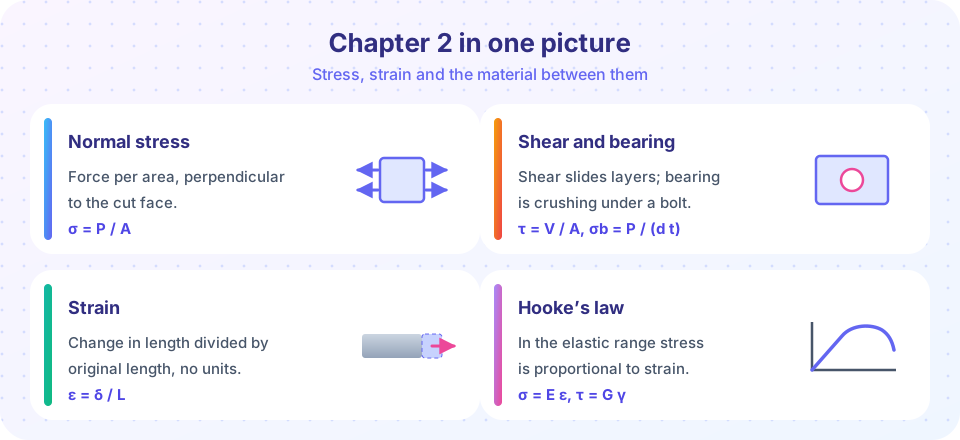
Chapter 2 introduced the four quantities that run through the rest of the course: stress, strain, the material law connecting them, and the allowable values that make a design safe. You can now take a force and a cross-section and say how hard the material is working, and take a stress and predict a deformation.
Recap table
| Lesson | Quantity | Formula | Unit |
|---|---|---|---|
| Normal stress | σ | P / A |
MPa |
| Shear and bearing | τ, σ_b | V / A, P / (d t) |
MPa |
| Strain | ε, γ | δ / L, angle |
none, rad |
| Hooke's law | E, G, ν | σ = E ε, τ = G γ, ε_lat = −ν ε |
GPa, none |
A combined worked example
A steel rod (E = 200 GPa, ν = 0.3, yield strength 250 MPa) with a 16 mm diameter and length 2.0 m hangs a load of 40 kN. The rod ends in a clevis with a 14 mm pin in double shear.
- Rod stress:
A = π × 16² / 4 = 201.1 mm²,σ = 40 000 / 201.1 = 198.9 MPa. The factor of safety against yield is250 / 198.9 = 1.26. - Strain and elongation:
ε = 198.9 / 200 000 = 9.94 × 10⁻⁴,δ = 9.94 × 10⁻⁴ × 2000 = 1.99 mm. - Pin shear: two planes, so
τ = 40 000 / (2 × π × 14² / 4) = 40 000 / 307.9 = 130 MPa. - Lateral change:
Δd = −0.3 × 9.94 × 10⁻⁴ × 16 = −0.0048 mm.
The rod is probably good for static use, but a safety factor of 1.26 is thin for most codes. The one calculation touches every idea of the chapter.
Press Run (or Ctrl + Enter) to see the result here.
Program input · what you'd type while the program runs
Type the answers before you press Run, one per line. Each time the program reads a line (with input()), it gets the next line from this box.
Press Run (or Ctrl + Enter) to see the result here.
Program input · what you'd type while the program runs
Type the answers before you press Run, one per line. Each time the program reads a line (with input()), it gets the next line from this box.
Check your understanding: chapter 2
Quick check · 10 questions
of 10 answered You scored / 10 · perfect!
-
1. A 25 kN force acts on a 500 mm² section. The normal stress is…
σ = 25 000 / 500 = 50 N/mm² = 50 MPa. -
2. A bolt in double shear carries 40 kN and has area 154 mm². The shear stress is about…
Two planes share the load: τ = 40 000 / (2 × 154) = 130 MPa. -
3. The bearing area of a 20 mm bolt in a 12 mm plate is…
Projected area = d × t = 20 × 12 = 240 mm². -
4. Strain is measured in…
Strain is a ratio of two lengths. -
5. A 3 m cable stretches 6 mm. The strain is…
6 mm / 3000 mm = 0.002. -
6. The proportional limit marks the end of…
Up to it, stress is proportional to strain. -
7. What is the 0.2% offset yield strength?
It stands in for the yield point of materials that have no yield plateau. -
8. A steel bar has ε = 0.0005 in the axial direction and ν = 0.3. The lateral strain is…
ε_lat = −ν ε_axial = −0.3 × 0.0005 = −0.00015. -
9. Which is true for all steel grades?
E is about 200 GPa for all steels; yield strength differs widely. -
10. For an isotropic material, which relation is correct?
Only two of E, G and ν are independent, linked by G = E / (2(1 + ν)).
Summary
- Normal stress
σ = P / A, shear stressτ = V / A, bearingσ_b = P / (d t). - Normal strain
ε = δ / L; shear strain γ is an angle. - The tensile-test curve shows E, yield, ultimate strength and ductility.
- Hooke's law and Poisson's ratio turn stress into deformation.
Track your progress
Create a free account to tick off lessons and pick up where you left off on any device.
of Strength of Materials lessons completed