


















Lesson 20 of 49 · Torsion
Angle of Twist and Power Transmission
Calculate the angle of twist of a shaft with φ = TL/(GJ), convert power and rpm to torque, and design a shaft for both strength and twist with worked examples.
A shaft that is strong enough can still be a poor shaft. If it twists too much, gears mesh badly, a precise machine loses its accuracy, and a long drill string coils like a spring. So shaft design has two checks: the stress must be below the allowable value, and the angle of twist must be below the allowable twist. And because most shafts exist to transmit power, you also need the link between power, speed and torque.
What you will learn
- The angle-of-twist formula
φ = T L / (G J). - How to handle shafts with several segments.
- How to convert power and rpm into torque.
- How to design a shaft for both strength and twist.
Key terms
Angle of twist φ: relative rotation of the two ends of a shaft, in radians (1 rad = 57.3°).
Torsional stiffness k_t: torque per unit twist, k_t = G J / L, in N·mm/rad.
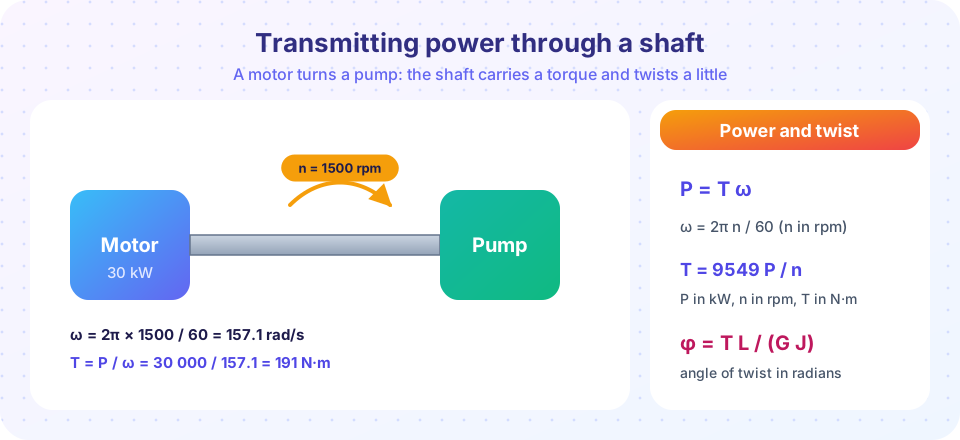
Angular speed ω: rotation rate in rad/s, ω = 2π n / 60 for n in rpm.
Power P: the rate of doing work; for a rotating shaft P = T ω, in watts.
The angle of twist
From the derivation in the last lesson, γ = ρ φ / L and τ = G γ, together with τ = T ρ / J. Eliminating gives
φ = T L / (G J)
Compare it with δ = P L / (A E): the same structure, with T, G, J in the roles of P, E, A. A longer shaft twists more; a stiffer material (larger G) or a larger J twists less. Since J ∝ d⁴, doubling the diameter divides the twist by 16.
If the torque, J or G change along the shaft (a stepped shaft, or several gears taking power off), treat each segment separately and add the twists with their signs: φ = Σ Tᵢ Lᵢ / (Gᵢ Jᵢ).
Example. A solid steel shaft, d = 50 mm, L = 1.5 m, carries T = 1.2 kN·m, with G = 80 GPa (steel is about 77-80 GPa; we use 80 for round numbers).
φ = 1.2 × 10⁶ × 1500 / (80 000 × 613 592) = 0.0367 rad = 2.10°
Power, speed and torque
Work done per revolution by a torque T is 2π T. Multiply by the revolutions per second n / 60:
P = T ω = 2π n T / 60 (SI units: P in W, T in N·m, ω in rad/s).
So T = P / ω. A handy form for P in kilowatts and n in rpm: T = 9549 × P / n in N·m. (The factor is 60 000 / 2π = 9549.3.)
Example. A motor delivers P = 30 kW at n = 1500 rpm: ω = 2π × 1500 / 60 = 157.1 rad/s, so T = 30 000 / 157.1 = 191 N·m.
Note the engineering insight: for the same power, a slow shaft carries a large torque. A gearbox that reduces the speed by 5 multiplies the torque by 5 (less losses). That is why low-speed output shafts are far thicker than the motor shaft.
Designing a shaft: strength and twist
Using the motor above and τ_allow = 40 MPa:
Strength: d³ = 16 T / (π τ_allow) = 16 × 190 986 / (π × 40) = 24 317 mm³, so d ≥ 29.0 mm.
Twist: suppose twist must not exceed 1° over a 1 m length (a common machine limit is about 1° per 20 diameters for precision work, but the limit depends on the application). Then φ_allow = 0.01745 rad, and
J = T L / (G φ_allow) = 190 986 × 1000 / (80 000 × 0.01745) = 136 800 mm⁴, so d = (32 J / π)^(1/4) = 34.4 mm.
The larger of the two governs: d ≥ 34.4 mm. A 35 mm or 36 mm shaft satisfies both. Notice that the twist limit, not the stress limit, controls here; this often happens for long shafts.
Press Run (or Ctrl + Enter) to see the result here.
Program input · what you'd type while the program runs
Type the answers before you press Run, one per line. Each time the program reads a line (with input()), it gets the next line from this box.
Common misconceptions
"Power is a property of the shaft." It is the product of the torque and speed the shaft happens to carry. Same shaft, double the speed, and it carries twice the power at the same torque and stress.
"If the stress is fine, the shaft is fine." Twist, vibration and fatigue are separate checks. Long shafts are usually limited by twist.
"Use degrees in φ = T L / (G J)." The formula gives radians. Multiply by 180 / π to convert to degrees.
Check your understanding
Quick check · 5 questions
of 5 answered You scored / 5 · perfect!
-
1. A motor delivers 30 kW at 1500 rpm. The torque is about…
ω = 157.1 rad/s and T = 30 000 / 157.1 = 191 N·m. -
2. A shaft's diameter is doubled with everything else fixed. Its angle of twist becomes…
J ∝ d⁴, so φ ∝ 1/d⁴ and doubling d divides φ by 16. -
3. Which formula gives the angle of twist?
φ = T L / (G J), the torsional counterpart of δ = P L / (A E). -
4. For the same power, a shaft turning ten times slower carries…
P = T ω, so for fixed P the torque is inversely proportional to the speed. -
5. If a shaft design is checked for strength and twist, which diameter do you use?
You must satisfy both requirements, so the larger required diameter governs.
Summary
φ = T L / (G J)in radians; sum segment by segment for stepped shafts.P = T ωwithω = 2π n / 60;T = 9549 P(kW) / n(rpm)in N·m.- Same power at a lower speed means more torque.
- Design shafts for strength and twist; the larger diameter governs.
Track your progress
Create a free account to tick off lessons and pick up where you left off on any device.
of Strength of Materials lessons completed