


















Lesson 37 of 49 · Deflection and Buckling
Chapter 7 review: deflection and buckling
Review curvature, integration, standard deflection cases, superposition and Euler buckling, with a recap table, check tools and a nine-question quiz.
This chapter added two checks to the strength check you already knew: stiffness (deflection stays within a limit) and stability (a slender member does not buckle). Here is the chapter on a page, a pair of tools that run all three checks, and a quiz.
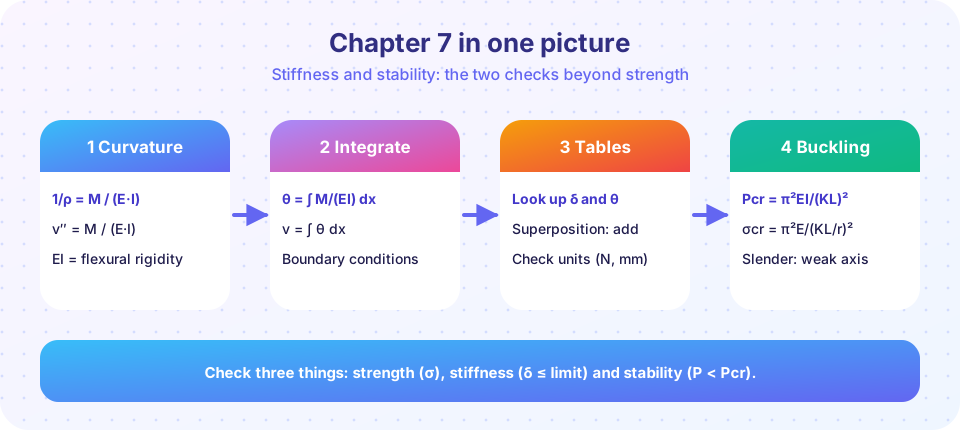
Recap table
| Topic | Result | Remember |
|---|---|---|
| Curvature | 1/ρ ≈ v″ = M/(EI) |
Small slopes only |
| Integration | EI v″ = M, two constants |
Fixed: v = θ = 0; pin: v = 0 |
| Cantilever, end load | δ = PL³/(3EI), θ = PL²/(2EI) |
Very flexible |
| Cantilever, uniform | δ = wL⁴/(8EI) |
L⁴ for distributed loads |
| Simple, center load | δ = PL³/(48EI) |
16 times stiffer than the cantilever |
| Simple, uniform | δ = 5wL⁴/(384EI) |
Max at midspan |
| Superposition | Add separate effects | Linear and small deflections |
| Propped cantilever | R = 3wL/8 |
Compatibility: tip δ = 0 |
| Euler load | Pcr = π²EI/(K·L)² |
Weak axis; K = 1, 2, 0.7, 0.5 |
| Slenderness | σcr = π²E/(KL/r)² |
Valid above about 126 for 250 MPa steel |
Try it
This tool runs the three checks, strength, stiffness and stability, for a simple beam with a center load, so you can see which one governs. Change the section depth and the span.
Press Run (or Ctrl + Enter) to see the result here.
Program input · what you'd type while the program runs
Type the answers before you press Run, one per line. Each time the program reads a line (with input()), it gets the next line from this box.
Second, how the buckling load of a steel column of 40 mm diameter falls with its length for each end condition. Notice the 1/L² collapse.
Press Run (or Ctrl + Enter) to see the result here.
Program input · what you'd type while the program runs
Type the answers before you press Run, one per line. Each time the program reads a line (with input()), it gets the next line from this box.
Check your understanding
Quick check · 9 questions
of 9 answered You scored / 9 · perfect!
-
1. A steel cantilever has EI = 2 × 10¹² N·mm², L = 1.5 m and P = 2 kN at the tip. What is the tip deflection?
δ = PL³/(3EI) = 2000 × 3.375 × 10⁹ / (3 × 2 × 10¹²) = 1.125 mm. -
2. A simply supported beam (EI = 2 × 10¹² N·mm², L = 3 m) carries w = 4 N/mm. Its midspan deflection is closest to...
δ = 5wL⁴/(384EI) = 5 × 4 × 8.1 × 10¹³ / (384 × 2 × 10¹²) = 2.1 mm. -
3. The fixed-pinned column has an effective length factor of about...
K ≈ 0.7 for fixed at one end and pinned at the other. -
4. A pinned-pinned column of E = 200 GPa and I = 100 000 mm⁴ is 2 m long. What is Pcr?
Pcr = π²EI/L² = 9.87 × 200 000 × 100 000 / 2000² = 49.3 kN. -
5. Replacing steel by a high-strength steel with the same E but twice the yield strength changes the Euler load of a slender column by...
Pcr depends on E, I and L only. -
6. Which beam deflection limit gives the largest allowed deflection for a 5 m span?
L/240 is the loosest of the three: 5000/240 = 20.8 mm. -
7. Why does superposition fail for a beam with very large deflections?
Large deflections change the geometry (lever arms), so the response is no longer linear in the loads. -
8. A propped cantilever carries a uniform load w. What happens to the wall moment compared with the unpropped cantilever (wL²/2)?
With R = 3wL/8, the wall moment is wL²/2 − 3wL²/8 = wL²/8. -
9. Doubling both the length of a column and its moment of inertia I (all else equal) changes Pcr by a factor of...
Pcr ∝ I/L², so doubling I doubles it and doubling L quarters it: 2/4 = 1/2.
Summary
- Deflection follows from
EI·v″ = M(x); two integrations and the support conditions give the elastic curve. - Memorize the four standard cases; add their effects by superposition for combined loads and for indeterminate beams (compatibility).
- Euler's column load
Pcr = π²EI/(K·L)²depends on stiffness and length, not strength; always use the weak axis. - Design means passing all three checks: strength, stiffness and stability.
Track your progress
Create a free account to tick off lessons and pick up where you left off on any device.
of Strength of Materials lessons completed