


















Lesson 8 of 49 · Stress and Strain
Shear and Bearing Stress in Connections
Calculate shear stress in bolts, pins and rivets in single and double shear, bearing stress on plates, and punching shear, with worked examples and a joint checker.
A bolted joint is the place where things go wrong most often in real structures. A bolt can be cut through (shear), the plate can be crushed where the bolt presses on it (bearing), or the plate can tear along its net section. Shear and bearing stress give you the arithmetic for the first two.
What you will learn
- How shear stress τ = V / A differs from normal stress.
- The difference between single and double shear.
- How to calculate bearing stress using the projected area.
- How to find the force needed to punch a hole through a plate.
Key terms
Shear stress τ: shear force divided by the area it acts on, parallel to the surface.
Single shear / double shear: a fastener loaded across one plane (one cut) or two planes (two cuts).
Bearing stress σ_b: the contact pressure between a fastener and the plate, using the projected area d × t.
Projected area: the flat area you see when looking along the load direction.
Average shear stress
When a force V acts parallel to a section, like the cut of a pair of scissors, the material on one side tries to slide past the other. The average shear stress is
τ = V / A
where A is the area of the shear surface, parallel to the force. Like normal stress it is measured in MPa, but it is a different kind of stress: it distorts rather than stretches. Normal and shear strengths of a material are different numbers (for steel, the shear yield strength is roughly 0.5-0.6 of the tensile yield strength).
Single and double shear
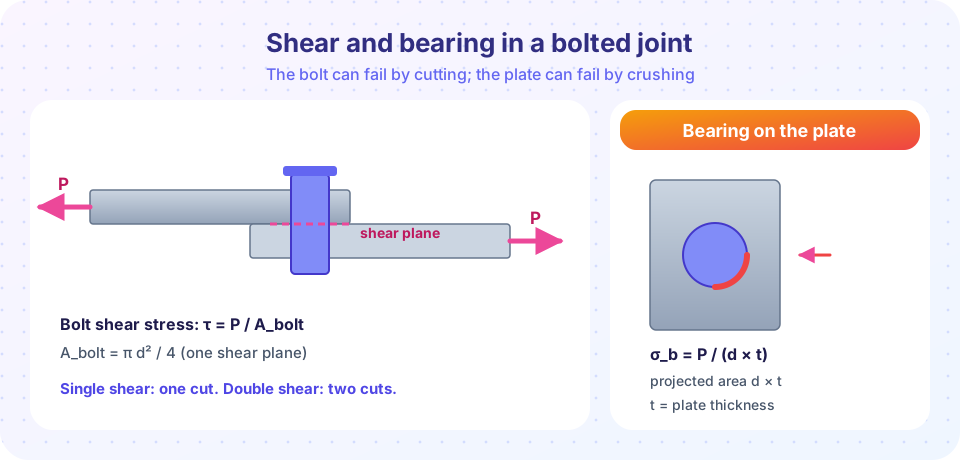
In the lap joint in the picture, each plate pulls a different way, so the bolt is cut across one plane: single shear. The shear force on that plane is the full load P, and the area is the bolt's cross-section:
τ = P / (π d² / 4).
In a joint where one plate sits between two others (a clevis, or a double strap joint), the load is shared by two planes: double shear. Each plane carries P / 2, so τ = P / (2 × π d² / 4). The same bolt can carry twice the load in double shear. This is why clevis pins are a standard design.
Bearing stress
Where a bolt pushes on the edge of its hole, the contact is spread over a cylindrical surface with a messy pressure pattern. For design, use the projected area: the bolt diameter times the plate thickness.
σ_b = P / (d × t)
Note that a bearing stress is a compressive stress on the plate, usually allowed to be higher than the tensile yield stress because the surrounding material supports the contact zone.
Example 1: bolt and plate
A 16 mm bolt joins two 10 mm plates, carrying P = 20 kN.
- Bolt area:
π × 16² / 4 = 201.1 mm². - Single shear:
τ = 20 000 / 201.1 = 99.5 MPa. - If the joint were in double shear:
τ = 49.7 MPa. - Bearing:
σ_b = 20 000 / (16 × 10) = 125 MPa.
With allowable values τ_allow = 100 MPa and σ_b,allow = 200 MPa, the bolt is just passing in single shear and the plate is fine in bearing.
Example 2: punching a hole
A punch of diameter d = 25 mm pushes through a plate t = 8 mm thick. The shear surface is the cylinder around the punch: A = π d t = π × 25 × 8 = 628.3 mm². If the plate's ultimate shear strength is 300 MPa, the force required is F = τ_u A = 300 × 628.3 = 188.5 kN. The same idea explains why a thin concrete slab can punch through around a column.
Complementary shear
Shear stress always comes in pairs. If a face of a small square element has shear stress τ, the perpendicular faces carry equal shear stress τ as well, pointing so that the element does not rotate. This is why a shear stress on a bolt's cross-section also exists on the longitudinal planes of a shaft or beam, a fact that will matter for torsion and bending.
Press Run (or Ctrl + Enter) to see the result here.
Program input · what you'd type while the program runs
Type the answers before you press Run, one per line. Each time the program reads a line (with input()), it gets the next line from this box.
Common misconceptions
"Shear stress is uniform across the bolt." The formula gives the average shear stress. The real distribution is parabolic-like and peaks higher at the centre, which is why codes use a conservative allowable value.
"Bearing area is the area of the hole." It is the projected area d × t, not π d² / 4 and not the cylinder's curved surface.
"A bigger bolt always fixes it." A larger hole also removes more plate and may cause the plate to tear, or put the edge too close to the hole. A joint has several failure modes and you must check each one.
Check your understanding
Quick check · 5 questions
of 5 answered You scored / 5 · perfect!
-
1. A 16 mm bolt in single shear carries 20 kN. What is the average shear stress?
A = π × 16² / 4 = 201.1 mm², τ = 20 000 / 201.1 = 99.5 MPa. -
2. Moving the same load to a double-shear arrangement changes the bolt shear stress by…
Two planes share the load, so each carries P / 2 and the stress halves. -
3. The bearing area for a bolt of diameter d in a plate of thickness t is…
Bearing uses the projected area, the diameter times the plate thickness. -
4. A 25 mm punch goes through an 8 mm plate with ultimate shear 300 MPa. The force needed is closest to…
Shear area = π × 25 × 8 = 628 mm², F = 300 × 628 = 188 kN. -
5. Complementary shear means that…
Moment balance of the small element forces equal shear stresses on perpendicular faces.
Summary
- Average shear stress is
τ = V / A, with A the area parallel to the shear force. - Single shear uses one plane; double shear shares the load over two and halves τ.
- Bearing stress is
σ_b = P / (d t)using the projected area. - Punching shear uses the cylinder area
π d t; shear stresses always come in perpendicular pairs.
Track your progress
Create a free account to tick off lessons and pick up where you left off on any device.
of Strength of Materials lessons completed