


















Lesson 2 of 49 · Getting Started
Loads, Supports and Free-Body Diagrams
Learn the types of loads and supports, how to draw a free-body diagram, and how to find the reactions of a simply supported beam step by step.
Before you can ask how strong a part is, you must know what forces act on it. The tool for that is the free-body diagram (FBD): you isolate the part, remove everything around it, and replace the surroundings by the forces they exert. If the FBD is right, the rest of the problem is arithmetic. If it is wrong, no amount of careful algebra rescues the answer.
What you will learn
- The common kinds of load: point, distributed, axial, moment and torque.
- What pin, roller and fixed supports do, and how many reactions each gives.
- How to draw a free-body diagram and solve for the reactions.
- How to replace a distributed load by its resultant.
Key terms
Reaction: a force or moment a support exerts on a body to keep it in place.
Point load: a force applied at a single location, in N or kN.
Distributed load: a load spread along a length, with intensity w in N/m or kN/m.
Resultant: the single force that has the same effect as a distributed load.
Equilibrium: the state in which the sum of all forces and moments is zero.
Kinds of load
A point load is idealized: no real force acts on a mathematical point, but if the contact area is small compared with the member, the idealization works. A distributed load is spread along a length: the weight of a floor on a joist, snow on a roof beam, water pressure on a dam strip. Its intensity w is measured in force per length. A uniform load has constant w; a triangular one grows linearly from zero.
A load along the axis of a bar is axial; a load perpendicular to the axis is transverse. A moment (or couple) tends to rotate a part about an axis perpendicular to the part; a torque is a moment about the axis of a shaft. Loads are also static (applied slowly and held) or dynamic (impact, vibration, moving traffic). This course starts with static loads.
Supports and reactions
A support prevents motions, and for every prevented motion it supplies a reaction.
| Support | Prevents | Reactions |
|---|---|---|
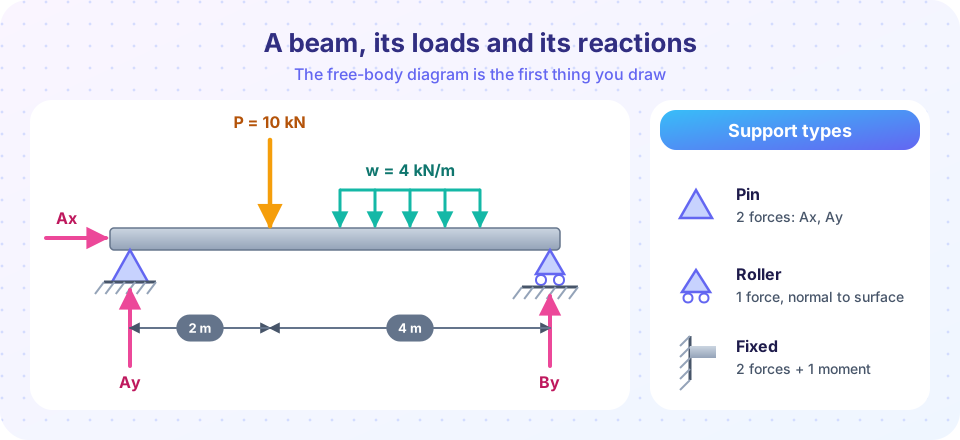
| Roller | movement perpendicular to the surface | 1 force |
| Pin (hinge) | movement in any direction, not rotation | 2 forces (Ax, Ay) |
| Fixed (built-in) | movement and rotation | 2 forces and 1 moment |
A beam on a pin and a roller is simply supported. A beam fixed at one end and free at the other is a cantilever. These are the standard test cases for the rest of the course.
Resultants of distributed loads
For a uniform load w over a length a, the resultant is W = w × a, acting at the midpoint of the loaded length. For a triangular load rising from zero to w_max over a length a, the resultant is W = ½ w_max a, acting one third of the length from the large end. The resultant is only for finding reactions: when you later find internal forces inside the loaded region, you must go back to the real distribution.
Drawing an FBD, step by step
- Sketch the member with its real dimensions.
- Remove the supports and draw in their reactions at the correct points, with assumed directions.
- Draw all loads with their true directions; replace distributed loads by resultants.
- Choose axes and write the equilibrium equations:
ΣFx = 0,ΣFy = 0,ΣM = 0about a convenient point. - Solve. A negative result means the true direction is opposite to the assumed one.
Taking moments about a point where two unknown forces meet removes both from the equation, so choose that point.
Worked example: the simply supported beam
The beam in the picture is 6 m long. The pin A is at the left end, the roller B at the right end. A point load P = 10 kN acts 2 m from A, and a uniform load w = 4 kN/m covers the stretch from 3 m to 5 m.
The uniform load has resultant W = 4 kN/m × 2 m = 8 kN at the middle of its stretch, 4 m from A.
Horizontal forces: there are no horizontal loads, so Ax = 0.
Moments about A (counter-clockwise positive; B pushes up at 6 m, loads push down):
By × 6 − 10 × 2 − 8 × 4 = 0, so By = 52 / 6 = 8.667 kN.
Vertical forces: Ay + By − 10 − 8 = 0, so Ay = 18 − 8.667 = 9.333 kN.
Check with moments about B: Ay × 6 − 10 × 4 − 8 × 2 = 56 − 40 − 16 = 0.
Always check with a second moment equation. It catches arithmetic slips, and costs one line.
Press Run (or Ctrl + Enter) to see the result here.
Program input · what you'd type while the program runs
Type the answers before you press Run, one per line. Each time the program reads a line (with input()), it gets the next line from this box.
Common misconceptions
"A distributed load acts at the end of the beam." Its resultant acts at the centroid of the load shape: the midpoint for a uniform load, one third from the large end for a triangle.
"Reactions always point up." Reactions point wherever equilibrium needs them. A beam with a load near one support can even have a downward reaction at the other (it is held down), and you only discover this by solving.
"I can replace a distributed load by its resultant everywhere." Only when finding reactions. Inside the loaded region the internal forces depend on the actual distribution.
Check your understanding
Quick check · 5 questions
of 5 answered You scored / 5 · perfect!
-
1. How many reactions does a roller support supply in a plane problem?
A roller only blocks motion perpendicular to its surface, so it gives a single force. -
2. A uniform load of 3 kN/m acts over 4 m. What is the resultant and where does it act?
W = w × a = 3 × 4 = 12 kN, acting at the centre of the 4 m stretch. -
3. Why take moments about a support where two unknown reactions meet?
A force through the moment centre has no moment about it, so you solve for the remaining unknown directly. -
4. A fixed support at the end of a cantilever supplies which reactions?
It blocks both translations and the rotation, so it supplies two force components and a moment. -
5. In the worked example, By was 8.667 kN. What is Ay?
The total downward load is 10 + 8 = 18 kN, so Ay = 18 − 8.667 = 9.333 kN.
Summary
- Loads are point, distributed, axial, transverse, moment or torque; static first, dynamic later.
- A roller gives 1 reaction, a pin 2 and a fixed support 3 (two forces and a moment).
- Draw the FBD, replace distributed loads by resultants, write
ΣFx = 0,ΣFy = 0,ΣM = 0and check with another moment equation. - A negative answer means the real direction is opposite to the assumed one.
Track your progress
Create a free account to tick off lessons and pick up where you left off on any device.
of Strength of Materials lessons completed