


















Lesson 38 of 49 · Failure Theories and Design
Chapter 8 overview: failure theories and design
Learn how materials fail by yielding, fracture and fatigue, why one tensile test must predict failure under any stress state, and how design uses safety factors.
Everything in the course so far has produced numbers: stresses, strains, deflections. Now comes the question that makes those numbers useful: will the part fail? A tensile test gives us one number, the yield strength, measured under the simplest possible loading, a single uniform pull. But a real part sits in a stress state with several components at once: bending plus torsion, a pressurized tube, a notched plate. A failure theory (also called a failure criterion) is a rule that turns a complicated stress state into one number we can compare with the tensile-test value.
What you will learn
- The main ways a part can fail, and the difference between ductile and brittle behavior.
- Why a failure criterion is needed and what it does.
- A map of the chapter: yield criteria, notches and fatigue, safety factors.
- Two historical cases that show what ignoring these ideas costs.
Failure is loss of function
A part has failed when it can no longer do its job, not necessarily when it breaks into pieces. Common ways:
| Mode | What happens | Typical remedy |
|---|---|---|
| Yielding | Permanent deformation of a ductile material | Keep the stress below σy / FS |
| Fracture | Sudden separation of a brittle material | Keep the stress below σu / FS and avoid cracks |
| Fatigue | Cracks grow under repeated loads, at stresses below yield | Use the S-N curve and lower stress concentrations |
| Buckling | A slender member bows sideways | P < Pcr / FS (Chapter 7) |
| Excessive deflection | The part bends too far to work | δ ≤ limit (Chapter 7) |
Other modes, such as creep (slow deformation at high temperature), wear and corrosion, matter in practice but need material science beyond this course.
Ductile or brittle?
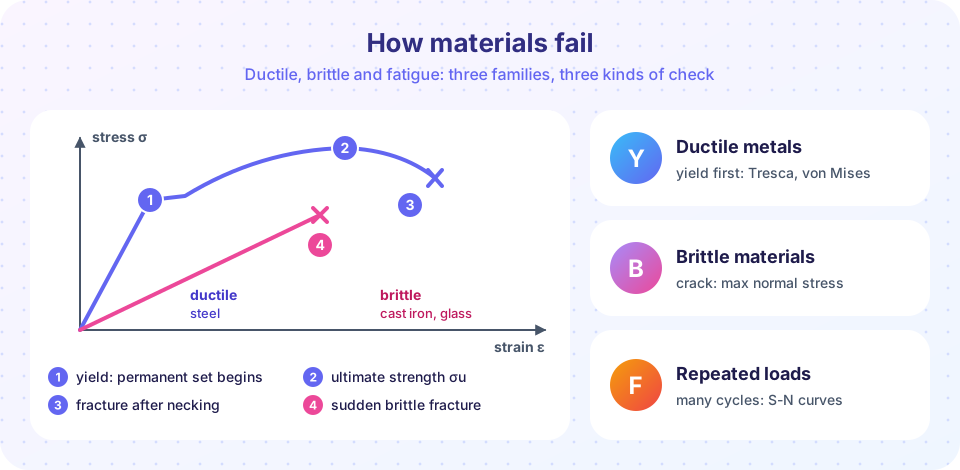
A ductile material, like mild steel, copper or most aluminum alloys, stretches a lot before it breaks. It gives warning: you can see the part bend and neck. It also absorbs energy, which is why car bodies are made of it. A brittle material, like glass, ceramics, cast iron and many hard plastics, breaks with little plastic strain, often with a clean crack and no warning. A rule of thumb used in textbooks is that a material with a strain at fracture above about 5% is ductile. The line is blurry: the same steel can behave in a brittle way at very low temperature or with a sharp crack.
For ductile materials, yielding is the end of useful life, so the criteria compare a combined stress with the yield strength. For brittle materials, fracture is governed by the largest tensile normal stress, so criteria compare σ1 with the ultimate strength.
Three families of failure
Why a criterion?
In this chapter
Design margin
Two lessons from history
During World War II, hundreds of welded Liberty ships built in the United States developed cracks, and some broke in two, often in cold water. Brittle fracture at low temperature, welds with defects and sharp corners all played a part. In the early 1950s, several de Havilland Comet jet airliners crashed; investigators traced the failures to metal fatigue, with cracks growing from the corners of the window openings under repeated cabin pressurization. Later aircraft use rounded windows. Both cases remind us that a design can pass the simple stress check and still fail because of a mode nobody checked.
Try it
Here is a classification tool. The elongations are rough orders of magnitude for textbook materials, not design data. It applies the 5% rule of thumb.
Press Run (or Ctrl + Enter) to see the console output here.
No output.
The second TryIt plots the two behaviors with simple model curves, so you can see where each failure criterion looks.
Press Run (or Ctrl + Enter) to see the result here.
Program input · what you'd type while the program runs
Type the answers before you press Run, one per line. Each time the program reads a line (with input()), it gets the next line from this box.
The area under a curve is the energy absorbed per unit volume before failure (the toughness). The ductile curve encloses far more area, which is why ductile materials survive impacts.
What each lesson covers
| Lesson | Key question |
|---|---|
| Yield criteria: Tresca and von Mises | Does a combined stress state make a ductile part yield? |
| Fatigue and notches | Why do parts fail under stresses far below yield? |
| Factor of safety and the design process | How do I turn all this into a safe size? |
| Chapter 8 review | Can I check a real part against all failure modes? |
Check your understanding
Quick check · 3 questions
of 3 answered You scored / 3 · perfect!
-
1. Which material behavior gives the most warning before failure?
A ductile material deforms visibly (bending, necking) before it breaks. -
2. Why is a failure criterion needed?
The criterion maps a multi-component stress state to an equivalent stress comparable with the tensile-test value. -
3. For a brittle material, the failure check usually compares which quantities?
Brittle failure is controlled by the largest principal tensile stress reaching the ultimate strength.
Summary
- Failure means loss of function: yielding, fracture, fatigue, buckling or too much deflection.
- Ductile materials yield and give warning; brittle materials fracture suddenly. A 5% strain at fracture is a common rule of thumb.
- Failure criteria convert a combined stress state into an equivalent stress comparable with a simple test value.
- Real failures (Liberty ships, Comet airliners) came from modes that the basic stress check did not cover.
Track your progress
Create a free account to tick off lessons and pick up where you left off on any device.
of Strength of Materials lessons completed