


















Lesson 11 of 51 · Nuclear Structure
Chapter 2 Review: Size, Binding and Models
Review chapter 2: nuclear radius and density, binding energy, the semi-empirical mass formula and the shell model, with a recap table and ten-question quiz.
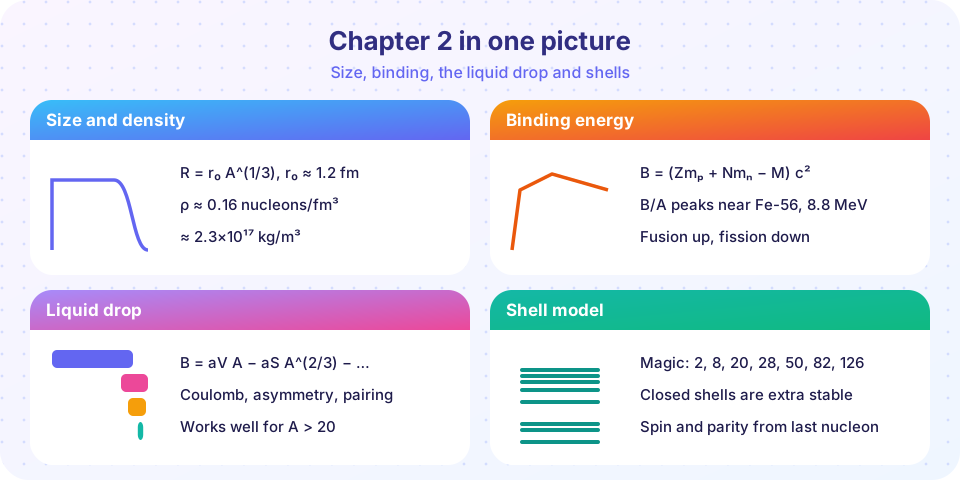
You have now looked at the nucleus from four angles: how big it is, how tightly it is bound, how well a charged liquid drop describes it, and how quantum shells explain its spin and special numbers. This review ties them together on one page and gives you a chance to practice recalling and applying the main ideas before moving on to radioactivity.
What you will learn
- Recall and apply the main formulas of nuclear structure.
- Choose the right model (liquid drop or shell) for a given question.
- See how separation energies reveal shell closures.
Key terms
R = r₀A^(1/3): nuclear radius, with r₀ ≈ 1.2 fm.
B/A: binding energy per nucleon, peaking near 8.8 MeV at the iron-nickel region.
SEMF: semi-empirical mass formula, with volume, surface, Coulomb, asymmetry and pairing terms.
Magic numbers: 2, 8, 20, 28, 50, 82, 126.
Separation energy S_n: the energy needed to remove one neutron.
The chapter in a table
| Topic | What to remember |
|---|---|
| Size | R = 1.2 fm × A^(1/3); skin thickness about 2.4 fm; Rutherford and Hofstadter scattering |
| Density | ρ ≈ 2.3–2.7 × 10¹⁷ kg/m³; about 0.16 nucleons/fm³; independent of A |
| Nuclear force | short range (1–3 fm), saturating, repulsive core, charge independent |
| Mass defect | B = Δm c²; 1 u = 931.494 MeV |
| B/A curve | 1.1 (²H), 7.07 (⁴He), 8.79 (⁵⁶Fe), 8.795 (⁶²Ni, the maximum), 7.87 (²⁰⁸Pb), 7.57 (²³⁸U) |
| Liquid drop | B = aV A − aS A^(2/3) − aC Z(Z−1)/A^(1/3) − aA (A−2Z)²/A + δ |
| Valley of stability | Z₀ = A/(1.98 + 0.0155 A^(2/3)) |
| Shell model | levels n l_j hold 2j + 1; magic numbers from spin-orbit coupling |
| Spin and parity | even-even 0⁺; odd-A takes the j and (−1)^l of the odd nucleon |
Which model for which question?
| Question | Best model |
|---|---|
| What is the energy released in fission or fusion? | liquid drop, B/A curve |
| Why can ²³⁵U fission easily? | liquid drop (Z²/A, surface vs Coulomb) |
| What is the spin of ¹⁷O? | shell model |
| Why is ²⁰⁸Pb so stable? | shell model (doubly magic) |
| Is a nucleus with 70 neutrons and 50 protons stable? | both: valley of stability and shell structure |
Worked review problems
Problem 1. Use R = 1.2 A^(1/3) to estimate the radius of ¹²⁵Te. 125^(1/3) = 5, so R = 6.0 fm.
Problem 2. The mass of ⁴⁰Ca is 39.962591 u. Hydrogen-1 is 1.007825 u and the neutron 1.008665 u. Find B/A. Parts: 20 × 1.007825 + 20 × 1.008665 = 40.329800 u. Δm = 0.367209 u. B = 342.05 MeV, B/A = 8.55 MeV.
Problem 3. Predict the spin and parity of ³⁹K (Z = 19, N = 20). The 19th proton is the third in 1d3/2 (the level holds 4), a hole in a closed shell, so J^π = 3/2⁺.
Problem 4. Why is the first neutron beyond N = 126 (in ²⁰⁹Pb) bound by only 3.9 MeV, while ²⁰⁸Pb needs 7.4 MeV to lose one? The 127th neutron must start a new shell above a large gap.
Common misconceptions
"Iron has the highest binding energy per nucleon." Nickel-62 does (8.795 MeV); iron-56 (8.790 MeV) is a close third behind iron-58.
"The liquid-drop formula works equally well for every nucleus." It is best for heavy nuclei away from magic numbers and poor for the lightest ones.
"The shell model and liquid-drop model disagree." They describe different aspects of the same nucleus.
Try it
First, compute neutron separation energies from atomic masses. A shell closure shows up as a sudden drop in S_n for the first neutron beyond a magic number.
Press Run (or Ctrl + Enter) to see the result here.
Program input · what you'd type while the program runs
Type the answers before you press Run, one per line. Each time the program reads a line (with input()), it gets the next line from this box.
Second, combine everything in a workbench: radius, liquid-drop binding energy, magic-number status and an estimate of the stable Z for the same A.
Press Run (or Ctrl + Enter) to see the result here.
Program input · what you'd type while the program runs
Type the answers before you press Run, one per line. Each time the program reads a line (with input()), it gets the next line from this box.
Check your understanding
Quick check · 10 questions
of 10 answered You scored / 10 · perfect!
-
1. What is the radius of a nucleus with A = 216, using R = 1.2 A^(1/3)?
216^(1/3) = 6, so R = 1.2 × 6 = 7.2 fm. -
2. Which statement about the binding energy per nucleon curve is correct?
B/A rises from about 1 MeV for deuterium to about 8.8 MeV near iron and nickel, then falls to about 7.6 MeV for uranium. -
3. In the liquid-drop formula, which term lowers B/A of heavy nuclei most?
The Coulomb term grows as Z²/A^(1/3), so for heavy nuclei it becomes a large negative contribution. -
4. Which nuclide is doubly magic?
Z = 82 and N = 126 are both magic numbers. -
5. What is the predicted ground-state spin and parity of ¹⁵N (Z = 7, N = 8)?
The 7th proton sits in 1p1/2 (after 1s1/2 and 1p3/2 are full), so J^π = 1/2⁻. -
6. A reaction releases 0.0200 u as energy. How much is that?
0.0200 × 931.494 ≈ 18.6 MeV. -
7. Why is neutron separation energy a sign of a shell closure?
The neutron beyond a closed shell starts a new level above a large gap, so it is held much more weakly. -
8. Which pair describes the nuclear force correctly?
The force acts at 1–3 fm and saturates, giving B ∝ A and constant density. -
9. How many nucleons can the 1f7/2 level hold?
2j + 1 = 2 × 7/2 + 1 = 8. -
10. Which has the highest binding energy per nucleon?
Nickel-62 at 8.795 MeV per nucleon.
Summary
- Size R ≈ 1.2 A^(1/3) fm, constant density, soft 2.4 fm edge.
- B = Δm c²; B/A peaks near 8.8 MeV (Ni-62, Fe-56) and is 7.6 MeV for uranium.
- The mass formula combines five terms and predicts the valley of stability and the fission limit.
- The shell model explains magic numbers, spins and parities.
- You are ready for chapter 3: what happens when a nucleus is outside the valley.
Track your progress
Create a free account to tick off lessons and pick up where you left off on any device.
of Nuclear and Particle Physics lessons completed