


















Lesson 7 of 51 · Nuclear Structure
Nuclear Size and Density
How do we measure a nucleus? Learn scattering experiments, the nuclear radius formula, the constant density of nuclear matter and the soft nuclear edge.
You cannot put a ruler next to a nucleus, and light cannot show you its shape: visible light has a wavelength a hundred thousand times larger than the nucleus. Physicists learned the size of the nucleus the way a blind person learns the shape of a statue, by throwing things at it and noting how they bounce. The answer is both simple and surprising: nuclei have a size that depends only on how many nucleons they contain, and all of them have practically the same density.
What you will learn
- Describe how scattering experiments measure nuclear sizes (Rutherford, Hofstadter).
- Use R = r₀A^(1/3) to find a radius and show the density is nearly constant.
- Explain the soft edge of the nucleus and the idea of a skin thickness.
- List the main properties of the nuclear force: short range, saturation and a repulsive core.
Key terms
Nuclear radius R: the radius of a uniform sphere with the same volume as the nucleus, found from R = r₀A^(1/3).
Charge radius: the root-mean-square radius of the proton distribution, measured with electrons.
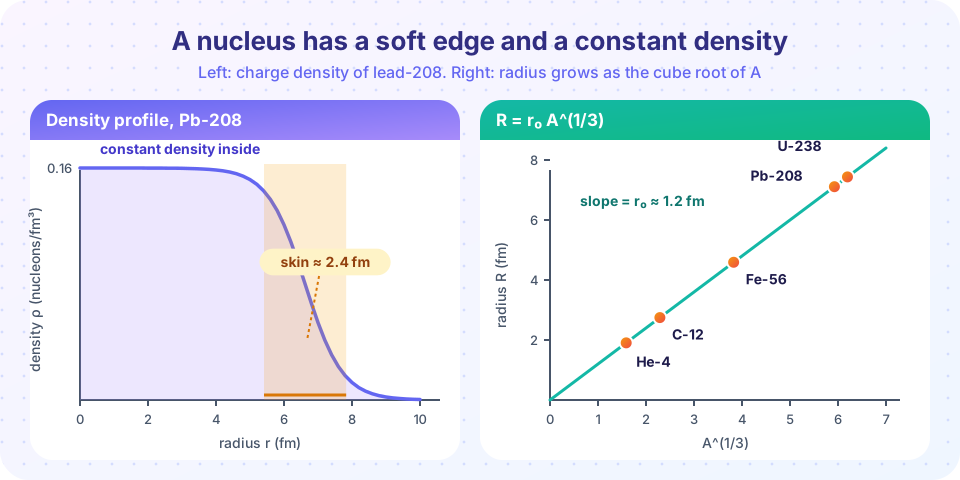
Skin thickness: the distance over which the density falls from 90% to 10% of its central value (about 2.4 fm).
Saturation: the property that each nucleon interacts mainly with its nearest neighbours, so total binding grows in proportion to A.
How to measure something 10⁻¹⁵ m wide
Rutherford scattering (1909–1911). Geiger and Marsden fired alpha particles at gold foil and found that a few were turned back by large angles. Rutherford concluded that the positive charge sits in a tiny core. The closest an alpha particle of kinetic energy E can approach a nucleus of charge Z in a head-on collision is where all its energy has turned into electric potential energy:
d = 2Ze² / (4πε₀E) = (1.44 MeV·fm × 2Z) / E
For a 5.5 MeV alpha and gold (Z = 79) this gives d = 1.44 × 158 / 5.5 ≈ 41 fm. That is much bigger than the nucleus, so the alpha only feels the pure Coulomb force. Rutherford could only say the nucleus is smaller than about 40 fm. To touch the nucleus of gold the alpha needs about 26 MeV.
Electron scattering (Hofstadter, 1950s). Electrons feel no strong force, so they see only the electric charge. At 500 MeV an electron has a de Broglie wavelength λ = 2πħc/pc ≈ 1240 MeV·fm / 500 MeV ≈ 2.5 fm, which is comparable to the nucleus. The scattering pattern shows diffraction minima, like light going through a hole, whose positions give the size and shape of the charge distribution. Robert Hofstadter received the 1961 Nobel Prize for this.
Other probes include the energy of X-rays from muonic atoms (the muon orbits so close that it samples the nucleus), small shifts in atomic spectral lines between isotopes, and the scattering of protons and neutrons, which feel the strong force and measure where the nuclear matter is.
The result: R = r₀A^(1/3)
All these methods give the same pattern. The radius of a nucleus with A nucleons is
R = r₀ A^(1/3), with r₀ ≈ 1.2 fm.
The value 1.2 fm depends a little on the probe (between 1.1 and 1.3 fm), because "size" has different meanings for charge and nuclear matter. Check some examples:
| Nucleus | A | R (fm) |
|---|---|---|
| ⁴He | 4 | 1.90 |
| ¹²C | 12 | 2.75 |
| ⁵⁶Fe | 56 | 4.59 |
| ²⁰⁸Pb | 208 | 7.11 |
| ²³⁸U | 238 | 7.44 |
The A^(1/3) rule says volume ∝ R³ ∝ A. Twice as many nucleons means twice the volume: nucleons pack like molecules in a liquid, each taking up the same room. The density therefore does not depend on A:
ρ = A m_N / (4/3 π R³) = m_N / (4/3 π r₀³)
With m_N = 1.66 × 10⁻²⁷ kg and r₀ = 1.2 fm this gives about 2.3 × 10¹⁷ kg/m³, equal to 0.14 nucleons/fm³. Measurements of the central density of heavy nuclei give a slightly higher 0.16 nucleons/fm³ (about 2.7 × 10¹⁷ kg/m³), because the true edge is soft, not sharp. A teaspoonful (5 cm³) of such matter would weigh about a billion tonnes. Neutron stars are giant balls of matter at about this density.
A soft edge
The nuclear surface is not a sharp line. The density follows a smooth step called the Fermi (or Woods–Saxon) profile:
ρ(r) = ρ₀ / (1 + e^((r − c)/a))
where c is the radius at which the density has dropped to half and a ≈ 0.55 fm controls the width. The 90%-to-10% skin thickness is 4.39a ≈ 2.4 fm, almost the same in all nuclei from calcium upward. A lead nucleus therefore has a core of constant density with a radius of about 5.4 fm and a skin about 2.4 fm thick.
The root-mean-square charge radius of ²⁰⁸Pb is measured to be 5.50 fm. A uniform sphere of radius R has an rms radius of √(3/5) R, which for R = 7.11 fm gives 5.51 fm, in excellent agreement. For light nuclei such as ¹²C the formula works less well, because they are too small to have an interior, and the proton itself has a charge radius of about 0.84 fm.
The nuclear force
Because nuclear matter has constant density and constant binding per nucleon, the force between nucleons must have special properties:
- Short range. It is strong at 1–2 fm and nearly zero beyond 3 fm.
- Saturation. Each nucleon interacts with only a few neighbours, so B ∝ A (a force that acted on all nucleons would give B ∝ A²).
- Repulsive core. Below about 0.5 fm the force turns strongly repulsive, which is why the density cannot increase.
- Charge independence. The proton-proton, neutron-neutron and proton-neutron nuclear forces are nearly equal.
- Spin dependence. Two nucleons bind only when their spins are parallel: the deuteron (a proton and a neutron) is bound with spin 1, but no bound two-neutron or two-proton system exists. The deuteron is held by only 2.2 MeV.
Worked example: radius, volume and density of ⁵⁶Fe
R = 1.2 × 56^(1/3) = 1.2 × 3.826 = 4.59 fm. Volume = 4/3 π (4.59 fm)³ = 405 fm³. Mass = 56 × 1.66 × 10⁻²⁷ kg = 9.3 × 10⁻²⁶ kg. Density = 9.3 × 10⁻²⁶ kg / 4.05 × 10⁻⁴³ m³ = 2.3 × 10¹⁷ kg/m³, the same as for lead or helium.
Common misconceptions
"A nucleus has a sharp surface, like a billiard ball." It has a fuzzy skin about 2.4 fm thick.
"Nuclear density is mostly empty space." Unlike atoms, nuclei contain almost no empty space; nucleons fill the volume.
"The nuclear radius formula is exact." It is an average over many nuclei; individual radii deviate by a few percent, and the parameter r₀ depends on the probe used.
Try it
Compute radii, volumes and densities, and the closest approach of an alpha particle. Then plot the soft edge of three nuclei.
Press Run (or Ctrl + Enter) to see the result here.
Program input · what you'd type while the program runs
Type the answers before you press Run, one per line. Each time the program reads a line (with input()), it gets the next line from this box.
Press Run (or Ctrl + Enter) to see the result here.
Program input · what you'd type while the program runs
Type the answers before you press Run, one per line. Each time the program reads a line (with input()), it gets the next line from this box.
Now draw a nucleus to scale and compare it with a proton.
Check your understanding
Quick check · 5 questions
of 5 answered You scored / 5 · perfect!
-
1. What is the radius of ²⁷Al according to R = 1.2 fm × A^(1/3)?
27^(1/3) = 3, so R = 1.2 × 3 = 3.6 fm. -
2. Why is the density of nuclear matter almost the same for all nuclei?
R ∝ A^(1/3) means volume ∝ A, so mass divided by volume is constant. -
3. Why did Hofstadter use electrons around 500 MeV?
To resolve a nucleus the wavelength must be comparable to it, and electrons do not feel the strong force. -
4. What does 'saturation' of the nuclear force mean?
A saturating force gives binding ∝ A. If every nucleon interacted with every other, binding would grow as A². -
5. About how thick is the nuclear skin (90% to 10% density)?
With diffuseness a ≈ 0.55 fm the skin thickness is 4.39a ≈ 2.4 fm.
Summary
- Scattering experiments (Rutherford, Hofstadter) measure nuclear sizes.
- R ≈ 1.2 fm × A^(1/3), so the volume is proportional to A and the density is constant, near 2.3–2.7 × 10¹⁷ kg/m³.
- The edge is soft, with a 2.4 fm skin.
- The nuclear force is short-range, saturating, repulsive at the core and nearly charge independent.
Track your progress
Create a free account to tick off lessons and pick up where you left off on any device.
of Nuclear and Particle Physics lessons completed