


















Lesson 1 of 51 · Getting Started
Course Map: Nuclear and Particle Physics
Meet the whole course: nine chapters from the atom to the quark, what you need to know first, how to study, and how the pieces fit together.
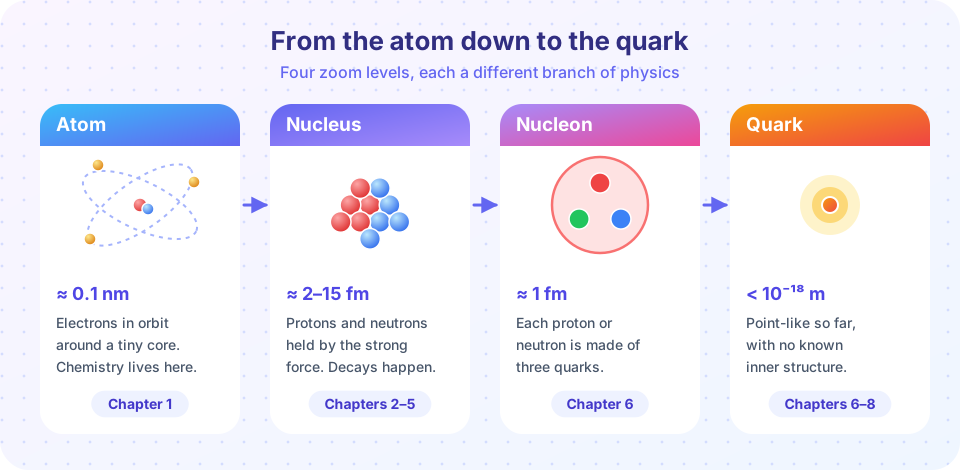
Every atom you have ever touched has a heart that is about a hundred thousand times smaller than the atom itself. That heart, the nucleus, powers the Sun, heats the inside of the Earth, lights up hospital scanners and, in the wrong hands, destroys cities. Go one step deeper and the protons and neutrons inside it turn out to be built from still smaller things. This course follows that journey from the atom down to the quark, and then out to the biggest machines and the earliest moments of the universe.
What you will learn
- What the nucleus is made of, how big it is and why it holds together.
- Why some nuclei are unstable, and how to calculate decay rates, energies and doses.
- How fission reactors, fusion stars and nuclear weapons work in principle, without any secrets, only physics.
- What the Standard Model says the universe is built from, and what it cannot yet explain.
- How accelerators and detectors turn invisible particles into data you can analyze.
Key terms
Nucleus: the tiny, dense, positively charged core of an atom, made of protons and neutrons.
Nucleon: a proton or a neutron; the word for either inside a nucleus.
Radioactivity: the spontaneous change of an unstable nucleus, with emission of radiation.
Elementary particle: a particle with no known internal structure, such as the electron or a quark.
Standard Model: the current theory of the elementary particles and three of the four forces.
Who this course is for
You may be a high-school student who found a physics textbook chapter too short, a first-year university student, or an adult who wants to understand the news about reactors, medical isotopes or the Large Hadron Collider. We assume you can use algebra, powers of ten and a calculator, and that you have met energy, electric charge and waves in an introductory physics course. Calculus helps in a few places, but every idea that needs it comes with a plain-language version and a runnable example.
How the course is organized
The nine chapters build on each other. Here is the whole map at a glance. Use the arrow keys or the buttons to move through it.
Chapter 1: Getting Started
Chapter 2: Nuclear Structure
Chapter 3: Radioactivity and Decay
Chapter 4: Nuclear Reactions
Chapter 5: Fission and Fusion
Chapter 6: The Standard Model
Chapter 7: Accelerators and Detectors
Chapters 8 and 9
How to study
Read each lesson with a pencil. Before a worked example, cover the solution and try the first step yourself. Run every interactive example, then change one number and predict what will happen before you press Run. Finish with the quiz and read the explanation of every answer, including the ones you got right. After each chapter there is a review lesson with a one-page picture and a longer quiz; treat it as a checkpoint before moving on.
Keep a small notebook of constants you will use over and over. A good start:
| Quantity | Value |
|---|---|
| Speed of light, c | 2.99792458 × 10⁸ m/s |
| Elementary charge, e | 1.602176634 × 10⁻¹⁹ C |
| 1 eV | 1.602176634 × 10⁻¹⁹ J |
| Atomic mass unit, u | 931.494 MeV/c² |
| Proton rest energy | 938.272 MeV |
| ħc | 197.327 MeV·fm |
Common misconceptions
"The nucleus is a tiny solar system." Electrons do not orbit like planets, and nucleons do not circle each other. Both are described by quantum mechanics, with probability clouds instead of orbits.
"Radioactive means dangerous in every amount." Radioactivity is natural: your own body undergoes several thousand radioactive decays every second. What matters is the dose, the type of radiation and the exposure time, which the course quantifies.
Try it
First, a calculator for the ladder of sizes in the picture. Run it, then change the sizes and see how the ratios move.
Press Run (or Ctrl + Enter) to see the result here.
Program input · what you'd type while the program runs
Type the answers before you press Run, one per line. Each time the program reads a line (with input()), it gets the next line from this box.
Second, an interactive picture. Drag the slider to build a nucleus of any mass number A and watch its radius grow as the cube root of A.
Check your understanding
Quick check · 4 questions
of 4 answered You scored / 4 · perfect!
-
1. Roughly how many times smaller than an atom is a typical nucleus?
An atom is about 10⁻¹⁰ m across and a nucleus about 10⁻¹⁵ m, so the ratio is about 10⁵. -
2. What is a nucleon?
Nucleon is the common name for the two particles found in nuclei, the proton and the neutron. -
3. Which description of the Standard Model is correct?
The Standard Model covers the strong, weak and electromagnetic forces; gravity is not included. -
4. Which statement about radioactivity is true?
Radioactivity is natural; potassium-40 and carbon-14 in your body decay every second. Risk depends on dose, type and time.
Summary
- The course follows the zoom from atom to nucleus to nucleon to quark.
- Nine chapters: foundations, structure, decay, reactions, fission and fusion, the Standard Model, accelerators and detectors, cosmic frontiers, and projects.
- You need algebra, powers of ten and basic physics; every runnable example can be changed and re-run.
- Study actively: predict before you run, and finish every lesson with its quiz.
Track your progress
Create a free account to tick off lessons and pick up where you left off on any device.
of Nuclear and Particle Physics lessons completed