


















Lesson 49 of 51 · Projects and Practice
Glossary: Nuclear and Particle Physics
A glossary of about 60 key terms from fission and fusion, the Standard Model, accelerators and detectors, and cosmology, each defined briefly and linked to its lesson.
Physics has its own vocabulary, and much of the difficulty of a new topic is simply learning the words. This glossary collects the key terms from the second half of the course, with one-line definitions and a link to the lesson where each is explained. Use it as a checklist: if you cannot explain a term in your own words, follow the link.
What you will learn
- The meaning of about sixty core terms.
- Which lesson to revisit for each one.
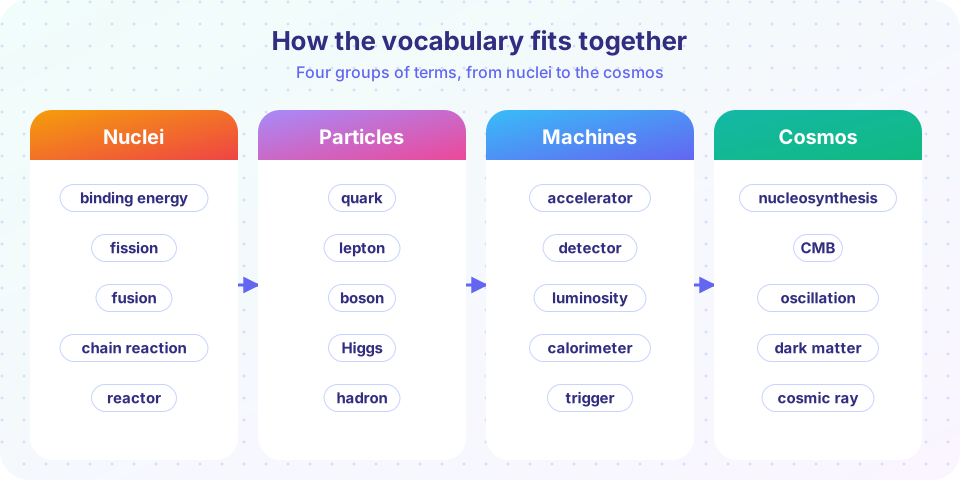
- How the terms group into nuclei, particles, machines and cosmos.
Key terms
How to use this page. Skim a group, cover the right-hand column and try to define each term aloud. Anything you miss goes on your revision list.
Nuclei: fission and fusion
| Term | Meaning | Lesson |
|---|---|---|
| Binding energy | Energy needed to pull a nucleus into separate nucleons; equals the mass defect times c² | Big picture |
| Chain reaction | Self-sustaining sequence in which neutrons from fission cause further fissions | Fission |
| Control rod | Neutron absorber inserted into a reactor to lower k | Reactors |
| Cross-section | Effective target area for a reaction; unit barn = 10⁻²⁸ m² | Fission |
| Decay heat | Heat from radioactive decay of fission products after shutdown | Reactors |
| Delayed neutron | Neutron emitted seconds after fission by a decaying fission product | Fission |
| Fertile | A nuclide that becomes fissile after neutron capture (²³⁸U, ²³²Th) | Fission |
| Fissile | A nuclide that fissions with slow neutrons (²³⁵U, ²³⁹Pu) | Fission |
| Fission | Splitting of a heavy nucleus into lighter fragments plus neutrons | Fission |
| Fusion | Joining of light nuclei into a heavier one | Fusion in stars |
| Gamow peak | Energy window where most fusion happens, from thermal tail times tunneling | Fusion in stars |
| Lawson criterion | Condition on n T τ for a fusion plasma to ignite | Fusion power |
| Moderator | Material that slows fast neutrons without absorbing them | Reactors |
| Multiplication factor k | Average number of neutrons per generation that cause new fissions | Fission |
| Plasma | Gas of free electrons and ions | Fusion power |
| Q-value | Net energy released by a reaction | Big picture |
| Reactivity | Fractional deviation from criticality, (k − 1)/k | Reactors |
| Tokamak | Doughnut-shaped magnetic confinement device | Fusion power |
| Tunneling | Quantum passage through a barrier that is classically forbidden | Fusion in stars |
Particles: the Standard Model
| Term | Meaning | Lesson |
|---|---|---|
| Antiparticle | A particle with the same mass and opposite charges | Big picture |
| Baryon | A hadron of three quarks (baryon number 1) | Quarks |
| Boson | A particle with integer spin; force carriers and the Higgs | Big picture |
| Branching ratio | Fraction of decays going into a given final state | Conservation |
| Color charge | The charge of the strong force: red, green, blue | Quarks |
| Confinement | Quarks are never seen alone; only color-neutral hadrons appear | Quarks |
| Electroweak theory | Unified description of electromagnetism and the weak force | Forces |
| Fermion | A particle with half-integer spin; quarks and leptons | Big picture |
| Feynman diagram | A picture of a process in which each piece represents a term in a calculation | Conservation |
| Gauge boson | Spin-1 force carrier: photon, gluon, W, Z | Forces |
| Generation | One of three sets of quarks and leptons with the same charges but increasing mass | Big picture |
| Hadron | A particle made of quarks | Quarks |
| Higgs boson | The quantum of the Higgs field, 125 GeV, found in 2012 | Forces |
| Lepton | A fermion that does not feel the strong force | Quarks |
| Meson | A hadron of one quark and one antiquark | Quarks |
| Quark | A fermion that feels the strong force; six flavors | Quarks |
| Strangeness | Quantum number counting strange antiquarks minus strange quarks | Quarks |
| Vacuum expectation value | The Higgs field's nonzero value in empty space, 246 GeV | Forces |
| Virtual particle | A short-lived exchange particle in a force | Forces |
Machines: accelerators and detectors
| Term | Meaning | Lesson |
|---|---|---|
| Calorimeter | Detector that absorbs particles and measures their energy | Detectors |
| Cherenkov radiation | Light emitted by a particle faster than light in the medium | Detectors |
| Collider | Machine in which two beams collide head-on | Big picture |
| Invariant mass | Mass computed from the energies and momenta of decay products | Detectors |
| Jet | A narrow spray of hadrons from a quark or gluon | Detectors |
| Luminosity | Measure of the collision intensity; rate = σ L | Accelerators |
| RF cavity | Metal cavity with an oscillating electric field that accelerates bunches | Accelerators |
| Significance | Number of standard deviations by which a signal exceeds background | Detectors |
| Synchrotron radiation | Radiation from charged particles on curved paths | Accelerators |
| Trigger | System that decides in real time which collisions to record | Big picture |
Cosmos
| Term | Meaning | Lesson |
|---|---|---|
| Baryon asymmetry | The excess of matter over antimatter, η ≈ 6×10⁻¹⁰ | Big picture |
| CMB | Relic radiation from recombination, now 2.7255 K | Big picture |
| Cosmic ray | A high-energy particle from space | Cosmic rays |
| Dark energy | Component driving accelerated expansion | Dark sector |
| Dark matter | Unseen matter detected by its gravity | Dark sector |
| Deuterium bottleneck | Delay in nucleosynthesis caused by photodissociation of deuterium | Nucleosynthesis |
| GZK cutoff | Suppression of protons above about 5×10¹⁹ eV from collisions with CMB photons | Cosmic rays |
| Neutrino oscillation | Change of neutrino flavor with distance, due to mass differences | Neutrinos |
| Nucleosynthesis | Formation of light nuclei in the first minutes | Nucleosynthesis |
| Redshift | Stretching of light's wavelength by cosmic expansion | Big picture |
| WIMP | Hypothetical weakly interacting massive particle, a dark matter candidate | Dark sector |
Try it
Press Run (or Ctrl + Enter) to see the console output here.
No output.
Check your understanding
Quick check · 5 questions
of 5 answered You scored / 5 · perfect!
-
1. Which term means a hadron made of one quark and one antiquark?
Mesons are q q̄ pairs; baryons are qqq. -
2. What is the term for the non-zero value of the Higgs field in empty space?
The vacuum expectation value is about 246 GeV. -
3. Which term describes the delay of nucleosynthesis until the universe cools enough for deuterium to survive?
Photons break deuterium apart until kT is about 0.07 MeV. -
4. Which is a measure of collision intensity in an accelerator?
Event rate is cross-section times luminosity. -
5. A material that slows neutrons without absorbing many is called a...
Water, heavy water and graphite are moderators.
Summary
- The vocabulary falls into four groups: nuclei, particles, machines and cosmos.
- Each term has a precise meaning; use the links to revisit the lesson that explains it.
- Being able to define a term and give one number or example for it shows real understanding.
Track your progress
Create a free account to tick off lessons and pick up where you left off on any device.
of Nuclear and Particle Physics lessons completed