


















Lesson 6 of 51 · Nuclear Structure
Inside the Nucleus: Chapter 2 Overview
Preview chapter 2: nuclear size and density, binding energy and the mass defect, the liquid-drop model and the shell model with its magic numbers.
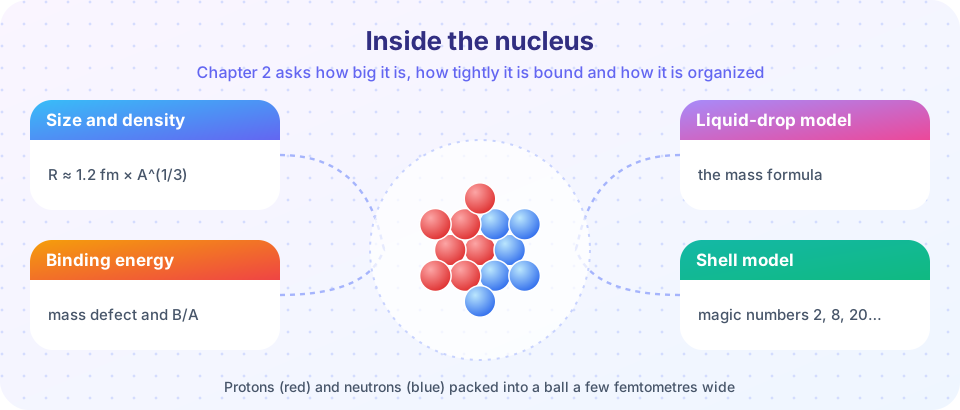
A nucleus is an astonishing object: dozens or hundreds of particles packed into a ball a few femtometres wide, held together by a force that fades to nothing within three femtometres. This chapter answers four questions about it. How big is it, and how dense? How much energy holds it together? Why does one simple picture, a charged drop of liquid, explain so much? And why do certain numbers of protons and neutrons, the magic numbers, make nuclei especially stable?
What you will learn
- Which questions chapter 2 answers, and how the four lessons fit together.
- Why a nucleus is described by two models that seem to contradict each other.
- What you should be able to calculate by the end of the chapter.
Key terms
Nuclear matter: the idealized, uniform material that nucleons form inside a large nucleus, with a density of about 0.16 nucleons per cubic femtometre.
Binding energy: the energy needed to pull a nucleus apart into free protons and neutrons.
Mass defect: the amount by which a nucleus is lighter than its separate nucleons.
Magic number: a number of protons or neutrons (2, 8, 20, 28, 50, 82, 126) that makes a nucleus unusually stable.
The big picture
Ordinary matter is mostly empty space, but nuclear matter is not. Wherever you cut a heavy nucleus the density is the same, about 2 × 10¹⁷ kg/m³; a teaspoonful would weigh about a billion tonnes. This tells us the nucleons touch their neighbours and little else: the force between them is strong at 1 fm and negligible beyond 3 fm.
Because the force saturates (each nucleon feels only its nearest neighbours), the binding energy grows roughly in proportion to the number of nucleons, about 8 MeV per nucleon for most nuclei. A few corrections tell you almost everything else: surface nucleons have fewer neighbours, protons repel each other, neutron-proton balance matters, and pairs of identical nucleons like to team up.
Two pictures capture this:
- The liquid-drop model treats the nucleus as a droplet of incompressible charged fluid. It predicts binding energies and explains fission.
- The shell model treats each nucleon as moving in an average potential well and filling quantum levels, like electrons in atoms. It predicts spins and the magic numbers.
Both are right, in different regimes. The nucleus is both a dense, strongly interacting liquid and a set of well-defined quantum orbits. Seeing why those pictures can live together is one of the best lessons of the chapter.
Lesson 2: Size and density
Lesson 3: Binding energy
Lesson 4: Liquid drop
Lesson 5: Shell model
What each lesson covers
- Nuclear Size and Density: how we measure nuclear radii by scattering, the formula R = r₀A^(1/3) and the soft edge.
- Binding Energy and the Mass Defect: how to compute B and B/A from atomic masses, and the famous binding energy curve.
- The Liquid-Drop Model and the Mass Formula: a five-term formula that gets binding energies within a few percent.
- The Shell Model and Magic Numbers: quantum levels, spin-orbit coupling and doubly magic nuclei.
- Chapter 2 Review: a one-page picture and a ten-question quiz.
Common misconceptions
"A nucleus is like a bag of marbles." Nucleons overlap in the sense that their quantum wave functions spread through the whole nucleus, and they are not tiny hard spheres.
"A nucleus is either a liquid or a shell structure." Both models are approximations of the same system, each good at certain questions.
Try it
Which nuclei are "magic"? This tiny program checks Z and N against the list, and the plot after it shows magic lines on the chart of nuclides.
Press Run (or Ctrl + Enter) to see the result here.
Program input · what you'd type while the program runs
Type the answers before you press Run, one per line. Each time the program reads a line (with input()), it gets the next line from this box.
Press Run (or Ctrl + Enter) to see the result here.
Program input · what you'd type while the program runs
Type the answers before you press Run, one per line. Each time the program reads a line (with input()), it gets the next line from this box.
Check your understanding
Quick check · 4 questions
of 4 answered You scored / 4 · perfect!
-
1. What does the shell model explain best?
The shell model fills quantum levels, explaining why certain nucleon numbers are special and what spin a nucleus has. -
2. Which statement about nuclear density is true?
Radius grows as A^(1/3), so volume grows in proportion to A, which makes the density constant. -
3. Why does binding energy grow roughly in proportion to A?
Saturation means each nucleon contributes about the same binding, so the total scales with the number of nucleons. -
4. Which of these is a magic number?
The magic numbers are 2, 8, 20, 28, 50, 82 and 126.
Summary
- Chapter 2 builds a picture of the nucleus from size, binding energy and two models.
- Nuclear matter has a constant density because the force saturates.
- The liquid drop explains energies and fission; the shell model explains spins and magic numbers.
- Each model is an approximation useful in its own regime.
Next: Nuclear Size and Density
Track your progress
Create a free account to tick off lessons and pick up where you left off on any device.
of Nuclear and Particle Physics lessons completed