


















Lesson 25 of 51 · Fission and Fusion
Fission and Fusion: The Big Picture
Why splitting heavy nuclei and joining light ones both release energy: the binding energy curve, mass defect, Q-values and a first look at the chapter.
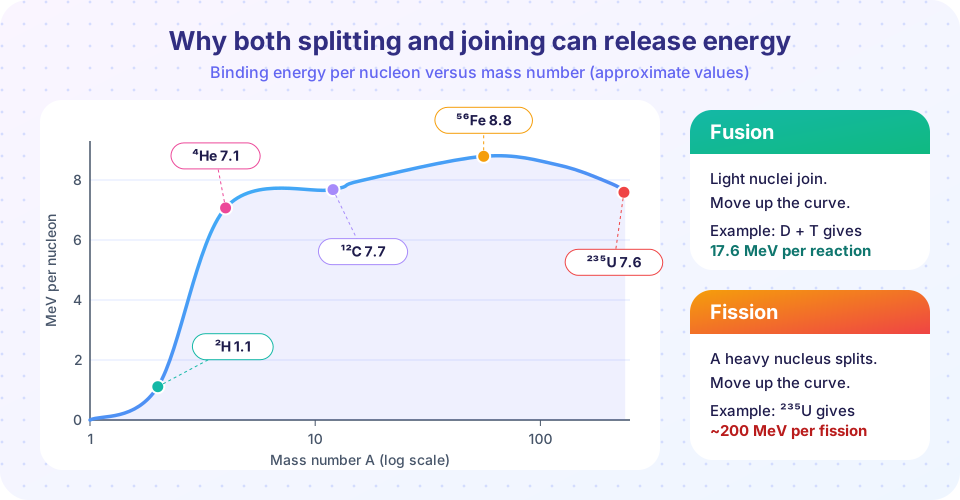
Two very different processes power the Sun and the nuclear plants on Earth. In fusion, small nuclei join to make a bigger one. In fission, a very large nucleus splits into two smaller ones. It sounds contradictory that both release energy, but one picture explains it: the curve of binding energy per nucleon.
This chapter follows that picture from the physics of a single reaction to chain reactions, reactors, stars and fusion power plants. This first lesson gives you the map.
What you will learn
- Why a nucleus has less mass than its separate protons and neutrons.
- How to read the binding energy per nucleon curve and where fusion and fission sit on it.
- How to compute a reaction's Q-value from atomic masses.
- A quick estimate of the energy of a fission and of a fusion reaction.
- What the rest of this chapter covers.
Key terms
Mass defect: the difference between the mass of the separate nucleons and the mass of the nucleus.
Binding energy: the energy equivalent (E = Δm c²) of the mass defect; the energy needed to pull a nucleus completely apart.
Q-value: the net energy released by a reaction, equal to (mass in − mass out) × c².
Fission: a heavy nucleus splits into two lighter nuclei (plus neutrons).
Fusion: two light nuclei merge into a heavier one.
Mass turns into energy
A helium-4 nucleus contains two protons and two neutrons. Add up their separate masses and you get slightly more than the mass of the nucleus. The missing mass is about 0.0304 u, which Einstein's relation E = Δm c² converts to 28.3 MeV. That is the helium-4 binding energy: you would have to supply that much energy to pull it apart into four free nucleons.
The unit conversion you will use constantly is 1 u = 931.494 MeV/c². So a mass change of 0.001 u is about 0.93 MeV.
Dividing the binding energy by the number of nucleons gives the average binding per nucleon. For helium-4 that is 28.3 / 4 ≈ 7.07 MeV. This is the quantity plotted in the figure above.
Reading the curve
Look at the curve of binding energy per nucleon B/A against mass number A:
- It rises quickly for the lightest nuclei. Deuterium (²H) has only about 1.1 MeV per nucleon, but helium-4 jumps to 7.1.
- It rises more slowly and peaks near iron-56 and nickel-62 at about 8.8 MeV per nucleon.
- It then falls gently. Uranium-235 has about 7.6 MeV per nucleon.
A system tends to release energy when it moves to a more tightly bound state. Two moves go uphill on the curve:
- Fusion. Join light nuclei and
B/Aincreases, so energy is released. The gain per nucleon is large because the curve is steep at the left. - Fission. Split a heavy nucleus into two medium ones and
B/Aincreases by roughly 0.8 to 0.9 MeV per nucleon. The gain per nucleon is smaller, but there are so many nucleons (235) that the total is large.
Iron-group nuclei sit at the top, so nothing is gained by fusing or splitting them. That is why massive stars stop producing energy once their cores fill with iron.
Two quick estimates
Fission of uranium-235. Splitting a nucleus with A = 236 into two fragments near A = 118 each, with B/A ≈ 8.5 MeV for the fragments and 7.6 MeV for the parent:
Q ≈ 236 × (8.5 − 7.6) MeV ≈ 212 MeV
The measured figure is about 200 MeV per fission. The estimate lands close because the curve is almost flat over the relevant range.
Fusion of deuterium and tritium. Use real masses:
D  = 2.014102 u      T = 3.016049 u      sum  = 5.030151 u
⁴He = 4.002603 u     n = 1.008665 u      sum  = 5.011268 u
Δm = 0.018883 u   →   Q = 0.018883 × 931.494 = 17.59 MeV
A single fusion event gives less energy than a fission, but it involves only 5 nucleons, so the energy per kilogram of fuel is about four times larger.
Why not just fuse or split everything?
A reaction that releases energy is not necessarily easy to start.
- Fusion has to push positively charged nuclei together against electric repulsion. That needs temperatures of tens of millions of degrees, or very high pressure.
- Fission has an almost opposite problem. A uranium nucleus is only barely stable and a slow neutron is enough to trigger it, but then you must control the resulting chain reaction.
These two contrasts shape everything in the chapter: how reactors are built, how stars shine, and why fusion power is hard.
Binding energy
The curve
Two ways to gain
Both climb toward the peak
This chapter
Common misconceptions
"Mass is converted into energy and disappears." Mass is not destroyed; the system's total energy is conserved. The products simply have less rest mass because some energy left as motion and radiation.
"Fusion is more powerful than fission, so it is more dangerous." Per reaction fission gives more energy; per kilogram fusion gives more. A fusion plasma holds only a few grams of fuel at a time and stops if conditions fail.
"Splitting always releases energy." Only nuclei heavier than the iron peak gain energy by splitting. Splitting iron costs energy.
Try it
Press Run (or Ctrl + Enter) to see the result here.
Program input · what you'd type while the program runs
Type the answers before you press Run, one per line. Each time the program reads a line (with input()), it gets the next line from this box.
Press Run (or Ctrl + Enter) to see the console output here.
No output.
Check your understanding
Quick check · 5 questions
of 5 answered You scored / 5 · perfect!
-
1. Why does a helium-4 nucleus have less mass than two protons plus two neutrons?
The nucleus is bound, so energy was released when it formed. By E = Δm c² the system therefore has less rest mass. -
2. Where does the binding energy per nucleon curve peak?
The peak is near A = 56 to 62 at about 8.8 MeV per nucleon. Nuclei there are the most tightly bound. -
3. Which statement about fission is correct?
Heavy nuclei sit on the falling side of the curve. Splitting them moves nucleons toward the peak. -
4. A reaction has total mass 0.0189 u smaller after than before. About how much energy is released?
0.0189 u × 931.5 MeV/u is about 17.6 MeV. This is the D–T fusion reaction. -
5. Why is fusion energy per kilogram of fuel larger than fission energy per kilogram?
A D–T reaction gives 17.6 MeV from 5 nucleons (3.5 MeV each); fission gives about 200 MeV from 236 nucleons (0.85 MeV each).
Summary
- A bound nucleus has less mass than its separate nucleons; the difference times c² is the binding energy.
- Binding energy per nucleon rises from hydrogen to a peak at iron-56/nickel-62 (about 8.8 MeV) and then falls.
- Fusion of light nuclei and fission of heavy ones both increase B/A and release energy.
- Fission gives about 200 MeV per event; D–T fusion gives 17.59 MeV per event but more energy per kilogram.
- A reaction's Q-value is the mass difference times 931.494 MeV per u.
Track your progress
Create a free account to tick off lessons and pick up where you left off on any device.
of Nuclear and Particle Physics lessons completed