


















Lesson 48 of 51 · Projects and Practice
Practice Set: Nuclear and Particle Physics
Sixteen worked practice problems covering Q-values, fission, reactors, stellar fusion, the Standard Model, accelerators, nucleosynthesis, neutrinos and cosmic rays, with Python checks.
Reading is not the same as being able to calculate. This practice set has sixteen problems across the chapters of this part of the course, ranging from one-line estimates to multi-step calculations. Try each one on paper first, then compare with the answers and the Python check-code.
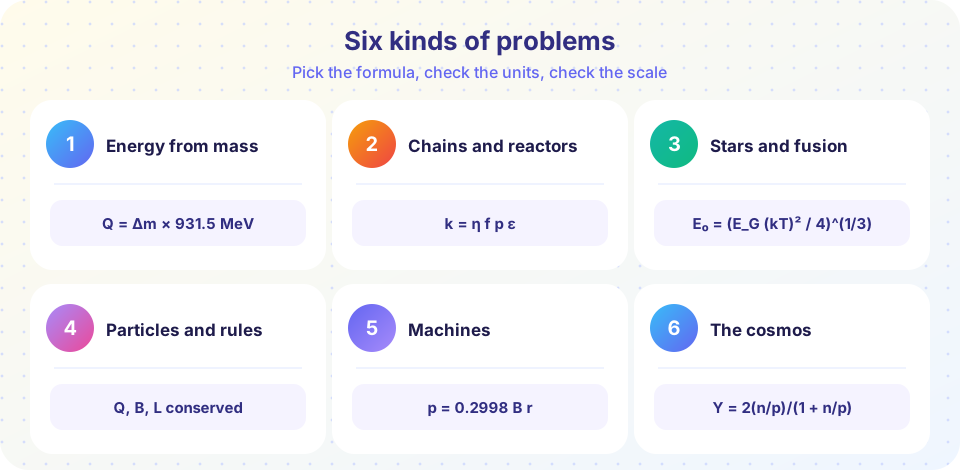
What you will learn
- How to choose the right relation for a nuclear or particle problem.
- Typical sizes: MeV for nuclei, keV for stellar plasma, GeV to TeV for colliders.
- How to check an answer by units and order of magnitude.
- Which conservation laws to test first.
Key terms
Order of magnitude: the nearest power of ten; a quick sanity check on a result.
Natural units: units with ħ = c = 1; masses, momenta and energies are all quoted in eV or GeV.
Conversion constants: 1 u = 931.494 MeV/c², ħc = 197.327 MeV fm, 1 eV = 1.602×10⁻¹⁹ J.
The problems
Energy and nuclei
- Q-value. Using atomic masses
D = 2.014102 u,³He = 3.016029 u,n = 1.008665 u, find the energy released inD + D → ³He + n. - Energy per gram. If every nucleus in 1 g of ²³⁵U fissions and each fission releases 200 MeV, how much energy is released? How much coal (24 MJ/kg) is equivalent?
Reactors
- Multiplication. A core has
η = 1.65,f = 0.71,p = 0.87,ε = 1.02and a non-leakage probability of 0.97. Findkand the reactivity in pcm (1 pcm = 10⁻⁵). - Prompt jump. For
β = 0.0065, a step reactivity ofρ = 0.0026is inserted. By what factor does the power jump immediately (before the delayed neutrons matter)? Usen₂/n₁ = β/(β − ρ).
Fusion
- Gamow peak. For p + p fusion with
E_G = 493 keV, find the Gamow peak energy atT = 2×10⁷ K. - Lawson. A D–T plasma has
n = 2×10²⁰ m⁻³andT = 14 keV. What energy confinement time reaches the ignition triple product3×10²¹ keV s m⁻³?
Standard Model
- Quark content. The Ξ⁻ baryon has quark content dss. Find its charge, baryon number and strangeness.
- Conservation. Decide whether each is allowed and, if forbidden, which law it breaks: (a)
n → p + e⁻ + ν_μ, (b)π⁻ + p → K⁰ + Λ(via the strong force), (c)e⁻ → ν_e + γ. - Decay kinematics. A K⁺ (493.677 MeV/c²) decays at rest to a muon (105.658) and a massless neutrino. Find the momentum of the muon.
Accelerators
- Bending. What bending radius is needed for a 1 TeV/c proton beam in 5 T dipoles?
- √s. A 50 GeV proton beam hits a proton at rest. Find √s, and compare with two 50 GeV beams colliding head-on.
- Event counts. A process has σ = 1 pb and the luminosity is
2×10³⁴ cm⁻² s⁻¹. How many events in a year of10⁷s of running?
Cosmos
- BBN. If
n/p = 1/7at nucleosynthesis, find the helium mass fraction and the number ratio He/H. - Oscillation. A muon neutrino beam of 1 GeV travels 500 km. With
Δm² = 2.5×10⁻³ eV²andsin²2θ = 0.95, what is the survival probability? - Larmor radius. Find the radius of curvature of a
10¹⁷ eVproton in a 3 µG field. - CMB. What would the CMB temperature be at redshift 7?
Check the numbers
Press Run (or Ctrl + Enter) to see the result here.
Program input · what you'd type while the program runs
Type the answers before you press Run, one per line. Each time the program reads a line (with input()), it gets the next line from this box.
Press Run (or Ctrl + Enter) to see the result here.
Program input · what you'd type while the program runs
Type the answers before you press Run, one per line. Each time the program reads a line (with input()), it gets the next line from this box.
Worked answers
Δm = 2×2.014102 − (3.016029 + 1.008665) = 0.003510 u, soQ ≈ 3.27 MeV.- About
8.2×10¹⁰ J, which is 22.8 MWh, equivalent to 3.4 tonnes of coal. k ≈ 1.0084, so reactivity is about+833 pcm(supercritical; control rods would absorb the excess).- The power jumps by a factor
0.0065/0.0039 ≈ 1.67within a fraction of a second, then rises more slowly. kT ≈ 1.72 keV, soE₀ ≈ 7.2 keV; the peak moves up with temperature asT^(2/3).τ ≈ 1.07 s.- Charge −1, baryon number 1, strangeness −2.
- (a) forbidden: the neutrino flavor must be antielectron (lepton family number); (b) allowed: strangeness balances (0 → +1 −1); (c) forbidden: charge changes from −1 to 0.
p ≈ 235.5 MeV/c.r ≈ 667 m.- Fixed target gives
√s ≈ 9.8 GeV; the collider gives 100 GeV, ten times more. rate = 0.02 s⁻¹, so about2×10⁵events per year.Y = 0.25and He/H≈ 0.083.- The phase is 1.584 rad, so
sin² ≈ 0.9998and the survival probability is about0.05(a deep minimum). r ≈ 36 pc.T = 2.7255 × 8 ≈ 21.8 K.
Strategy notes
- Start every problem by writing the principle and the units. If a quantity should be in GeV/c and your answer is in joules, something has slipped.
- For reactions, check conservation of charge, baryon number and lepton number before you compute anything.
- Many numbers in nuclear and particle physics are rounded: expect agreement to 3 significant figures at best, and do not trust more than your input data.
Check your understanding
Quick check · 4 questions
of 4 answered You scored / 4 · perfect!
-
1. A quantity should be a momentum, and your answer has units of MeV. What do you do?
In particle physics momenta are quoted as pc in MeV or as MeV/c; always keep track of c. -
2. A reaction conserves charge and baryon number but changes electron-lepton number from 0 to 1 without a compensating antineutrino. Is it allowed?
Lepton family numbers are conserved in all observed charged-lepton reactions. -
3. In which situation is √s largest for the same beam energy of 50 GeV?
√s = 100 GeV in a collider but only about 9.8 GeV with a fixed target. -
4. Doubling the temperature of the Sun's core would move the Gamow peak by a factor of about...
E₀ ∝ (kT)^(2/3), so doubling T multiplies it by 2^(2/3) ≈ 1.59.
Summary
- Name the principle, check units, and check the order of magnitude for each problem.
- Typical nuclear energies are MeV, stellar plasma keV, collider energies GeV to TeV, cosmic rays up to 10²⁰ eV.
- Test conservation laws first when deciding whether a reaction is allowed.
- Python checks make sure arithmetic matches.
Track your progress
Create a free account to tick off lessons and pick up where you left off on any device.
of Nuclear and Particle Physics lessons completed