


















Lesson 13 of 51 · Radioactivity and Decay
The Decay Law and Half-Life
Derive the exponential decay law, use half-life, mean life and activity, simulate random decays and date objects with carbon-14 and uranium-lead.
Take a thousand identical radioactive atoms. After one half-life, about five hundred are left. After another half-life, about two hundred and fifty. Yet no one can say which atoms will be the survivors. This mixture of total unpredictability for one nucleus and clockwork regularity for many is the hallmark of quantum mechanics, and it gives us one of the most useful formulas in science: the exponential decay law. It lets us date a mummy, a mammoth and the Earth itself.
What you will learn
- State and derive the exponential decay law N = N₀e^(−λt).
- Convert between decay constant λ, half-life T½ and mean life τ.
- Calculate activity A = λN and use the becquerel and the curie.
- Explain statistical fluctuations in counting and simulate decays.
- Use radiocarbon and uranium-lead dating.
Key terms
Decay constant λ: the probability per unit time that a nucleus decays (units 1/s).
Half-life T½: the time for half the nuclei in a sample to decay.
Mean life τ: the average lifetime of a nucleus, τ = 1/λ.
Activity A: the number of decays per second, A = λN, in becquerel (1 Bq = 1 decay per second).
Radiometric dating: estimating an age from the ratio of a radioactive isotope to its decay product.
Deriving the law
Suppose that each nucleus has the same probability λ of decaying in each unit of time, independent of its age and of the other nuclei. In a small time dt, the expected number of decays out of N nuclei is λN dt, so
dN/dt = −λN
The solution is
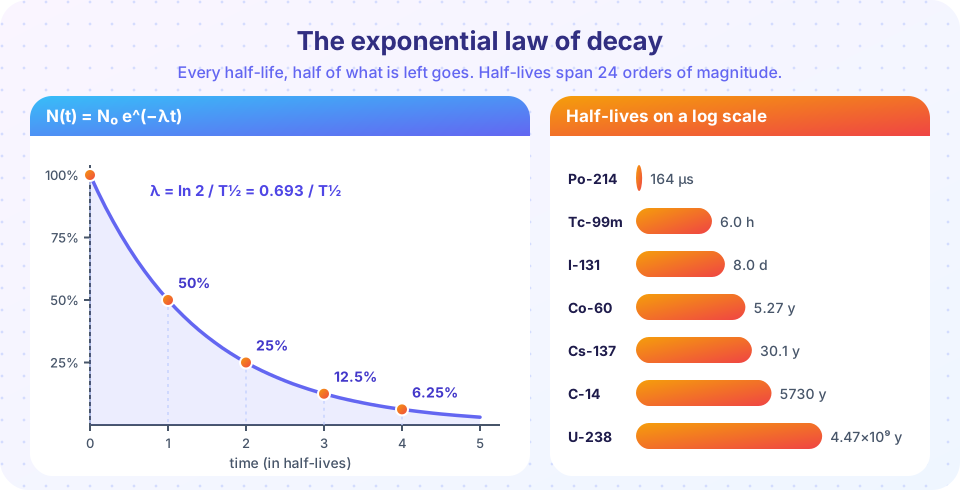
N(t) = N₀ e^(−λt)
where N₀ is the number at t = 0. The activity A = λN decays with the same factor: A(t) = A₀ e^(−λt).
Half-life. Setting N = N₀/2 gives e^(−λT½) = 1/2, so
T½ = ln 2 / λ = 0.693 / λ
Mean life. The average time a nucleus survives is τ = 1/λ = T½/ln 2 = 1.443 T½. After one mean life, 1/e ≈ 37% of the nuclei remain.
After n half-lives the fraction left is 2⁻ⁿ:
| n | 1 | 2 | 3 | 4 | 5 | 10 |
|---|---|---|---|---|---|---|
| fraction left | 50% | 25% | 12.5% | 6.25% | 3.1% | 0.098% |
The number of half-lives does not have to be a whole number: after t, the fraction is 2^(−t/T½).
Half-lives across nature
| Nuclide | Half-life | Mode | Role |
|---|---|---|---|
| ²¹⁴Po | 164 µs | α | member of the uranium chain |
| ⁹⁹ᵐTc | 6.01 h | γ | medical imaging |
| ¹³¹I | 8.02 d | β⁻ | thyroid treatment |
| ⁶⁰Co | 5.27 y | β⁻ | sterilization and radiotherapy |
| ¹³⁷Cs | 30.1 y | β⁻ | fission product |
| ¹⁴C | 5,730 y | β⁻ | radiocarbon dating |
| ²³⁸U | 4.47 × 10⁹ y | α | primordial, dating rocks |
Activity and units
The SI unit of activity is the becquerel, 1 Bq = 1 decay per second. The older curie (Ci) was defined from the activity of 1 gram of radium-226, and today 1 Ci = 3.7 × 10¹⁰ Bq exactly. The specific activity is the activity per unit mass; it is large for short-lived isotopes.
Worked example 1: iodine-131. T½ = 8.02 days, so λ = 0.693/8.02 = 0.0864 per day. After 30 days the fraction left is 2^(−30/8.02) = 2^(−3.74) ≈ 0.075, or about 7.5%.
Worked example 2: one gram of radium-226. The number of atoms is N = (1 g / 226.0 g/mol) × 6.022 × 10²³ = 2.66 × 10²¹. With T½ = 1,600 years = 5.05 × 10¹⁰ s, λ = 0.693 / 5.05 × 10¹⁰ = 1.37 × 10⁻¹¹ per second, and A = λN = 3.66 × 10¹⁰ Bq, just about 1 curie.
Random, but predictable in the mass
Decay is a quantum process: the probability is exact but the outcome of one event is not. Counting decays is therefore a Poisson process: if you expect N counts, the typical fluctuation is √N, a relative uncertainty of 1/√N. A hundred counts give 10%, ten thousand counts give 1%. This is why a Geiger counter clicks randomly even for a constant source, and why precise measurements need long counting times. The simulation below shows how smooth the law becomes as N grows.
Radiometric dating
Radiocarbon. Cosmic-ray neutrons convert nitrogen-14 in the atmosphere into carbon-14, which mixes into carbon dioxide and enters plants and animals. While an organism lives, its carbon contains about one carbon-14 atom per 10¹² carbon atoms. After death the carbon-14 is no longer replenished and decays with a half-life of 5,730 years. The remaining fraction f gives the age
t = (T½ / ln 2) × ln(1/f)
If a wooden object has 25% of the original carbon-14, two half-lives have passed: t = 11,460 years. The method works up to about 50,000 years, when only about 0.2% is left. Because the atmospheric carbon-14 level varied in the past, real dates are calibrated against tree rings and other records. Willard Libby received the 1960 Nobel Prize in Chemistry for the method.
Uranium-lead. ²³⁸U decays through a chain to stable ²⁰⁶Pb with an overall half-life of 4.47 billion years. Measuring the ratio of lead to uranium in a mineral gives its age. This method dates the oldest meteorites to about 4.57 billion years and the Earth to about 4.54 billion years.
Several decay modes at once
A nucleus can have several possible decay modes, each with its own constant. The total constant is the sum, λ = λ₁ + λ₂ + ..., and the branching ratio of mode i is λᵢ/λ. For potassium-40 about 89% of decays are β⁻ and 11% are electron capture, both with the same overall half-life of 1.25 billion years.
Common misconceptions
"After two half-lives everything has decayed." After two half-lives 25% remains. The sample never reaches zero in a mathematical sense; it only becomes too small to detect.
"Heating or chemical reactions change the half-life." For nearly all decays the half-life is fixed to extraordinary precision, since it depends on the nucleus. Tiny effects (a fraction of a percent for electron capture in some isotopes) exist but do not matter for dating.
"A short half-life means a weak source." Per atom a short half-life means a high activity: a source of 1 g of a short-lived isotope is far more active than 1 g of a long-lived one.
Try it
First, a Monte Carlo experiment. Each remaining nucleus has the same probability of decaying in each time step. Compare the simulation with the exponential curve, for 1,000 nuclei and for only 50.
Press Run (or Ctrl + Enter) to see the result here.
Program input · what you'd type while the program runs
Type the answers before you press Run, one per line. Each time the program reads a line (with input()), it gets the next line from this box.
Second, calculators for the worked examples: iodine, radium and carbon dating.
Press Run (or Ctrl + Enter) to see the result here.
Program input · what you'd type while the program runs
Type the answers before you press Run, one per line. Each time the program reads a line (with input()), it gets the next line from this box.
Finally, an interactive picture of a hundred atoms. Move the sliders and watch the survivors.
Check your understanding
Quick check · 5 questions
of 5 answered You scored / 5 · perfect!
-
1. A sample has a half-life of 6 hours. What fraction remains after 24 hours?
24 h is four half-lives, so the fraction is (1/2)⁴ = 1/16. -
2. What is the relation between half-life and decay constant?
From N = N₀e^(−λt) with N = N₀/2 you get T½ = ln 2 / λ ≈ 0.693/λ. -
3. A source has 5.0 × 10⁶ nuclei with λ = 2.0 × 10⁻⁵ s⁻¹. What is its activity?
A = λN = 2.0 × 10⁻⁵ × 5.0 × 10⁶ = 100 Bq. -
4. A bone contains 12.5% of its original carbon-14. How old is it (T½ = 5,730 years)?
12.5% = 1/8 = (1/2)³, so three half-lives: 3 × 5,730 = 17,190 years. -
5. A counter records 400 counts. What is the typical statistical uncertainty?
For a Poisson process the standard deviation is √N = 20, which is 5% of 400.
Summary
- N = N₀e^(−λt); A = λN; T½ = ln 2/λ = 0.693/λ; τ = 1/λ = 1.443 T½.
- After n half-lives the fraction left is 2⁻ⁿ; it never becomes exactly zero.
- Activity is measured in becquerel (decays per second); 1 Ci = 3.7 × 10¹⁰ Bq.
- Decays are random: counting N events has an uncertainty of √N.
- Carbon-14 (5,730 years) and uranium-lead dating turn the decay law into a clock.
Track your progress
Create a free account to tick off lessons and pick up where you left off on any device.
of Nuclear and Particle Physics lessons completed