


















Lesson 41 of 51 · Cosmic Frontiers
Big Bang Nucleosynthesis
How the first three minutes made helium-4, deuterium and lithium: the neutron-proton ratio, the deuterium bottleneck, the baryon density and the lithium problem.
Within the first few minutes after the Big Bang the universe was a nuclear reactor on the largest scale imaginable. It lasted only a few minutes, but it fixed the recipe of the cosmos: about three quarters hydrogen and a quarter helium by mass, plus a pinch of lithium. Stars later added only a few percent of heavier elements. This lesson follows the nuclear physics of that brief episode, and shows why the result is one of the cleanest tests of the Big Bang.
What you will learn
- Why the neutron-proton ratio freezes out at about 1/6.
- Why nucleosynthesis waits until about three minutes (the deuterium bottleneck).
- How to estimate the helium-4 mass fraction from the neutron-proton ratio.
- Why deuterium measures the density of ordinary matter.
- What the lithium problem is.
Key terms
Freeze-out: the moment when a reaction becomes too slow to keep particles in equilibrium.
Neutron-proton ratio n/p: the number of neutrons per proton in the early universe.
Deuterium bottleneck: the delay in nucleosynthesis caused by photons destroying deuterium nuclei.
Mass fraction Y_p: the proportion of baryon mass in helium-4.
Baryon-to-photon ratio η: the number of baryons per photon, about 6×10⁻¹⁰.
Step 1: setting the neutron-proton ratio
Neutrons are slightly heavier than protons, by Δm c² = 1.293 MeV. While the weak interactions (n + ν ↔ p + e⁻, n + e⁺ ↔ p + ν̄) are fast, the ratio follows a Boltzmann factor:
n/p = exp(−Δm c² / kT)
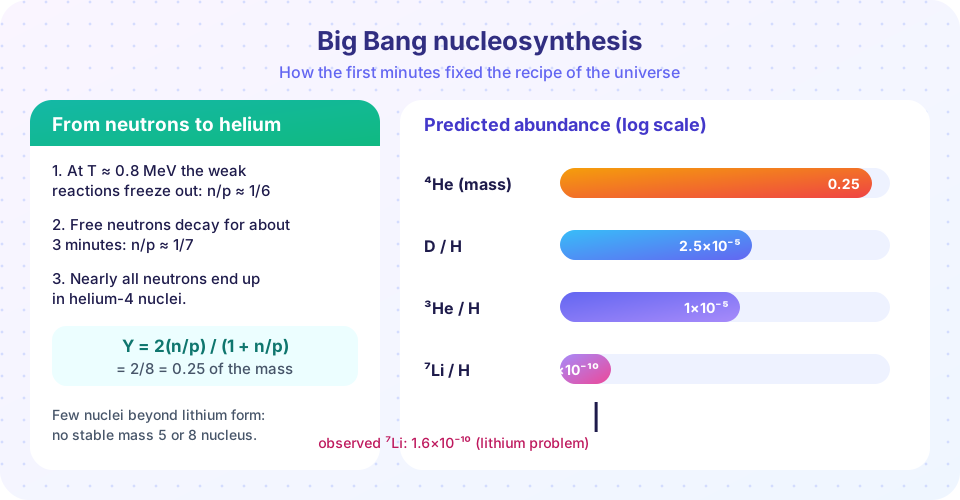
At kT = 10 MeV this is nearly 0.88, almost equal numbers. As the universe cools, protons become favoured. Around t ≈ 1 s (kT ≈ 0.8 MeV) the weak rates fall below the expansion rate and the ratio freezes at about exp(−1.29/0.8) ≈ 1/5 to 1/6.
After freeze-out, free neutrons still decay: n → p + e⁻ + ν̄ₑ with a mean life of about 880 s. So the ratio keeps falling, slowly. How long it falls depends on when nucleosynthesis begins.
Step 2: the deuterium bottleneck
To make helium, nucleons first need to form deuterium: p + n → d + γ. But the binding energy of deuterium is only 2.2 MeV, and the universe has more than a billion photons for every nucleon. Even at kT = 0.2 MeV, the high-energy tail of the photon distribution contains enough photons above 2.2 MeV to smash apart each deuteron as soon as it forms. Only when kT falls to about 0.07 MeV, at t ≈ 3 minutes, can deuterium survive. This is the bottleneck: nothing heavier can form until it opens.
By then the neutrons have been decaying for about 180 seconds, so
n/p ≈ (1/6) × exp(−180 / 880) ≈ 0.136 ≈ 1/7
Step 3: building helium
Once deuterium survives, reactions run quickly through ³H, ³He and finally ⁴He, which is very tightly bound (28.3 MeV). Almost every neutron ends up in a helium-4 nucleus. Since helium has two neutrons and two protons, the mass fraction of helium is
Y_p = 2 (n/p) / (1 + n/p)
With n/p = 1/7, Y_p = (2/7)/(8/7) = 0.25. Careful calculations give Y_p ≈ 0.247, and astronomers measuring metal-poor galaxies find about 0.245. The match is remarkable.
Nucleosynthesis stops at mass 7 because there is no stable nucleus with mass number 5 or 8, so reactions cannot build upward easily; only trace amounts of lithium-7 (and beryllium-7, which later decays to lithium) form. Carbon and heavier elements must wait for stars.
The baryon density from deuterium
The leftover amounts of deuterium, helium-3 and lithium depend on η, the baryon-to-photon ratio. More baryons means deuterium is destroyed more efficiently and ends up in helium, so less deuterium survives: the deuterium abundance D/H falls steeply with η (roughly ∝ η^(−1.6)). That makes it a sensitive baryometer. The measured D/H ≈ 2.5×10⁻⁵ in gas clouds at high redshift gives η ≈ 6×10⁻¹⁰, a baryon density of just 4 to 5% of the critical density. This value agrees independently with the one from the CMB. Galaxy motions and the CMB show far more gravitating matter than baryons can supply, so this result is a major argument that most matter is not made of baryons; see the lesson on dark matter.
The lithium problem
The agreement is good for helium-4 and deuterium. For lithium-7 there is a mismatch: BBN with the CMB-measured baryon density predicts about 5×10⁻¹⁰ Li/H, while old stars in our galaxy show about 1.6×10⁻¹⁰, three times less. Proposed explanations include stars destroying lithium, errors in nuclear reaction rates, and new physics. It remains unsolved.
Common misconceptions
"Nucleosynthesis made all the elements." The Big Bang made H, He and traces of Li. Carbon through iron come from stellar fusion, and heavier elements from supernovae and neutron star mergers.
"The helium fraction would be the same whatever the neutrons did." It is set by the neutron-proton ratio, which depends on the neutron-proton mass difference, the weak interaction and the expansion rate. Changing any of them changes Y_p.
"Helium formed because the universe was hot enough." The universe had to be cool enough: hot enough to fuse, but cool enough that photons do not break deuterium.
Try it
Press Run (or Ctrl + Enter) to see the result here.
Program input · what you'd type while the program runs
Type the answers before you press Run, one per line. Each time the program reads a line (with input()), it gets the next line from this box.
Press Run (or Ctrl + Enter) to see the result here.
Program input · what you'd type while the program runs
Type the answers before you press Run, one per line. Each time the program reads a line (with input()), it gets the next line from this box.
Check your understanding
Quick check · 5 questions
of 5 answered You scored / 5 · perfect!
-
1. Why is the neutron-proton ratio less than 1?
The equilibrium ratio is exp(−Δmc²/kT), which falls as kT drops. -
2. What delays nucleosynthesis until about 3 minutes?
Photons outnumber baryons by a billion, so deuterium survives only when kT is about 0.07 MeV. -
3. If n/p = 1/7 at nucleosynthesis, what is the helium mass fraction?
Y = 2(n/p)/(1 + n/p) = (2/7)/(8/7) = 0.25. -
4. What does the deuterium abundance measure?
More baryons destroy more deuterium, so D/H falls steeply with η. -
5. The lithium problem is that...
BBN predicts about 5×10⁻¹⁰ Li/H but stars show about 1.6×10⁻¹⁰.
Summary
- The neutron-proton ratio freezes near 1/6 at
t ≈ 1 s, then neutrons decay until deuterium forms (about 3 minutes), leavingn/p ≈ 1/7. - Nearly all neutrons end in helium-4, so
Y_p = 2(n/p)/(1 + n/p) ≈ 0.25. - The leftover deuterium, helium-3 and lithium-7 depend on the baryon-to-photon ratio
η ≈ 6×10⁻¹⁰. - The data confirm the hot Big Bang for H, ⁴He and D; lithium-7 remains a puzzle.
- Ordinary matter is only about 5% of the universe's energy budget.
Track your progress
Create a free account to tick off lessons and pick up where you left off on any device.
of Nuclear and Particle Physics lessons completed