


















Lesson 51 of 51 · Projects and Practice
Further Study: Where to Go Next
How to continue after this course: quantum mechanics, relativity, statistical mechanics, cosmology, statistics and computing, plus open questions, careers and hands-on projects.
You now know the main ideas of nuclear and particle physics: how nuclei hold energy, how that energy is released in reactors and stars, which particles and forces make up the Standard Model, how accelerators and detectors reveal them, and how the cosmos connects it all. This lesson maps out where to go from here, both within this site and beyond.
What you will learn
- Which topics deepen the tools used in this course.
- Which open questions drive current research.
- What kinds of projects and careers build on this subject.
- How to continue learning with data and simulations.
Key terms
Quantum field theory: the framework that combines quantum mechanics and special relativity; the language of the Standard Model.
Scattering theory: the calculation of reaction probabilities from interaction potentials.
Open data: real detector data released for public analysis.
Effective theory: a description valid at some energy scale without worrying about physics at much higher scales.
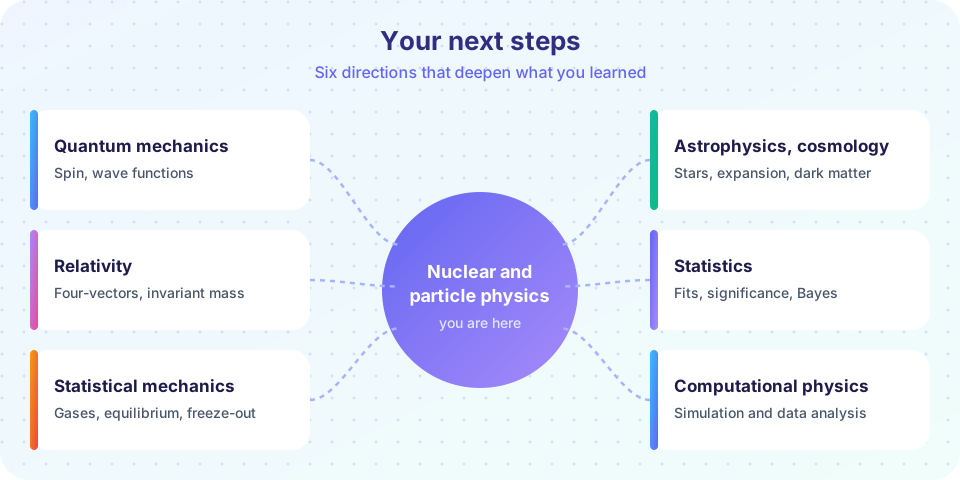
Six directions
| Direction | Why it helps | Where on this site |
|---|---|---|
| Quantum mechanics | Tunneling, spin, angular momentum and scattering are used throughout nuclear and particle physics | Quantum Mechanics, Advanced Quantum Mechanics |
| Relativity | Four-vectors, invariant mass and decay kinematics are relativity in practice | Relativity |
| Statistical mechanics | Thermal distributions, freeze-out and the early universe | Statistical Mechanics |
| Astrophysics and cosmology | Stars, expansion, dark matter and dark energy in depth | Astrophysics and Cosmology |
| Statistics | Fits, significance, Bayesian inference and the look-elsewhere effect | Probability and Statistics |
| Computational physics | Simulation, numerical methods and data analysis | Computational Physics |
If you want to see where the electromagnetic part of the Standard Model comes from, the Electrodynamics track is the natural companion, and the Classical Mechanics (Lagrangian) track introduces the action principle that underlies field theory.
What comes after: quantum field theory
The Standard Model is a quantum field theory. A typical university sequence is:
- Quantum mechanics, including angular momentum and perturbation theory.
- Special relativity with four-vectors, and classical field theory.
- Quantum electrodynamics (QED): Feynman rules, scattering amplitudes, renormalization.
- The gauge theories of the weak and strong interactions (QCD), and the Higgs mechanism.
- Specialized topics: neutrino physics, flavor physics, collider phenomenology, cosmology, lattice QCD.
Standard textbooks for these stages include David Griffiths' Introduction to Elementary Particles (an accessible first book), Kenneth Krane's Introductory Nuclear Physics, and, for field theory, the books of Peskin and Schroeder or Schwartz. Pick one at your level and work through the problems; reading alone is not enough.
Open questions
Research in the field is driven by questions that the Standard Model cannot answer:
- What is dark matter, and is it a particle? Does it interact with ordinary matter beyond gravity?
- Why is there more matter than antimatter?
- What sets the masses and mixings of the quarks and neutrinos, and why three generations?
- Why is the Higgs boson so much lighter than the Planck scale? (the hierarchy problem)
- Is the neutrino its own antiparticle? What is the mass ordering?
- Does the proton decay, on very long timescales?
- Can fusion produce net power economically?
- How do gravity and quantum mechanics fit together?
Hands-on ways to continue
- Open data. The CERN Open Data portal releases real events from the LHC experiments. With Python (NumPy, SciPy, matplotlib) you can repeat the invariant mass project of this course on real data.
- Cloud chamber. A simple chamber with dry ice and isopropyl alcohol shows the tracks of cosmic-ray muons and radioactive decays. (Handle dry ice and alcohol carefully, as in any lab.)
- Muon counting. A small scintillator and a few electronics parts can count cosmic-ray muons and show their angular distribution. Compare with the rates in this course.
- Simulations. Reproduce the projects of this chapter with your own parameters, or extend them: a second delayed-neutron group, a different background shape, a three-flavor oscillation.
Careers and fields
The skills you build here are used well beyond research physics: nuclear engineering and reactor operation, fusion energy, medical physics (radiotherapy, PET, proton therapy), radiation protection, accelerator technology, detector and electronics design, data science and machine learning for large datasets, and space science.
Try it
Press Run (or Ctrl + Enter) to see the result here.
Program input · what you'd type while the program runs
Type the answers before you press Run, one per line. Each time the program reads a line (with input()), it gets the next line from this box.
Press Run (or Ctrl + Enter) to see the console output here.
No output.
Check your understanding
Quick check · 4 questions
of 4 answered You scored / 4 · perfect!
-
1. Which framework is the language of the Standard Model?
The Standard Model is a quantum field theory that combines quantum mechanics and special relativity. -
2. Which of these is an open question in particle physics?
The matter-antimatter asymmetry is unexplained. Quarks inside protons and the electron charge are well established. -
3. What can you do with real LHC open data and Python?
Experiments release real events publicly, and the methods of this course apply to them. -
4. Which statistical concept protects against overinterpreting a bump found by scanning?
Global significance accounts for the many places a fluctuation could have appeared.
Summary
- The next steps are quantum mechanics, relativity, statistical mechanics, cosmology, statistics and computation, all on this site, leading toward quantum field theory.
- Open questions include dark matter, the matter-antimatter imbalance, neutrino properties and fusion power.
- Open data, cloud chambers, muon counting and your own simulations are good ways to keep practicing.
- The skills apply to energy, medicine, instrumentation, data science and space science.
Track your progress
Create a free account to tick off lessons and pick up where you left off on any device.
of Nuclear and Particle Physics lessons completed