


















Lesson 32 of 51 · The Standard Model
Quarks, Leptons and Hadrons
How quarks combine into baryons and mesons, what color charge and confinement mean, how to read quark content and strangeness, and how leptons differ.
Quarks have a strange property: they are the building blocks of the proton and neutron, yet no one has ever seen a single one on its own. They appear only inside composite particles called hadrons. This lesson shows how those composites are put together, what "color" has to do with it, and how leptons, which do not take part in the strong interaction, fit into the picture.
What you will learn
- How to read a hadron's quark content and calculate its charge.
- The difference between baryons and mesons.
- What color charge is and why quarks are confined.
- What strangeness is and how it helps to organise hadrons.
- How leptons differ from quarks and how lepton number works.
Key terms
Baryon: a hadron made of three quarks (or three antiquarks). Baryon number B = 1 (or −1 for antibaryons).
Meson: a hadron made of one quark and one antiquark; B = 0.
Color charge: the charge of the strong interaction, with three values (red, green, blue) and their anti-colors.
Confinement: the fact that only color-neutral combinations are observed as free particles.
Strangeness S: a quantum number equal to minus the number of strange quarks plus the number of strange antiquarks.
Flavors and charges
The six quark flavors are up, down, strange, charm, bottom and top. Their electric charges are fractions of the proton charge e: +2/3 for up-type quarks (u, c, t) and −1/3 for down-type quarks (d, s, b). Each quark also has baryon number B = 1/3. Antiquarks have opposite charge and baryon number.
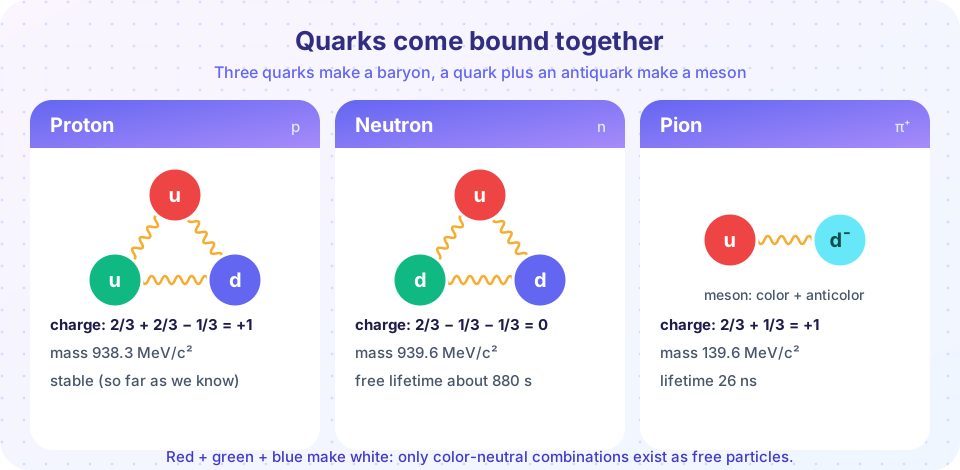
Add quark charges to get a hadron's charge:
proton   (uud):  +2/3 + 2/3 − 1/3 = +1
neutron  (udd):  +2/3 − 1/3 − 1/3 =  0
π⁺       (u d̄):  +2/3 + 1/3       = +1      (the d̄ has charge +1/3)
K⁺       (u s̄):  +2/3 + 1/3       = +1
Ω⁻       (sss):  −1/3 × 3         = −1
Notice that charges always add up to whole numbers, and that this is an observed fact that the color rule below explains.
Color and confinement
Quarks carry a second kind of charge. In the strong interaction it comes in three types called red, green and blue (nothing to do with visible colors) and the force is carried by eight gluons. The theory is called quantum chromodynamics (QCD). Gluons themselves carry color, so they interact with each other, which makes QCD very different from electromagnetism.
Only color-neutral (white) combinations exist free:
- three quarks, one of each color: a baryon;
- three antiquarks, one of each anticolor: an antibaryon;
- a color and its anticolor: a meson.
Why can a single quark not be pulled free? Between two electrons the force falls with distance. Between two quarks the force stays roughly constant at about 10⁵ N (about the weight of ten tonnes) because the gluon field forms a narrow tube between them. Pulling harder stores energy in the tube. When the energy is enough to make a new quark-antiquark pair, the tube "snaps" and two hadrons appear, each color-neutral. You never end up with a lone quark. This is why high-energy collisions produce jets, narrow sprays of hadrons.
At very short distances the opposite happens: the strong force becomes weak, called asymptotic freedom. It was discovered in 1973 by David Gross, Frank Wilczek and David Politzer (Nobel Prize 2004), and it explains why quarks inside a proton behave almost like free particles when struck hard in the SLAC experiments.
Hadron families
With only up, down and strange quarks, the possible combinations organise into the familiar families:
| Type | Quarks | Examples | Charge |
|---|---|---|---|
| Meson | q q̄ | π⁺ (ud̄), K⁺ (us̄), K⁰ (ds̄) | 0, ±1 |
| Baryon | qqq | p (uud), n (udd), Λ (uds), Σ⁺ (uus), Ξ⁰ (uss), Ω⁻ (sss) | −1 to +2 |
The Δ⁺⁺ baryon (uuu) puzzled physicists, since it has three identical quarks in the same state, which seems to break the Pauli exclusion principle. Color solved the puzzle: the three u quarks have different colors.
Exotic hadrons exist too: in 2015 the LHCb experiment at CERN reported pentaquarks with four quarks and one antiquark (uudcc̄), and tetraquark candidates appeared earlier.
The strangeness assigned to each hadron explains certain decay patterns: strong and electromagnetic interactions conserve strangeness, so strange particles are produced in pairs and decay only through the weak interaction, which makes them live far longer (around 10⁻¹⁰ s) than a strong decay would (around 10⁻²³ s). This was the original "strange" puzzle of the 1950s.
Where does the proton's mass come from?
The three valence quarks of a proton have rest masses of about 2.2, 2.2 and 4.7 MeV/c², roughly 9 MeV in all, yet the proton has mass 938 MeV/c². The other 99% is the energy of the strong-field and the motion of the quarks and gluons: E = mc² at work. This has been confirmed by supercomputer calculations of QCD on a lattice. It means that most of the visible mass of the universe is not due to the Higgs mechanism.
Leptons
Leptons are fermions that do not feel the strong force. There are three charged leptons (electron, muon, tau, charge −1) and three neutrinos (charge 0), one per charged lepton. Each charged lepton and its neutrino form a lepton family: (e, νₑ), (μ, ν_μ), (τ, ν_τ).
Leptons are free particles and can be found alone. The muon, found in cosmic rays in 1936, is a heavier copy of the electron (105.7 MeV/c², 207 times heavier) with a lifetime of 2.2 µs. When Isidor Rabi heard of it he reportedly asked "Who ordered that?" The tau (1,777 MeV/c²) lives only about 0.29 ps.
Each lepton family has a conserved number: lepton number L = +1 for a lepton and −1 for an antilepton. In nearly every observed reaction, the lepton number of each family is conserved (neutrino oscillations, in Chapter 8, are the exception).
Common misconceptions
"A proton is three quarks and nothing else." A proton also contains a sea of gluons and short-lived quark-antiquark pairs. The uud quarks are only the "valence" content.
"Color is the visible color of quarks." The word is a label for three types of charge. Quarks have no visible color.
"A neutron is a proton plus an electron." Inside the neutron there is no electron; beta decay creates one, see conservation laws and decays.
Try it
Press Run (or Ctrl + Enter) to see the result here.
Program input · what you'd type while the program runs
Type the answers before you press Run, one per line. Each time the program reads a line (with input()), it gets the next line from this box.
Press Run (or Ctrl + Enter) to see the console output here.
No output.
Check your understanding
Quick check · 5 questions
of 5 answered You scored / 5 · perfect!
-
1. What is the charge of a hadron made of u d̄?
u has +2/3 and an anti-d has +1/3, so the charge is +1: the π⁺. -
2. Why is a single free quark never observed?
The energy stored in the gluon tube eventually makes a quark-antiquark pair, giving color-neutral hadrons. -
3. Which baryon has quark content sss and strangeness −3?
Ω⁻ is three strange quarks, with charge −1. -
4. What did the color charge solve about the Δ⁺⁺ baryon?
Color is an extra quantum number that makes the three u quarks distinguishable. -
5. Where does most of the proton's mass come from?
Valence quark masses add up to only about 1% of 938 MeV.
Summary
- Quarks have charge +2/3 or −1/3 and baryon number 1/3; hadrons have whole-number charge.
- Baryons are qqq (B = 1), mesons are q q̄ (B = 0). Pentaquarks and tetraquarks exist.
- Color charge and gluons make up QCD; confinement means only color-neutral hadrons are seen.
- Strangeness is conserved in strong and electromagnetic interactions but not in weak ones.
- Leptons do not feel the strong force and each family carries its own conserved lepton number.
Track your progress
Create a free account to tick off lessons and pick up where you left off on any device.
of Nuclear and Particle Physics lessons completed