


















Lesson 26 of 51 · Fission and Fusion
Fission and Chain Reactions
How a neutron splits uranium-235, where the 200 MeV goes, why fissile and fertile nuclei differ, and how the multiplication factor k decides if a chain reaction grows.
In December 1938 the chemists Otto Hahn and Fritz Strassmann found barium in uranium that had been bombarded with neutrons. Lise Meitner and Otto Frisch explained it within weeks: the uranium nucleus had split in two, in a process Frisch named fission after cell division in biology. Within a year physicists realised that fission releases more neutrons, which could split more nuclei, giving a chain reaction.
This lesson explains what happens in one fission, where the energy goes, and the single number that decides whether a chain dies away, holds steady or runs away.
What you will learn
- How the liquid-drop picture explains why a nucleus can split.
- What fissile, fissionable and fertile mean.
- Where the roughly 200 MeV of energy per fission is found.
- What the multiplication factor
kmeans and how it sets the fate of a chain. - Why a few percent of neutrons arrive late, and why that matters.
Key terms
Fissile: a nuclide that can be fissioned by neutrons of any energy, including slow (thermal) ones: ²³³U, ²³⁵U, ²³⁹Pu.
Fertile: a nuclide that becomes fissile after absorbing a neutron: ²³⁸U (becomes ²³⁹Pu) and ²³²Th (becomes ²³³U).
Cross-section σ: the effective target area of a nucleus for a reaction, measured in barns (1 b = 10⁻²⁸ m²).
Multiplication factor k: the average number of neutrons from one fission generation that cause fission in the next.
Prompt and delayed neutrons: neutrons emitted within about 10⁻¹⁴ s of fission versus those emitted later by decaying fission products.
Why a nucleus splits: the liquid drop
Niels Bohr and John Wheeler modelled the nucleus as a charged drop of liquid. Two forces compete:
- Surface tension (from the short-range strong force) pulls the drop into a sphere.
- Coulomb repulsion between the many protons tries to push it apart.
In a heavy nucleus the two are almost balanced. When a neutron is absorbed, the new nucleus is excited by its binding energy (about 6.5 MeV for ²³⁵U + n). The drop wobbles, stretches into a peanut shape, and if the stretch passes a critical point the repulsion wins and it pinches in two. The energy needed to reach that point is the fission barrier, around 6 MeV for ²³⁶U. Slow neutrons already supply slightly more than that, which is why ²³⁵U fissions with neutrons of almost zero energy.
Adding a neutron to ²³⁵U makes an even-even nucleus, which gains extra pairing energy. Adding one to ²³⁸U makes an odd-neutron nucleus with a smaller gain (about 4.8 MeV), short of the barrier, so ²³⁸U needs a fast neutron of roughly 1 MeV or more. That is why natural uranium cannot easily sustain a chain with fast neutrons.
One fission, with numbers
A typical event is
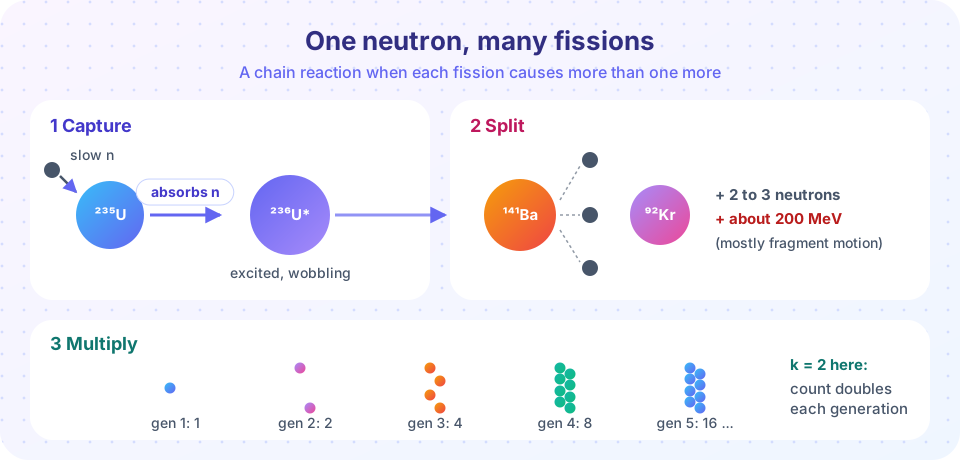
n + ²³⁵U → ²³⁶U* → ¹⁴¹Ba + ⁹²Kr + 3 n + energy
but the nucleus splits many ways: over 300 fragment pairs appear, with an asymmetric mass split typically near A ≈ 95 and A ≈ 140. On average a thermal fission of ²³⁵U releases ν̄ ≈ 2.43 neutrons.
Where does the roughly 200 MeV go?
| Share | Energy (approx.) |
|---|---|
| Kinetic energy of the two fragments | 170 MeV |
| Prompt neutrons | 5 MeV |
| Prompt gamma rays | 7 MeV |
| Later decays of fragments (β, γ, antineutrinos) | about 20 MeV |
The fragments stop within a few micrometres inside the fuel, so nearly all of that 170 MeV becomes heat right where it is made. Antineutrinos (about 5% of the total) escape and are not recovered.
A useful number: one kilogram of ²³⁵U completely fissioned releases about 8×10¹³ J, roughly what 3,400 tonnes of coal produce when burned.
The multiplication factor
Let k be the average number of neutrons from one generation that go on to cause a fission. Start with N₀ neutrons:
N after g generations = N₀ × k^g
k < 1(subcritical): the chain dies out.k = 1(critical): the chain is self-sustaining at a constant rate.k > 1(supercritical): the number of fissions grows exponentially.
Neutrons can be lost by leaking out of the fuel, by capture in non-fuel material, or by capture in ²³⁸U without fission. To reach k ≥ 1, you need enough fuel in the right arrangement. The smallest mass of material that sustains a chain in a given shape is called the critical mass.
You may notice that k = 2 doubling per generation would be explosive. Generations are short, about 10⁻⁸ s for fast neutrons in a bomb and about 10⁻⁴ s in a thermal reactor, so the exact value of k matters enormously. Reactors operate at k = 1 and are carefully designed never to rely on prompt neutrons alone.
Delayed neutrons make control possible
About 0.65% of the neutrons from ²³⁵U fission (fraction β ≈ 0.0065) do not appear promptly. They come from fission products such as ⁸⁷Br that decay by beta emission to a state that then emits a neutron. These delayed neutrons appear with half-lives from fractions of a second up to about a minute.
If a reactor were supercritical on prompt neutrons alone, power would change on a scale of microseconds. Because delayed neutrons are needed to push k just over 1, the effective reaction time stretches to seconds, giving control rods and operators time to respond. The next lesson uses a numerical model to show this.
Common misconceptions
"A nuclear reactor can explode like a nuclear bomb." A bomb needs highly enriched material assembled quickly into a very supercritical configuration. Power reactor fuel (3 to 5% ²³⁵U) cannot do that. Reactors can have other accidents, such as overheating, but not a bomb-style detonation.
"Fission releases energy because the neutron has a lot of energy." The incoming neutron contributes only a few MeV. The 200 MeV comes from the different binding of the products.
"Every fission gives exactly the same fragments." The split is statistical. There are hundreds of fragment pairs, and the average neutron number 2.43 is an average.
Try it
Press Run (or Ctrl + Enter) to see the result here.
Program input · what you'd type while the program runs
Type the answers before you press Run, one per line. Each time the program reads a line (with input()), it gets the next line from this box.
Press Run (or Ctrl + Enter) to see the console output here.
No output.
Check your understanding
Quick check · 5 questions
of 5 answered You scored / 5 · perfect!
-
1. In the liquid drop model, what pulls a heavy nucleus apart?
Surface tension holds the drop together; the electric repulsion of the many protons tries to split it. -
2. Which nuclide is fertile?
²³⁸U is not easily fissioned by slow neutrons but becomes ²³⁹Pu after neutron capture and two beta decays. -
3. A reactor has k = 1.00. What does that mean?
k is the number of neutrons in one generation that cause fission in the next; k = 1 means each fission is replaced by exactly one new one. -
4. Which energy share is largest in a fission of ²³⁵U?
About 170 of the roughly 200 MeV is the kinetic energy of the two fragments, which turns into heat. -
5. Why are delayed neutrons important?
Because about 0.65% of neutrons arrive late, the effective generation time becomes seconds, not microseconds.
Summary
- Fission is the splitting of a heavy nucleus, usually after neutron absorption, into two fragments plus neutrons.
- A thermal fission of ²³⁵U gives about 200 MeV (mostly fragment motion) and about 2.4 neutrons.
- The multiplication factor
kdecides if the chain dies (k < 1), holds (k = 1) or grows (k > 1). - ²³⁵U, ²³³U and ²³⁹Pu are fissile; ²³⁸U and ²³²Th are fertile.
- Delayed neutrons (about 0.65% for ²³⁵U) make reactor control practical.
Track your progress
Create a free account to tick off lessons and pick up where you left off on any device.
of Nuclear and Particle Physics lessons completed