


















Lesson 12 of 51 · Radioactivity and Decay
How Nuclei Decay: Chapter 3 Overview
A map of radioactivity: why unstable nuclei decay, the main decay modes (alpha, beta, gamma), natural and artificial sources, and how far radiation travels.
In 1896 Henri Becquerel left uranium salts in a drawer on top of a wrapped photographic plate. When he developed it days later, the plate was fogged: something invisible had passed through the paper. That accident revealed radioactivity, and Marie and Pierre Curie, Ernest Rutherford and many others spent the next decades finding out what it was. The answer turned out to be simple and profound: some nuclei are not at the lowest-energy arrangement of their nucleons, and sooner or later they change, releasing the difference as radiation.
What you will learn
- Explain why a nucleus decays, using the idea of the Q-value.
- Name the main decay modes and the change each one makes to Z and A.
- Classify natural and artificial radioactive sources.
- Compare the penetrating power of alpha, beta and gamma radiation.
Key terms
Radioactive decay: the spontaneous transformation of an unstable nucleus, with emission of particles or photons.
Parent and daughter: the nuclide before and after a decay.
Q-value: the energy released in a decay; it must be positive for the decay to happen.
Ionizing radiation: radiation with enough energy to knock electrons out of atoms.
Activity: the number of decays per second, measured in becquerel (Bq).
Why do nuclei decay?
A nucleus decays if the total rest mass of the products is smaller than the rest mass of the parent. The energy difference is the Q-value:
Q = (M_parent − Σ M_products) c²
If Q > 0 the decay is energetically allowed, and the extra energy appears as kinetic energy of the products. If Q < 0 the nucleus is stable against that decay and would need energy supplied from outside. Whether a decay actually happens, and how fast, also depends on the quantum rules that govern it: the force involved, conservation of angular momentum and parity, and barriers.
The binding energy curve from chapter 2 shows the general direction. Heavy nuclei (above about A = 200) can lower their mass by shedding alpha particles; nuclei with too many neutrons or too few turn neutrons into protons or vice versa, sliding toward the valley of stability; and excited nuclei release their extra energy as photons.
The main decay modes
| Mode | What is emitted | Change in the nucleus | Typical cause |
|---|---|---|---|
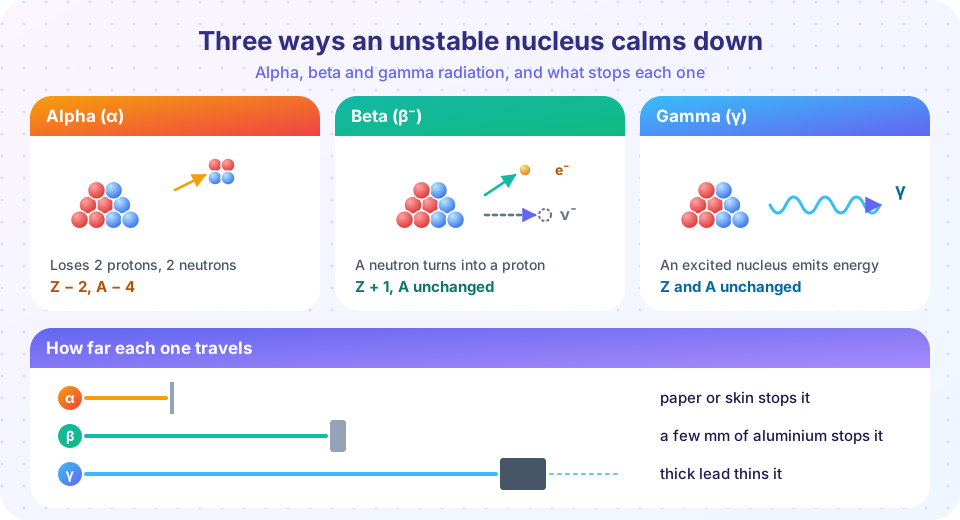
| Alpha (α) | ⁴He nucleus | Z − 2, A − 4 | heavy nuclei, mostly Z > 82 |
| Beta minus (β⁻) | electron and antineutrino | Z + 1, A same | too many neutrons |
| Beta plus (β⁺) | positron and neutrino | Z − 1, A same | too many protons |
| Electron capture (EC) | neutrino (the nucleus absorbs an atomic electron) | Z − 1, A same | too many protons |
| Gamma (γ) | photon | none | excited nucleus |
| Internal conversion | an atomic electron instead of a photon | none | excited nucleus |
| Spontaneous fission | two fragments and neutrons | splits | very heavy nuclei |
| Proton or neutron emission | a single nucleon | Z − 1 or N − 1 | beyond the drip lines |
The three discovered first were named by Rutherford with the first Greek letters: alpha (stopped easily), beta (more penetrating) and gamma (the most penetrating, found by Paul Villard in 1900).
Chance, not clockwork
You can never predict when one particular nucleus will decay, but a large sample behaves with great regularity: in each second, each nucleus has the same fixed probability of decaying, no matter how long it has already existed. That single idea leads to the exponential decay law and the half-life, the subject of the next lesson.
Where radioactive nuclei come from
- Primordial: present since the Earth formed, because their half-lives are comparable to or longer than the age of the Earth (4.5 billion years): uranium-238 (4.47 billion years), thorium-232 (14 billion years), uranium-235 (704 million years) and potassium-40 (1.25 billion years).
- Decay products: short-lived daughters of the primordial series, such as radon-222 (3.8 days), which keeps appearing as uranium decays in rock.
- Cosmogenic: created by cosmic rays in the atmosphere, such as carbon-14 (5,730 years), tritium and beryllium-7.
- Artificial: made in reactors and accelerators, such as cobalt-60, iodine-131, caesium-137 and technetium-99m (chapter 4).
How far does radiation travel?
| Radiation | Typical energy | Range in air | Stopped by |
|---|---|---|---|
| Alpha | 4–9 MeV | a few cm | paper, outer layer of skin |
| Beta | up to a few MeV | up to a few metres | a few mm of aluminium, a plastic sheet |
| Gamma | 0.01–10 MeV | far (dozens of metres) | thick lead or concrete reduces it; never fully stops it |
| Neutrons | any | far | hydrogen-rich materials such as water or paraffin |
Because alpha particles carry a double charge and are heavy, they ionize intensely along a very short track. That makes them harmless outside the body but potentially dangerous if the source is swallowed or inhaled. Gamma rays pass through the body, depositing energy only occasionally, so shielding and distance matter. Lesson 6 covers dose in detail.
This course gives educational information about radiation, not medical or safety advice. Real radioactive sources need trained handling and legal oversight.
Chapter 3: the road ahead
Gamma and chains
Radiation and people
Common misconceptions
"Radiation is a substance that contaminates and glows." Radiation is energy carried by particles or photons. Contamination is the presence of radioactive atoms where they should not be.
"A radioactive sample becomes radioactive after exposure to radiation." Gamma rays and X-rays do not make things radioactive. Only nuclear reactions (usually with neutrons) can, and that requires special conditions.
"A decaying nucleus has a clock." The decay probability per second never changes, so a nucleus that has survived a million years is no closer to decaying than a new one.
Try it
Compute the Q-values of two decays from atomic masses: the alpha decay of uranium-238 and the beta-minus decay of carbon-14.
Press Run (or Ctrl + Enter) to see the result here.
Program input · what you'd type while the program runs
Type the answers before you press Run, one per line. Each time the program reads a line (with input()), it gets the next line from this box.
The mass of a nucleus with a fixed A plotted against Z forms a parabola. Nuclei slide down it by beta decay. Here is the parabola from the liquid-drop formula for A = 100, where pairing splits it into two curves.
Press Run (or Ctrl + Enter) to see the result here.
Program input · what you'd type while the program runs
Type the answers before you press Run, one per line. Each time the program reads a line (with input()), it gets the next line from this box.
Check your understanding
Quick check · 5 questions
of 5 answered You scored / 5 · perfect!
-
1. What must be true for a nuclear decay to be energetically possible?
Q = (M_parent − Σ M_products)c². A positive Q means the products are lighter, so the energy difference is released. -
2. How does alpha decay change Z and A?
An alpha particle is a ⁴He nucleus, taking away two protons and two neutrons. -
3. Which radiation is stopped by a sheet of paper?
Alpha particles are heavy and doubly charged and lose their energy over a few centimetres of air or a thin layer of skin. -
4. Which is a cosmogenic radioactive isotope?
Carbon-14 is continuously made in the atmosphere by cosmic-ray neutrons striking nitrogen-14. -
5. A radioactive nucleus has survived for a million years. How does its chance of decaying in the next second compare with a brand-new identical nucleus?
Decay is memoryless: the probability per second is a constant.
Summary
- A nucleus decays if Q = (M_parent − ΣM_products)c² is positive.
- Alpha: Z − 2, A − 4. Beta minus: Z + 1. Beta plus or electron capture: Z − 1. Gamma: no change in Z and A.
- Radioactive nuclei are primordial, decay products, cosmogenic or artificial.
- Alpha is stopped by paper, beta by millimetres of aluminium, gamma only reduced by thick lead.
Track your progress
Create a free account to tick off lessons and pick up where you left off on any device.
of Nuclear and Particle Physics lessons completed