


















Lesson 20 of 51 · Nuclear Reactions
Q-Values and Thresholds
Calculate the energy released or required in a nuclear reaction from masses, find threshold energies and see how the Coulomb barrier limits reactions.
In 1932 John Cockcroft and Ernest Walton accelerated protons to about half a million electronvolts and fired them at lithium. Out came two alpha particles, each with about 8.6 MeV. A projectile of 0.5 MeV had produced a total of 17 MeV of kinetic energy. Where did the extra energy come from? From the mass difference between the lithium-7 plus proton before and the two helium-4 nuclei after: the first direct test of E = mc² in a nuclear reaction. This lesson shows how to do that bookkeeping for any reaction.
What you will learn
- Define and calculate the Q-value of a reaction from atomic masses and from kinetic energies.
- Distinguish exothermic and endothermic reactions and find the threshold energy.
- Estimate the Coulomb barrier and explain how charged projectiles get through it.
- Work out how the available energy is shared between the products.
Key terms
Q-value: Q = (Σ m_initial − Σ m_final)c² = T_final − T_initial.
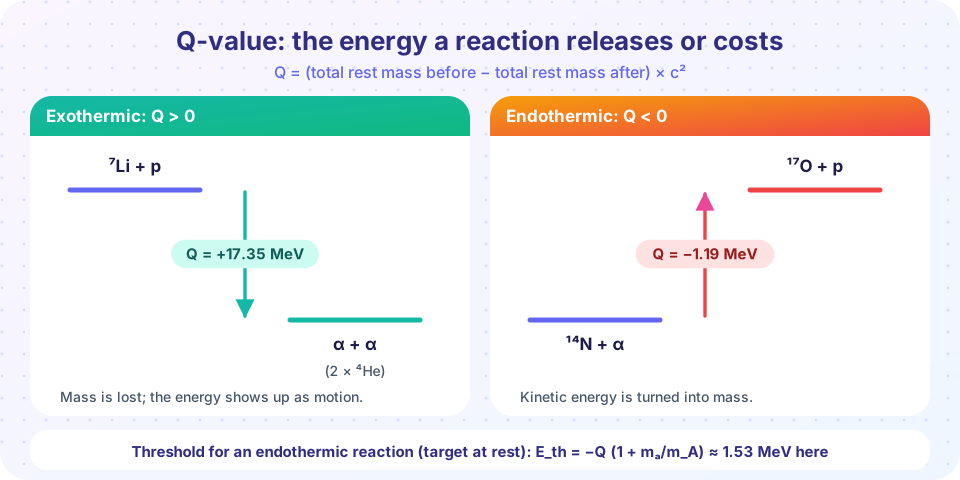
Exothermic (exoergic) reaction: Q > 0; kinetic energy is released.
Endothermic (endoergic) reaction: Q < 0; kinetic energy must be supplied.
Threshold energy: the smallest projectile energy (target at rest) at which an endothermic reaction can occur.
Coulomb barrier: the electric repulsion between positively charged nuclei, which must be overcome or tunnelled through.
The Q-value
Energy conservation for a + A → b + B says that the total energy (rest energy plus kinetic energy) is the same before and after. Rearranged:
Q = (m_a + m_A − m_b − m_B) c² = (T_b + T_B) − (T_a + T_A)
The first form gives Q from masses; the second shows that Q is the gain in kinetic energy. As with beta decay, atomic masses may be used directly, because the number of electrons on both sides is the same for a reaction that conserves Z (the electron masses cancel).
Worked example 1: ⁷Li(p, α)⁴He. Masses: ⁷Li 7.016003 u, ¹H 1.007825 u, ⁴He 4.002603 u. Initial total: 8.023828 u. Final total: 2 × 4.002603 = 8.005206 u. Difference: 0.018622 u, so Q = 0.018622 × 931.494 = 17.35 MeV. If the proton arrives with a negligible energy, momentum conservation makes the two alpha particles fly apart with equal and opposite momenta, so each gets about 8.7 MeV, as Cockcroft and Walton observed.
Worked example 2: ¹⁴N(α, p)¹⁷O. Masses: ¹⁴N 14.003074 u, ⁴He 4.002603 u, ¹⁷O 16.999132 u, ¹H 1.007825 u. Initial: 18.005677 u. Final: 18.006957 u. Difference: −0.001280 u, so Q = −1.19 MeV. This is Rutherford's 1919 reaction, endothermic.
Worked example 3: ¹⁴N(n, p)¹⁴C. Q = +0.626 MeV. It is exothermic and proceeds with the slowest neutrons. This reaction, driven by cosmic-ray neutrons in the atmosphere, makes the carbon-14 used for radiocarbon dating.
Threshold energy
If Q < 0, the reaction cannot occur unless the projectile brings in at least |Q| of kinetic energy. But |Q| is not enough. By momentum conservation, the products must continue to move after the collision with the momentum of the projectile, and carrying it takes kinetic energy. In the laboratory frame, with the target at rest and low energies, the threshold is
E_th = −Q × (1 + m_a/m_A) (non-relativistic approximation)
For the reaction ¹⁴N(α, p)¹⁷O: E_th = 1.19 MeV × (1 + 4.003/14.003) = 1.53 MeV. For ⁷Li(p, n)⁷Be, with Q = −1.644 MeV, E_th = 1.644 × (1 + 1.008/7.016) = 1.88 MeV, the famous threshold used to make nearly monoenergetic neutrons in accelerators. (At high energy the exact relativistic formula, E_th = −Q (Σ all four masses)/(2 m_A), must be used.)
The Coulomb barrier
Even for an exothermic reaction, charged particles have to come within the range of the nuclear force (about 1 fm) before it takes over. As they approach they feel the electric repulsion, so the projectile must have enough energy to approach the target. The potential energy when the surfaces touch is
V_B = 1.44 MeV·fm × Z₁Z₂ / (R₁ + R₂), with R = 1.2 A^(1/3) fm.
| Reaction | Barrier |
|---|---|
| p + ⁷Li | 1.2 MeV |
| α + ¹⁴N | 4.2 MeV |
| p + ²⁷Al | 3.9 MeV |
| α + ¹⁹⁷Au | 25.6 MeV |
Reactions often take place at energies below the barrier, because quantum tunnelling allows the particle to pass through it with a reduced but not zero probability. That is how Cockcroft and Walton succeeded with protons of 0.5 MeV on lithium, a little less than half the barrier. For an estimate of the tunnelling probability at relative speed v, the Gamow factor is exp(−2πη), where η = Z₁Z₂α/β and β = v/c: the probability rises steeply with energy. Neutrons have no charge and no barrier at all.
Sharing the energy
If a projectile with energy T_a hits a target at rest in the non-relativistic limit, the total kinetic energy available to the products is T_b + T_B = T_a + Q. Momentum conservation divides it. For the simple case T_a ≈ 0 and two products, the lighter one gets the larger share, in inverse proportion to the masses: T_b = (T_a + Q) × m_B/(m_b + m_B). For ¹⁴N(n, p)¹⁴C with Q = 0.626 MeV the proton gets 0.626 × 14/15 = 0.58 MeV and the carbon-14 nucleus 0.04 MeV.
Common misconceptions
"Threshold energy equals −Q." The threshold is higher than |Q| because the products must carry the projectile's momentum, which takes kinetic energy.
"Exothermic reactions always happen." Q > 0 only means the reaction is energetically allowed. A positively charged projectile still has to get through the Coulomb barrier.
"Mass is destroyed when Q > 0." Mass is converted into the kinetic energy of the products, and total energy is conserved.
Try it
Compute Q-values and thresholds for several reactions from atomic masses.
Press Run (or Ctrl + Enter) to see the result here.
Program input · what you'd type while the program runs
Type the answers before you press Run, one per line. Each time the program reads a line (with input()), it gets the next line from this box.
Now the Coulomb barrier, and what it means for tunnelling. This plot compares the Gamow factor for protons on lithium and alpha particles on nitrogen at various energies. The estimate is crude but shows the steep rise.
Press Run (or Ctrl + Enter) to see the result here.
Program input · what you'd type while the program runs
Type the answers before you press Run, one per line. Each time the program reads a line (with input()), it gets the next line from this box.
Check your understanding
Quick check · 5 questions
of 5 answered You scored / 5 · perfect!
-
1. A reaction has initial mass 12.0200 u and final mass 12.0150 u. What is Q?
Q = (12.0200 − 12.0150) × 931.494 = 0.0050 × 931.494 = +4.66 MeV. -
2. Which reaction type needs a threshold energy?
An endothermic reaction needs the projectile to bring in at least |Q| plus the energy to conserve momentum. -
3. Why is the threshold in the laboratory greater than |Q|?
Momentum conservation forces the products to keep moving, so some of the projectile's kinetic energy cannot be used. -
4. What is the Coulomb barrier for a proton hitting ²⁷Al, using V = 1.44 Z₁Z₂/(1.2(A₁^(1/3) + A₂^(1/3))) MeV and ²⁷Al^(1/3) = 3?
V = 1.44 × 1 × 13 / (1.2 × (1 + 3)) = 18.72 / 4.8 ≈ 3.9 MeV. -
5. Cockcroft and Walton used 0.5 MeV protons on lithium although the barrier is about 1.2 MeV. Why did it work?
Tunnelling makes reactions possible below the classical barrier, with a probability that rises steeply with energy.
Summary
- Q = (Σ m_in − Σ m_out)c² = ΔT; Q > 0 releases energy, Q < 0 consumes it.
- The threshold for an endothermic reaction is E_th ≈ −Q(1 + m_a/m_A), larger than |Q|.
- Charged projectiles face the Coulomb barrier V_B = 1.44 Z₁Z₂/(R₁ + R₂) MeV·fm and pass it by tunnelling.
- Momentum conservation decides how the available energy is shared between the products.
Track your progress
Create a free account to tick off lessons and pick up where you left off on any device.
of Nuclear and Particle Physics lessons completed