


















Lesson 31 of 51 · The Standard Model
The Standard Model: The Big Picture
A guided tour of the Standard Model: quarks, leptons, force carriers and the Higgs boson, how the particle zoo was tamed, and what the theory leaves unexplained.
By the 1950s physicists had found dozens of "elementary" particles, with names like lambda, sigma and kaon, and nobody could say which ones were really fundamental. Within twenty years a single scheme tidied up the chaos: a small set of truly elementary particles, three kinds of forces between them and a set of strict rules. This scheme is the Standard Model of particle physics, and it has passed every experimental test for half a century.
This chapter is its guided tour. This first lesson shows the whole chart and the logic behind it, and the next four lessons fill in the details.
What you will learn
- How the Standard Model sorts particles into quarks, leptons and bosons.
- What a "generation" is and why only the first one makes ordinary matter.
- Which forces the model describes, and which one it leaves out.
- How the particle zoo led to the quark model.
- What the Standard Model does not explain.
Key terms
Fermion: a particle with half-integer spin (1/2, 3/2, ...). Matter particles are fermions.
Boson: a particle with integer spin. Force carriers (spin 1) and the Higgs (spin 0) are bosons.
Quark: a fermion that feels the strong force and is never found alone.
Lepton: a fermion that does not feel the strong force: the electron, muon, tau and three neutrinos.
Hadron: any particle made of quarks, such as protons, neutrons and pions.
From zoo to periodic table
In 1932 an atom was simple: electrons, protons and neutrons. Then cosmic ray experiments and accelerators began finding more: the muon (1936), pions (1947) and a whole menagerie of "strange" particles. By the early 1960s over a hundred had been catalogued.
Murray Gell-Mann and George Zweig proposed in 1964 that the many hadrons were combinations of only three kinds of smaller constituents, which Gell-Mann called quarks. Experiments at SLAC in 1968 scattered high-energy electrons from protons and found point-like hard centres inside, the first direct evidence. Over the following decades more quarks were discovered: charm (1974), bottom (1977) and finally the heavy top quark (1995).
The matter particles
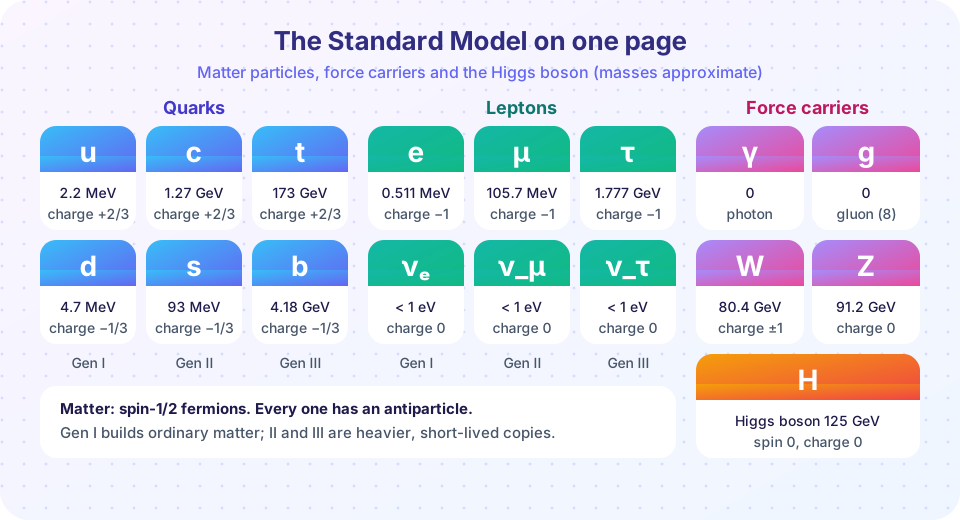
The Standard Model has two families of matter particles, both spin-1/2 fermions.
| Family | Particles | Charges | Feels strong force? |
|---|---|---|---|
| Quarks | up, down; charm, strange; top, bottom | +2/3 (u, c, t) and −1/3 (d, s, b) | yes |
| Leptons | electron, muon, tau; three neutrinos | −1 (charged leptons), 0 (neutrinos) | no |
The particles come in three generations. Generation I (up, down, electron, electron neutrino) builds all ordinary matter: a proton is uud, a neutron is udd, and an atom adds electrons. Generations II and III are heavier copies with the same charges. They are made in cosmic ray collisions and in accelerators and then decay quickly into generation I. Why there are three, and why their masses differ so much, is an open question.
Each particle also has an antiparticle, with the same mass but opposite charges. The positron, discovered by Carl Anderson in 1932, is the antiparticle of the electron.
The force carriers
Forces arise when particles exchange gauge bosons, which have spin 1:
- Photon (γ): the electromagnetic force; massless.
- Gluons (g, eight kinds): the strong force that binds quarks; massless.
- W⁺, W⁻ and Z⁰: the weak force; very heavy (80.4 and 91.2 GeV/c²).
The Higgs boson (spin 0, 125 GeV/c²), found in 2012, is the visible quantum of the field that gives the W, Z and the fermions their masses. Gravity is not included: no one has a tested quantum theory of it, and it is far too weak to matter in particle collisions.
Three forces, three charges
A particle takes part in a force only if it carries the corresponding "charge":
| Force | Charge | Who has it |
|---|---|---|
| Electromagnetic | electric charge | quarks, charged leptons, W |
| Strong | color (red, green, blue) | quarks and gluons |
| Weak | weak isospin | all fermions and W, Z |
Neutrinos have only weak charge, which is why they pass through Earth with hardly any interaction. The next lessons treat the quarks, the forces and the Higgs in turn.
Two kinds of particles
Three generations
Three forces
Gravity is not in the model
What is missing
What the Standard Model leaves out
Despite its success it is incomplete. It contains no particle that could be the dark matter seen in galaxies (Chapter 8). It cannot explain why the universe contains matter and almost no antimatter. It originally gave neutrinos zero mass, but experiments show they have tiny masses. And it does not include gravity. Many of the experiments in this course are searches for what comes next.
Common misconceptions
"Quarks are tiny balls inside protons that we can pull out." Quarks are never seen alone. The strong force grows with distance, so pulling a quark out makes new quark-antiquark pairs instead (see Quarks, Leptons and Hadrons).
"The Higgs gives mass to everything." The Higgs gives mass to the W, Z and the fundamental fermions. Most of the mass of a proton comes from the energy of the strong force binding its quarks.
"Antimatter is science fiction." Positrons are used every day in PET medical scanners.
Try it
Press Run (or Ctrl + Enter) to see the result here.
Program input · what you'd type while the program runs
Type the answers before you press Run, one per line. Each time the program reads a line (with input()), it gets the next line from this box.
Press Run (or Ctrl + Enter) to see the console output here.
No output.
Check your understanding
Quick check · 5 questions
of 5 answered You scored / 5 · perfect!
-
1. Which of these particles is a lepton?
The muon is a charged lepton. Up quarks are quarks, gluons are bosons and the proton is a hadron. -
2. What makes up a proton?
A proton is uud with charge 2/3 + 2/3 − 1/3 = +1. -
3. Why are generations II and III not found in ordinary matter?
Muons, charm and strange quarks, and so on are unstable and decay into lighter particles, so ordinary matter uses only generation I. -
4. Which is NOT described by the Standard Model?
Gravity has no tested quantum description and is not part of the model. -
5. Roughly where does most of a proton's mass come from?
The quark masses are only about 1% of the proton mass (about 9 of 938 MeV); the rest is binding and motion energy.
Summary
- The Standard Model has 12 matter fermions (6 quarks, 6 leptons), the gauge bosons γ, g, W and Z, and the Higgs boson.
- Matter comes in three generations; only generation I makes ordinary atoms.
- It describes the electromagnetic, strong and weak forces but not gravity.
- It leaves out dark matter, the matter-antimatter imbalance and neutrino mass.
- Hadrons such as protons and neutrons are bound states of quarks.
Track your progress
Create a free account to tick off lessons and pick up where you left off on any device.
of Nuclear and Particle Physics lessons completed