


















Lesson 18 of 51 · Radioactivity and Decay
Chapter 3 Review: Decay and Dose
Review chapter 3: decay law, alpha tunnelling, beta decay and neutrinos, gamma rays, decay chains, shielding and dose, with a recap table and quiz.
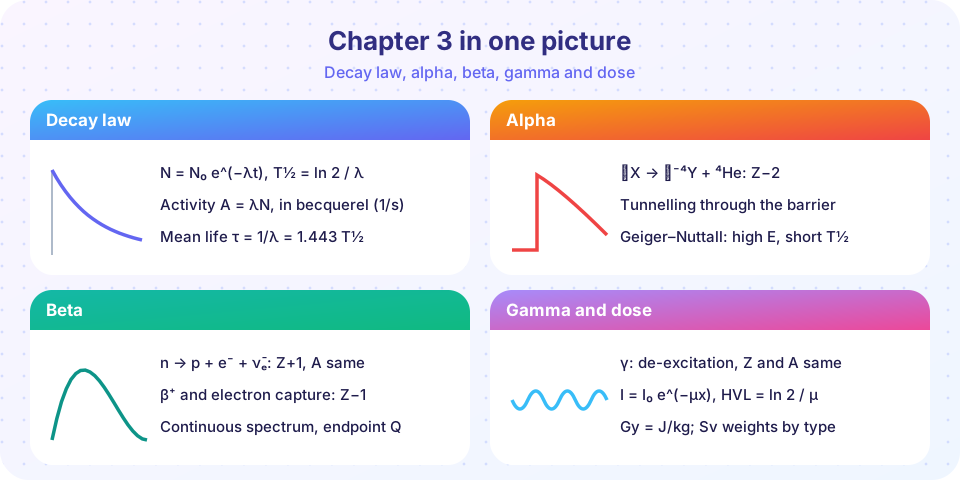
Chapter 3 gave you a toolkit for radioactivity. You can predict how many nuclei remain after any time, decide which decay mode is open for a given nuclide, calculate the energy released, follow a decay chain from uranium to lead, and size the shielding for a gamma source. This review collects all of it on a single page, adds a few worked problems and finishes with a ten-question quiz.
What you will learn
- Recall the decay law, the three decay modes and the dose units without notes.
- Apply them to short mixed problems.
- Connect the chapter to nuclear reactions, the topic of chapter 4.
Key terms
λ, T½, τ: decay constant, half-life (ln 2/λ) and mean life (1/λ).
Q-value: the energy released; positive means the decay can occur.
Neutrino: the invisible particle that shares the energy in beta decay.
HVL: half-value layer for gamma shielding.
Gy and Sv: absorbed dose (J/kg) and dose that weights the radiation type.
The chapter in a table
| Topic | Key facts |
|---|---|
| Decay law | N = N₀e^(−λt); T½ = 0.693/λ; τ = 1.443 T½; A = λN in becquerel |
| Counting | N counts have an uncertainty √N |
| Dating | t = (T½/ln 2) ln(N₀/N); C-14 works to about 50,000 years |
| Alpha | Z − 2, A − 4; T_α = Q(A − 4)/A; barrier tunnelling; Geiger-Nuttall: log T½ ∝ 1/√Q |
| Beta | β⁻ n → p e⁻ ν̄ (Z + 1); β⁺ and EC (Z − 1); continuous spectrum up to Q; Q(β⁺) = ΔMc² − 1.022 MeV |
| Gamma | E_γ ≈ E_i − E_f; isomers; internal conversion |
| Chains | A mod 4 is conserved; U-238 → Pb-206: 8 α and 6 β⁻; secular equilibrium A₂ = A₁ |
| Shielding | I = I₀e^(−μx); n HVL gives (1/2)ⁿ; inverse-square law |
| Dose | 1 Gy = 1 J/kg; H = w_R D in Sv; background about 2.4 mSv/y |
Worked review problems
Problem 1 (decay law). A sample of ¹³¹I has 8.0 × 10⁹ nuclei. Its half-life is 8.02 days. What is the activity now, and how many nuclei remain after 24 days? λ = 0.693/(8.02 × 86,400 s) = 1.00 × 10⁻⁶ s⁻¹, so A = λN = 8.0 × 10³ Bq. After 24 days, 24/8.02 = 3.0 half-lives, so N = 8.0 × 10⁹/8 = 1.0 × 10⁹.
Problem 2 (alpha energy). ²²⁶Ra decays to ²²²Rn with Q = 4.871 MeV. What is the alpha energy? T_α = 4.871 × 222/226 = 4.785 MeV.
Problem 3 (beta choice). The atomic mass difference between a parent and its Z − 1 daughter is 0.60 MeV/c². Which modes are possible? Only electron capture, since β⁺ needs more than 1.022 MeV.
Problem 4 (chain). ²³⁵U ends at ²⁰⁷Pb. How many alpha and beta decays? ΔA = 28, so 7 alpha decays. The alpha decays lower Z by 14, from 92 to 78; Pb has Z = 82, so 4 beta-minus decays.
Problem 5 (shielding). What fraction of 0.66 MeV gamma rays passes through a 2 mm lead sheet? With HVL = 0.6 cm, 2 mm is 0.33 HVL, so the transmitted fraction is 2^(−0.33) = 0.80.
Where this leads
Chapter 4 asks what happens when we do not wait for nature but collide nuclei ourselves: Q-values of reactions, cross sections, and how reactors and accelerators make the isotopes of medicine. Decay is the spontaneous version of the same physics.
Common misconceptions
"Half-life is the time a sample stays radioactive." It is the time for half the nuclei to decay; the rest are still radioactive.
"Alpha is the most dangerous radiation because it has the biggest weighting factor." It depends on location: outside the body it is harmless, inside it is the most damaging per unit absorbed dose.
"Beta-plus decay can happen to a free proton." It cannot: a proton is lighter than a neutron.
Try it
Write the decay rules as code. The function below changes (Z, A) according to the decay mode, then follows ²³⁸U down to lead and counts the steps.
Press Run (or Ctrl + Enter) to see the result here.
Program input · what you'd type while the program runs
Type the answers before you press Run, one per line. Each time the program reads a line (with input()), it gets the next line from this box.
A picture of what each mode does to a nucleus on the chart of nuclides.
Press Run (or Ctrl + Enter) to see the result here.
Program input · what you'd type while the program runs
Type the answers before you press Run, one per line. Each time the program reads a line (with input()), it gets the next line from this box.
Check your understanding
Quick check · 10 questions
of 10 answered You scored / 10 · perfect!
-
1. A source has an activity of 800 Bq and a half-life of 2 hours. What is its activity after 6 hours?
6 hours is 3 half-lives, so 800/8 = 100 Bq. -
2. A beta-minus decay changes (Z, A) to which of the following?
β⁻ turns a neutron into a proton: Z + 1 and A unchanged. -
3. Which law links the half-life of an alpha emitter to its energy?
log T½ is approximately linear in 1/√Q. -
4. Which energy is required for a nuclide to decay by β⁺ rather than only by electron capture?
The positron must be created, and with atomic masses an extra 2mₑc² = 1.022 MeV is needed. -
5. In which decay series does ²²⁶Ra appear (A = 226)?
226 = 4 × 56 + 2. -
6. A gamma beam passes through 4 half-value layers. What fraction survives?
(1/2)⁴ = 1/16. -
7. What equivalent dose results from an absorbed dose of 3 mGy from gamma rays (w_R = 1)?
H = w_R × D = 1 × 3 mGy = 3 mSv. -
8. Which particle was introduced to save conservation of energy and angular momentum in beta decay?
Pauli's neutrino carries the missing energy and spin. -
9. After 3 half-lives of carbon-14, how old is the sample (T½ = 5,730 years)?
3 × 5,730 = 17,190 years. -
10. Which statement about secular equilibrium is correct?
The long-lived parent produces the daughter at a constant rate, so after several daughter half-lives A₂ = A₁.
Summary
- N = N₀e^(−λt); T½ = 0.693/λ; A = λN; statistics go as √N.
- Alpha: Z − 2, A − 4, with tunnelling and Geiger-Nuttall. Beta: Z ± 1 with a neutrino. Gamma: the same nuclide, lower energy.
- Chains conserve A mod 4; equilibrium links daughter and parent activities.
- HVLs, inverse-square and time protect people; gray measures energy per kilogram and sievert accounts for the radiation type.
Track your progress
Create a free account to tick off lessons and pick up where you left off on any device.
of Nuclear and Particle Physics lessons completed